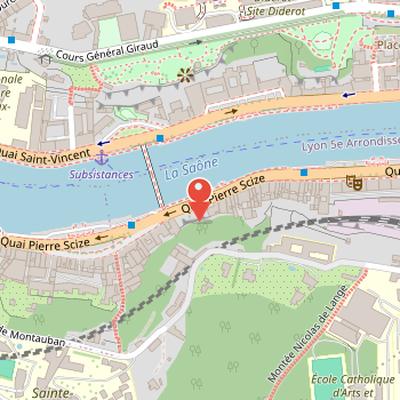
The Château de Pierre Scize, also called Château de Pierre Encise, was a medieval castle in Lyon. It was strategically placed on the Pierre Scise, a granitic rocky spur on the south bank of the Saône River, at the west entrance to the city. From this position, it overlooked the river by about fifty meters and controlled the entrance to the Pierre-Scise defile between Fourvière hill and Croix-Rousse hill. The château marked the border between the Kingdom of France and the Holy Roman Empire. It was also the residence of the archbishops of Lyon. Later, Louis XI recovered the château and used it as a state prison. The building was demolished in 1793.
Nearby Objects
-
 Les Subsistances 400 m away
 -
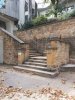 Sainte-Marie Lyon 450 m away
 -
 Lyon-Saint-Paul station 450 m away
 -
 Église Saint-Paul 450 m away
 -
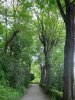 Parc des Hauteurs 450 m away
Chateau de Pierre Scize in Lyon
The Chateau de Pierre Scize, also called Chateau de Pierre Encise, was located in Lyon and was constructed in the Middle Ages. It was strategically placed facing the Saone at the west entrance of the city, where it marked the border between the kingdom of France and the Holy Roman Empire. The chateau served as the residence of the archbishops of Lyon. Later, Louis XI recovered it and used it as a state prison. The building was demolished in 1793.
Etymology and Rock Passage
The name Pierre Scize is explained through the form Petra incisa, meaning split or incised stone. This etymology has been linked to Roman road construction associated with Agrippa, and it is noted that the Romans began cutting the rock to create a passage. Clerjon, writing in 1830, described the Pierre Scise spur as extending to the middle of the Saone.
Geological Setting of Pierre Scize
Gologie describes the Eperon de Pierre Scise as part of the crystalline basement on the eastern edge of the Massif central. Granite covers the heights that dominate the castle, beneath the sedimentary massif of Monts d'Or, which has an average altitude and inclines to the east, forming a cuesta. This massif dominates the Saone valley through a steep talus extending from Fourviere to Millery, identified as an exposed fault line escarpment.
The crystalline basement is also present on the left bank of the Saone at the Pierre-Scize defile and in the riverbed upstream to Ile Barbe. Downstream, near the exit of the Pierre Scise canyon, an outcrop of Pierre Scise rock was located in the Saone riverbed. It measured a width and length and emerged to about a height during average water periods. The central pillars of the Pont du Change bridge rested on this outcrop. The rock was later destroyed by mining around 1847.
Site and Defensive Setting
The Chateau de Pierre Scize stood on the Pierre Scise, a granitic rocky spur on the south bank of the Saone River. It was placed at the entrance to the Pierre-Scise defile, where the river passes between Fourviere hill and Croix-Rousse hill, and it overlooked the Saone by about fifty meters. The site served as a fortress for the chateau, and medieval fortifications linked it to the citys defensive system. To the southeast, a valley separated it from the Fourviere height, while high walls built on Gallo-Roman remains connected it to the fort on Fourviere and to the neighborhoods of Fourviere, Saint-Just, and Saint-Irenee. The surrounding area also included the voie de la Gaule du nord. The name of the site later passed to the quai Pierre-Scize, which runs along the Saone at the foot of the spurs remains.
Architectural Features of the Castle
The Château de Pierre Scize included a terrace on the south side of the castle, shaded by a large tree and supplied by a good spring. A Saint-Michel chapel within the castle is cited in 1392. The site also had a rock-carved staircase descending to the northeast toward the Saone. This staircase ended at the base of the hill at a gate called the porte de Pierre Scize, which marked the beginning of a narrow and winding suburb.
Early History and Episcopal Use
The site of Chateau de Pierre Scize was occupied during the Roman Empire, and workers later found sepulchral lamps, medals, and other antique objects at the foot of the castle. Documentary evidence for its existence begins only in the 11th century, although its position was already favorable for use before then. In 1099, Archbishop Hugues assembled a council of bishops there. Later, Archbishop Heraclius of Lyon, who held office from 1153 to 1163, took refuge in the site several times and first made it the fortress of the archbishops of Lyon.
From Episcopal Refuge to State Prison
In 1244, Bishop Aymeric retreated to Pierre Scize castle, and after the First Council of Lyon in 1245 he resigned. Although Lyon lost its justice in 1312 to Philip the Fair by treaty, the castle retained its temporal jurisdiction and the dependencies attached to it. By the 14th century, the site had an organized military presence: in 1330, twelve men-at-arms served under the castellan, and in 1335 the governor of the castle, the lord of Iseron, received 50 sous Viennois each week while commanding twelve men-at-arms paid 8 florins monthly each.
Pierre Scize also played a role in controlling movement on the Saone. In 1434, the Saint-George chain and the chain near Pierre Scize blocked the river at night and prevented smugglers from entering Lyon by way of the Saone. The Pierre-Scize chain gave its name to the quay known as Sainte Marie aux chaines, later Serin and then Saint-Vincent quay.
The castle then became more directly linked to royal authority. King Louis XI ordered the occupation of Pierre Scize, removing the archbishops of Lyon from the site. Its governor, Odile des Estouyes, was a member of the Public Good league in 1465, and the Macon bailiff Francois Roger was charged with dismissing him. From that order onward, kings controlled the site, while the archbishops stayed at Saint-Just palace. The castle was transformed into a state prison, and Jacques d'Armagnac, Duke of Nemours, was imprisoned there in 1475. In 1500, it imprisoned only foreigners.
During the 16th century, the fortress continued to be contested. Protestant troops captured and held Pierre Scize in 1562 for more than one year, and it was besieged by the Gueux de Lyon in 1588. Charles-Emmanuel, duc de Nemours, commanded it in the last quarter of the century. Later, Richelieu made it royal property. At the end of the 18th century, M. Andre de Bory was commander, and Claude Esperance de Regnauld-Alleman had held command from 1780. During this period, Anne-Louis Goislard, vicomte de Monsabert, was imprisoned there after opposing Loménie de Brienne's taxation in 1788.
The castle was completely demolished during the Revolution. From the beginning of the 19th century, its rock was used as a quarry for nearby constructions, including roads and bridges.
Jean Baptiste Augustin Chauveau and the Quay Name
The quay is named after Jean Baptiste Augustin Chauveau, who served as director of the veterinary school and as a professor at the faculty of medicine in Lyon. His work included the development of vaccines, including one against charbon, as well as discoveries in anatomy, cardiac physiology, microbiology, and physiology related to viruses and antibodies. He also established that glucose combustion occurs in muscles and performed the world’s first cardiac probe implantation.