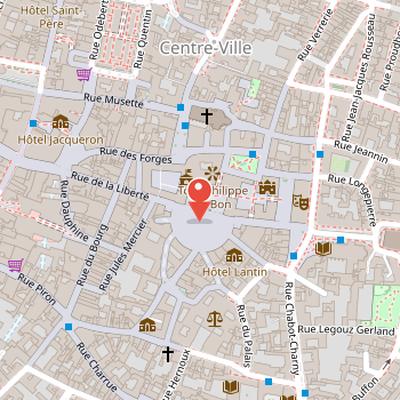
Place Émile-Zola is a square bordered by rue Monge and shaped like a parallelepiped. It is reached by rue François-Jouffroy and cour Madeleine. The square was long the market square of the neighborhood and also served as a public execution place until a certain period. Its center is marked by plane trees and a stone basin sculpted with aquatic animals. The basin originally stood at place des Cordeliers as part of a monument dedicated to Alexis Piron, and the bust that once adorned the fountain is now installed in the jardin de l'Arquebuse in Dijon. Several of the surrounding houses contain cafés or restaurants with terraces around the basin. Cour Madeleine also contains the cellier de Morimont, a 15th-century remnant of the former hôtel of the abbey of Morimond. The square was formerly called place du Morimont and was renamed place Émile-Zola in 1921.
Nearby Objects
-
 Place de la Libération 0 m away
 -
 Le Consortium 50 m away
 -
 Palace of the Dukes of Burgundy 70 m away
 -
 Musée Magnin 80 m away
 -
 Sainte-Chapelle de Dijon 90 m away
Situation et acces
Situation et acces is a square in the shape of a parallelepiped bordered by rue Monge. Rue Francois-Jouffroy and cour Madeleine lead to it. For a long time, it served as the market square of the neighborhood, and it also functioned as the public execution place until a certain period.
The center of the square is marked by plane trees and a stone basin sculpted with aquatic animals. This basin was originally located at place des Cordeliers, where it formed part of a monument dedicated to Alexis Piron. The bust of Alexis Piron that once adorned the fountain is now installed in jardin de l Arquebuse in Dijon.
Several houses bordering the square contain cafes or restaurants with terraces arranged around the basin. Cour Madeleine also contains the cellier de Morimont, a 15th-century remnant of the former hotel of the abbey of Morimond.
From Place du Morimont to Place Emile-Zola
The square was formerly known as place du Morimont before it was renamed place Emile-Zola in 1921. The earlier name referred to the abbaye de Morimond in Haute-Marne. The abbey also had a hotel at 17 rue Monge, formerly rue Saint-Jean, where the abbe de Morimond sometimes stayed. The name Morimond itself comes from the Latin mori mundo, meaning dying to the world.
The Execution Site at Place du Morimont
Place du Morimont hosted public executions for nearly five centuries, and its execution equipment was organised around a fixed scaffold. The scaffold was a rectangular platform about two meters high, standing on five stone pillars and reached by two side ladders. In 1535, a calvary cross with two figures at Christ's feet was erected against it. The site appears on Edouard Bredin's 1574 plan and on Jean de Beaurain's 1767 plan, showing its long-standing presence in the urban landscape.
The scaffold carried the chopping block, where the sword struck wood loudly. A gallows for hanging stood on one side, while a horizontal wheel stood on the other. In special cases, a pyre was arranged behind the platform. Executioners' instruments were stored under the scaffold. The place could also be decorated for public executions, including nighttime executions by torchlight.
Early executioners at the site included Jehan, who burned Poncet de Soulier, called Triorliere, accused of necromancy in 1403, and hanged a donkey from Plombieres in 1407 that had killed a child. From 1658, the society of Misericorde helped the poor and sick, but also accompanied condemned prisoners to execution and collected their bodies and execution instruments. It had a chapel behind the moulin des Carmes for the guillotine.
During the Revolution, the gibbet and wheel disappeared, but the guillotine remained on Place du Morimont for two years. It was removed after residents petitioned Jean-Marie Cales, and it later reappeared only for executions. Executioner Francois Etienne carried out the execution of Francois Langonier, mayor of Venarey-les-Laumes, at the site. A municipal decree then ordered the guillotine moved from Place du Morimont to chemin communal de Cromois, to the south of Clos de Montmuzard east of Porte Neuve, in order to distance executions from the city center and the public.
Renaming and Statue Installation
In 1904, the Barabant municipal government renamed more than twenty streets or places that had been named after saints. Place Saint-Jean, near place du Morimont, was renamed place Emile-Zola in honor of Emile Zola (1840-1902). Place du Morimont was also renamed place Emile-Zola to preserve this tribute. In 1921, Gaston Gerard's municipal government installed a statue of Bossuet on place Emile-Zola. After the statue was installed, the square was renamed place Bossuet.