Église Saint-Pothin is a Catholic church in the city of Lyon, located at place Édgar Quinet in the Foch district. It has been entirely registered as a Historic Monument by prefectural decree. The church is closely linked to the development of the Brotteaux district in the late 18th century, when the creation of the Saint-Pothin parish and the construction of its church formed part of the area’s urbanization. Brotteaux was then part of the commune of La Guillotière, later annexed to Lyon in 1852 and incorporated as the city’s third arrondissement. Its urbanization followed a plan by Lyon architect Jean-Antoine Morand, and Saint-Pothin church was a key element in the new parcelling of the district. A chapel opened there in 1818, and the parish boundaries were established in 1827. The present church was designed by Christophe Crépet in a neoclassical project executed partially from 1841 to 1843 and inaugurated on Christmas Day 1843. Its architecture includes a Latin cross plan, a hexastyle Doric portico, and a blind-vaulted central nave with a semicircular arch.
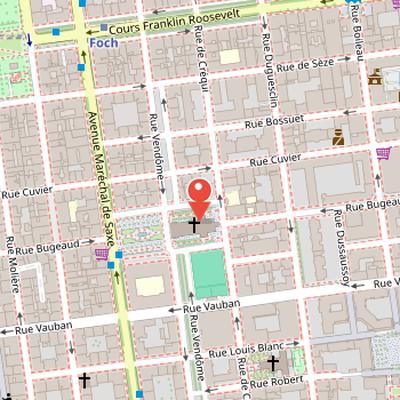
Nearby Objects
-
 Lycée Édouard-Herriot 130 m away
 -
 Chapelle Sainte-Croix de Lyon 250 m away
 -
 Rue de Créqui 350 m away
 -
 Place du Maréchal-Lyautey 400 m away
 -
 Rue Duguesclin 450 m away
Location and Heritage Status
Eglise Saint-Pothin is a religious building in the city of Lyon. It is located at Place Edgar Quinet in the Foch district. The building has been entirely registered as a Historic Monument by prefectural decree, which highlights its protected status within the citys architectural heritage.
Origins of Saint-Pothin Church
The creation of the Saint-Pothin parish and the construction of its church were part of the development of the Brotteaux district in the late 18th century. Brotteaux was then within the commune of La Guillotiere, which was forcibly annexed to Lyon in 1852 and became the city's third arrondissement. The urbanization of Brotteaux followed a plan drawn up by the Lyon architect Jean-Antoine Morand (1727-1794), and Saint-Pothin church was a key element in the new parcelling of the area.
A chapel opened in Brotteaux in 1818, and the parish was later granted the name Saint-Pothin by royal ordinance, reflecting pressure from local notables. The parish boundaries were established in 1827. In 1835, the Hospices Civils de Lyon donated the site for the church. A competition was then organized by the authorities of La Guillotiere to design the Saint-Pothin church.
Design, Construction, and Later Restorations
Christophe Crepet, the architect and surveyor of La Guillotiere, won the church design competition. A graduate of the Ecole des Beaux-Arts de Paris, where he studied under Vaudoyer, Crepet designed a neoclassical project that was carried out in part between 1841 and 1843. The building process was affected by financial difficulties: the budget tripled, decoration was postponed, and lower-quality materials were used. Because of these constraints, the front triangular pediment of the facade was left unfinished. The church was inaugurated on Christmas Day 1843.
Later restoration campaigns were led by Lyon city architect Tony Desjardins in 1867. Further restoration works were carried out by architect Claudius Porte in 1874 and again in 1876 to 1877. The church also has a musical connection: parish organist Adrien Rougier arranged for Maurice Durufle to perform the first organ version of his Requiem.
Architectural Layout of Saint-Pothin
The Eglise Saint-Pothin de Lyon was designed with a Latin cross plan. Its facade includes a hexastyle portico of Doric order, while the main nave is marked by Ionic colonnades. The central nave is blind vaulted and covered by a semicircular arch, with two collateral aisles running alongside it. At the crossing, the transept forms a square space crowned with a dome. The choir is finished in a cul-de-four, and its reduced space contains large organs. Beyond the choir, the bell tower and sacristies are positioned.
The Organ of Saint-Pothin
The church of Saint-Pothin has a long organ history marked by repeated rebuilding and enlargement. Its first organ was built in 1846 by the company Daublaine-Callinet. In 1875, the instrument was restored and expanded through negotiations with Joseph Merklin in Lyon. A new organ was then constructed in 1876 by J. Merklin and Company, with two manuals and one pedalboard, and it was arranged so that further expansion would be possible in the future.
The instrument continued to grow over the following decades. It was enlarged in 1880 by J. Merklin and Company, then again in 1910 by Michel-Merklin and Kuhn. In 1942, its repair and enlargement were entrusted to Ruche and Company. A new organ with three manuals and one pedalboard was completed in 1945, reusing Merklin material. The current organ dates from 2004 and was built by the company Kern, also reusing the old organ.
Beyond its physical development, the Saint-Pothin organ played an important role in Lyon's musical life after World War II. From 1945, the titular organist Adrien Rougier invited prominent musicians to play at the tribune, helping to establish the church as a notable musical venue. Among its organists were Loic Mallie and the current organist Octavian Saunier.