Place du Maréchal-Lyautey is a square in Lyon, located at the western end of cours Franklin-Roosevelt on the left bank of the Rhône. It lies at the junction of quai de Serbie and quai du Général Sarrail, with access to pont Morand, and forms part of the central axis Lyautey-Roosevelt-Vitton in the arrondissement. The square is shaded and bordered by five-story buildings to the north, south, and partly to the east. It contains a children’s playground, underground parking, a period flower kiosk, and a monumental fountain. From the square, there are views of the opera, the town hall tower, the basilica of Notre-Dame de Fourvière, and the Croix Rousse hill. The site has a layered naming history, beginning as place des Brotteaux, before later renamings and its current municipal name honoring Maréchal Lyautey.
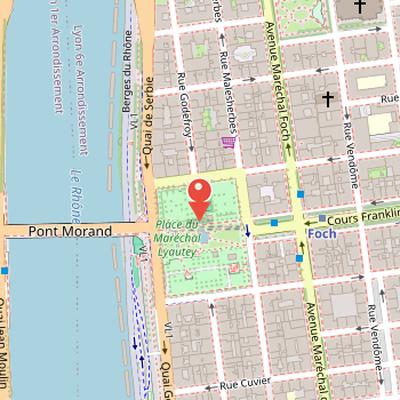
Nearby Objects
-
 Morand Bridge 200 m away
 -
 Église de la Rédemption 400 m away
 -
 Place Louis-Pradel 400 m away
 -
 Lycée Édouard-Herriot 400 m away
 -
 Église Saint-Pothin 400 m away
Urban Setting and Features
Place du Marechal-Lyautey is located in Lyon at the western end of cours Franklin-Roosevelt on the left bank of the Rhone. It lies at the junction of quai de Serbie and quai du General Sarrail, with access to pont Morand, and forms part of the central Lyautey-Roosevelt-Vitton axis in the arrondissement. The square is shaded and bordered by five-story buildings to the north, south, and partly to the east. Its public amenities include a children's playground, underground parking, a period flower kiosk, and a monumental fountain. It also offers views of the opera, the town hall tower, the basilica of Notre-Dame de Fourviere, and the Croix Rousse hill.
Renaming History of Place du Marechal-Lyautey
Place du Marechal-Lyautey was created under the reign of Louis XVI as part of the urbanization project for the Brotteaux district by Jean-Antoine Morand. At its creation, it was named place des Brotteaux. Its name changed repeatedly over time: it became place Louis XVI during the Restoration, then place du Pont Morand in 1826, place Berenger in 1848, and later place Morand, a name that is still used. The Municipal Council also voted to honor Andre Maginot, who died in 1932, but that decision was not implemented. In 1941, the Special Delegation named it Place Marechal Petain and its main street changed from Cours Morand to Cours Petain. Marechal Petain refused the naming, and no plaque was installed. The place then received its current name by municipal decision in honor of Marechal Lyautey (1854-1934).
The Monumental Fountain at Place du Marechal-Lyautey
The monumental fountain at Place du Marechal-Lyautey was constructed in 1865. It was created by architect Antoine Desjardins, while its statuary was entrusted to sculptor Guillaume Bonnet. The fountain was commissioned by the inhabitants and the city as a gesture of thanks to Napoleon III. It also commemorates the removal of tolls on the Rhone bridges, giving the monument both civic and historical significance.
The Kiosques a Fleurs
The Kiosques a Fleurs project dates from 1911 to 1913, with construction carried out from 1914 to 1924. Designed by Charles Meysson, the kiosks reflect architectural models from the previous century and show how Lyon architecture maintained a traditional style into the early 20th century. Brizon was responsible for the metallic construction. The original plan called for four kiosks in the square, but only two were realized.
Underground Parking and Naming
An underground parking facility was inaugurated by Lyon Parc Auto at Parc Morand. Its name was not taken from the square itself, following a decision by the Mairie centrale de Lyon. The naming decision was supported by Nicole Chevassus, mayor of the district, and was approved by the inhabitants of the neighborhood.
Cultural Events at the Square
Place du Marechal-Lyautey hosts events throughout the year. These activities include several musical events, shows for children, and exhibitions. The square also hosts the Marche aux Livres Anciens et Vieux Papiers Lyautey every fifteen days, giving the site a recurring role in local cultural life.