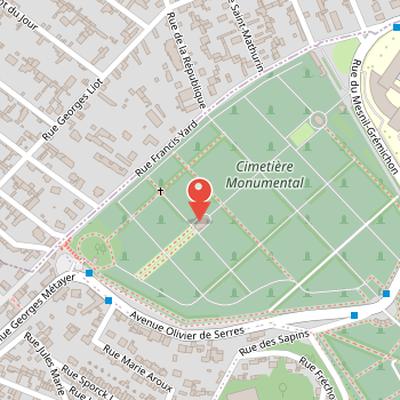
The Cimetière monumental de Rouen is the largest cemetery in Rouen, covering ten hectares in the northeast of the city. It contains the graves of about one hundred personalities who contributed to Rouen’s political, artistic, and other domains. Among those buried there are Charles Verdrel, mayor of Rouen at the end of the 19th century, as well as Gustave Flaubert, Marcel Duchamp, and Michel Bérégovoy. In 2019, the cemetery was labeled Cimetière remarquable d’Europe.
The cemetery project was planned in 1823 as a “monumental cemetery” and was established on uncultivated land north of Rouen on the Côte des Sapins, on land previously used as sheep pasture. Construction was completed in 1828. During the 19th century, the cemetery was closely associated with the social elite, in part because of high burial costs. Burials increased from fewer than twenty a year in the first decade to about forty in the second, then reached two hundred annually under the Second Empire and almost three hundred in 1885. Tariff increases in 1872 and 1886, and competition from suburban cemeteries, later affected its use.
Nearby Objects
-
 Conservatoire de Rouen 1100 m away
 -
 Église Saint-Nicaise de Rouen 1200 m away
 -
 Chapelle Corneille 1300 m away
 -
 Musée national de l'Éducation 1500 m away
 -
 Monument to Napoléon Ier 1500 m away
Burials and Cultural Recognition
The Cimetiere monumental de Rouen is the largest cemetery in Rouen, covering ten hectares in the northeast of the city. It contains the graves of about one hundred personalities who contributed to Rouen in political, artistic, and other fields. Among those buried there are Charles Verdrel, who was mayor of Rouen at the end of the 19th century, as well as Gustave Flaubert, Marcel Duchamp, and Michel Beregovoy. In 2019, the cemetery was labeled Cimetiere remarquable d'Europe, reflecting its recognized cultural significance.
Planning and Early Use
In 1823, the project for a monumental cemetery in Rouen was planned, and a suitable site was chosen on uncultivated land north of the city at Cote des Sapins. The location had previously been low-value land used as sheep pasture. Construction was completed in 1828.
During its first decade, the cemetery received fewer than twenty burials per year. In the second decade, the annual number rose to about forty, before increasing further under the Second Empire to two hundred burials per year. By 1885, it reached almost three hundred burials yearly.
In the 19th century, the cemetery mainly served Rouen's social elite, partly because burial costs were high. By the end of the Second Empire, 85 percent of burials were from the elite, including 20 percent industrialists or merchants.
Pricing, Expansion, and Later Additions
The cemetery generated high revenue from burials, which helped offset the cost of free burials for indigents. Its management adjusted prices several times: tariffs were increased in 1872, and again in 1886, when concession prices were also raised, especially for plots larger than 10 square meters, in order to finance expansion. After this increase, burials fell sharply. In 1894, tariffs were lowered again in an effort to regain clientele, while the cemetery also faced competition from suburban cemeteries offering lower prices or the proximity of a church.
The cemetery continued to adapt its facilities and use. Its chapel was closed in 1890 in accordance with the law, then reopened in 1897 as a columbarium. By 1897, a crematorium had also been established at the north of the necropolis. The cemetery expanded further and doubled its area just before World War I. It also attracted a middle-class population, helped by the availability of 30-year concessions authorized since 1886. Later, in 1972, an ossuary was created to receive remains from 800 presumed abandoned graves.
Layout and Historic Sections
The cemeterys arrangement combines historic sectors, notable burial areas, and present-day access points. Its original main entrance was the south porch, reached by avenue Georges-Metayer, but this entrance is now closed. The main access points today are the north and east gates. An access ramp bypasses the monument to the dead of the 1870-1871 war and leads to the lower alley.
The lower alley is bordered by tombs of local celebrities, artists, military figures, and politicians, and it also includes graves of famous people of Rouen. Several mayors of the city are buried in the cemetery. The first terrace and the surroundings of the avenue leading to the chapel are among the most sought-after sectors, while premium concessions have a floor area greater than 10 square meters. An avenue leading to the Columbarium is lined with the most expensive funerary monuments.
The historic section contains many family vaults and family chapels in neo-classical and neo-gothic styles. It also includes a western-eastward alley and an old cemetery area divided into Jewish and Protestant sections. On the central avenue are the Bouctot family chapel and the Prat family chapel. Section X contains monuments transferred from the old La Jatte cemetery, which was closed in 1890 and parceled in 1895.
Funerary Monuments and Family Plots
The Cimetiere monumental de Rouen includes a number of notable funerary monuments and family plots. Among the most distinctive is the memorial for Eustache-Hyacinthe Langlois, who died in 1837 and received a burial raised by the city and friends. Designed by Achille Deville, Grimaux, and Pottier, it combines a granite tomb with a menhir from the Essarts forest. The menhir holds a bronze plaque and a medallion with Langlois's portrait. David d'Angers executed and offered this portrait medallion.
Several prominent families are represented in the cemetery. The Flaubert family is buried under very simple steles, with the steles of Gustave Flaubert and Caroline Flaubert framing those of their parents. The Duchamp-Villon family has a plot south of the cemetery with three marble steles, where Raymond Duchamp-Villon, Jacques Villon, Marcel Duchamp, and Suzanne Duchamp rest. The cemetery also contains several tombs decorated by Rouen blacksmith Ferdinand Marrou, including those of Joseph Faucon, the Thouroude family, and his own tomb from 1917.
The cemetery also contains several collective tombs and commemorative monuments. At the south entrance stands a monument to the 1870-1871 war dead, commemorating 150 soldiers fallen in the battles of Buchy, Moulineaux, and La Maison Brulee. This memorial includes an obelisk and a statue of a woman sculpted by Eugene Benet.
Memorial Monuments in the Cemetery
Among the notable funerary monuments is a truncated obelisk decorated with a lyre, dedicated to the victims of the Arts Theater fire. The fire took place during a performance of Hamlet. According to Monuments remarquables, the monument was funded by a charity evening and inaugurated on an unspecified date. Another memorial consists of four iron-forged slabs forming the tomb of four Rouen firefighters who died in the Lille-Bonnieres vaseline factory fire. Rouen city organized solemn funerals for these firefighters after their deaths.
Notable Burials
The Cimetiere monumental de Rouen is the burial place of several notable personalities. Among those interred there is Gustave Flaubert, buried in the Tombe de Gustave Flaubert. Marcel Duchamp is also buried in the cemetery, in the Tombe de Marcel Duchamp. Another named burial is Charles Verdrel, who rests in Le tombeau de Charles Verdrel. These burials contribute to the cemetery's public significance as a place associated with important figures.