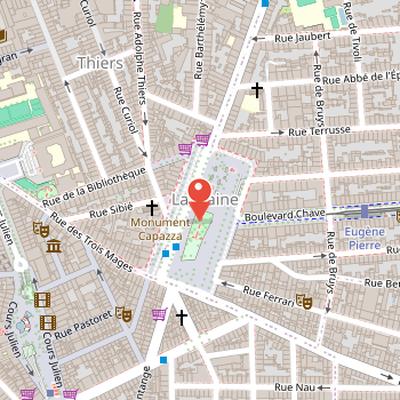
Place Jean-Jaurès, also known as La Plaine, is one of the largest squares in Marseille. Located in the city center, it lies at the boundary of the 1st, 5th, and 6th arrondissements, in the Thiers, Camas, and Notre-Dame-du-Mont neighborhoods. The square is served by bus line 74 and is accessible by Notre-Dame-du-Mont station on metro line 2 and Eugène-Pierre station on tramway line 1.
The name La Plaine does not refer to a topographical plain. The place is characterized as a plateau with a flat surface at a higher altitude than its surroundings, with a slightly convex center and a lower southeast corner. The naming history reflects the local transformation of the Provençal term plan, meaning plateau, into the francized form plaine. Historically, the area was known by several names, including Place, Place de la Constitution during the Revolution, and Place Saint-Michel ancien Champ-de-Mars on a map from the First Empire. The square was renamed Place Jean-Jaurès in memory of Jean Jaurès, later restored to Place Saint-Michel in May 1941 under the Vichy regime, and then returned to Place Jean-Jaurès shortly after the Liberation of Marseille. Its vast esplanade has also been used for battles, military ceremonies, and receptions of distinguished guests.
Nearby Objects
-
 Palais des arts 250 m away
 -
 Église des Réformés 450 m away
 -
 Hôtel Louvre et Paix 650 m away
 -
 Église de la Mission de France 700 m away
 -
 Musée Cantini 750 m away
La place Jean-Jaures
La place Jean-Jaures, also known as la Plaine, is one of the largest squares in Marseille. It is commonly identified by its formal name, La place Jean-Jaures, and by the shorter local name la Plaine. Its significance in the city is mainly tied to its scale, as it stands among the largest public squares in Marseille.
G�ographie at Place Jean-Jaure`s
Geographie is located in the city center at the boundary of the 1st, 5th, and 6th arrondissements, in the Thiers, Camas, and Notre-Dame-du-Mont neighborhoods. It is served by bus line 74 and is accessible by the Notre-Dame-du-Mont station on metro line 2 and the Eugene-Pierre station on tramway line 1.
The name does not refer to a topographical plain. Geographie is described as a plateau with a flat surface at a higher altitude than its surroundings. The confusion comes from the Provençal term plan, meaning plateau, and its local francization to plaine. Its surface is slightly convex in the center, and its altitude is lower at the southeast corner than at the southwest, northeast, and northwest corners.
Place Names and Historical Layers
The site now known as place Jean-Jaurs has a long toponymic history. In early history, the plateau outside the city was called Placito in Latin and Plaia in Provenal. These forms remained in use until the beginning of the 19th century, when francization led to the names plaine de Saint Michel or plaine Saint Michel. The name Saint-Michel was derived from an ancient chapel demolished during the construction of the Minimes convent.
The place itself was called Place before the Middle Ages and Place de la Constitution during the Revolution. A map from the First Empire records it as Place Saint-Michel ancien Champ-de-Mars, and the site was also associated with tournaments held by Crusaders awaiting embarkation to the Middle East. During the same period, the place began to be arranged and was initially named place Saint-Michel.
The municipal council later renamed it place Jean-Jaurs in memory of Jean Jaurès. The name was restored to place Saint-Michel under the Vichy regime in May 1941, then reinstated as place Jean-Jaurs shortly after the Liberation of Marseille.
Ceremonial Ground and Historic Gatherings
The vast esplanade at Place Jean-Jaurs has long been associated with military events, official ceremonies, and receptions of notable visitors. According to Histoire, it served as a setting for battles, troop movements, and public welcomes for important figures. Among the recorded receptions was that of Robert of Naples, count of Provence, who was received by city notables before visiting the relics of Saint Louis of Anjou. After the battle of Marignan, François and Queen Claude were welcomed there by the consuls, the viguier Louis de Vento, and bishop Claude de Seyssel. The site also received King Charles IX, accompanied by Catherine de Medicis, the duke of Anjou, and Henri de Bourbon, later Henri IV, as well as King Louis XIII, who was received by first consul Boniface de Cabannes.
The plateau also played a role in Marseille's defense. During the Siege of Marseille in 1524, the French garrison and the city militia formed a defense line at the foot of the plateau against the forces of the constable de Bourbon. Histoire further notes that women of high rank and common women took part in the city's defense.
In the nineteenth century, the esplanade remained a place for public ceremony. During the First Restoration, two ceremonies were held at La Plaine in honor of the duke of Orleans and the count of Artois. The duke of Orleans, returning from Sicily with the exiled family, received a military ceremony on 30 August 1814, while the count of Artois reviewed the troops on 21 November 1814. Later, Marshal Brune conducted a troop review there during the Champ-de-Mai ceremony on 1 May 1815, and on 27 May 1815 the vicomte de Bruges reviewed seven thousand armed peasants as lieutenant-general on behalf of the duke d'Angouleme.
From Minimes Convent to Place Jean-Jaures
The site of Place Jean-Jaures was once occupied by the Minimes convent, whose first stone was laid on 25 October 1623 by consul Charles de Casaulx. The Minimes brothers were noted for their dedication mainly to the exact sciences, and among them were Charles Plumier, a botanist, and Louis Feuillee, an explorer, botanist, geographer, and royal astronomer. King Louis XIV had an observatory built in the convent, underscoring its scientific associations. Over time, the convent was enlarged several times, including by encroaching on communal land despite lawsuits by the city. During the Revolution, the Convention listed it for destruction because it hosted federalist section meetings. The convent was then demolished and its land incorporated into the developing district. Its library later formed the basis of Marseille's municipal library.
From the Plaine to Place Jean-Jaures
The area that became Place Jean-Jaures formed as a suburb on the plateau beyond Louis XIV's ramparts in the mid period. As the city sold plots for development, the first buildings appeared on rue des Minimes and place Notre-Dame-du-Mont. When the plateau was almost entirely built up, the Plaine Saint-Michel was reduced to a public promenade at the edge of the Camas neighborhood. On the east side, vineyards and olive trees gave way to real estate operations that fixed the promenade's final rectangular shape.
The promenade was landscaped with elm trees in 1819 and 1820, then replanted with plane trees in 1855, watered by Canal de Marseille waters. In 1843, the bell tower of basilica Notre-Dame-de-la-Garde was built, and bell founder Gedeon Morel of Lyon was commissioned to create a bell that was transported by cart along the Rhone and displayed at Place Jean-Jaures. Bishop Eugene de Mazenod blessed and baptized the bell Marie Josephine before it was placed on the hill of Notre-Dame-de-la-Garde.
In 1848, during the revolution, Vaudois engineer Franz Mayor de Montricher organized municipal workshops for the unemployed. These workshops completed the corniche and arranged Place Saint-Michel. On 28 September 1852, the municipal council decided to establish a fountain on the square with a water jet and basins. Three concentric basins, with a diameter of 120 meters and more than 103 jets, were installed at the center of the square. The basins also served a practical function: because water infiltrated the ground and dripped onto the tramway below, the water reservoir was filled. The basins allowed children to take boat rides until 1936.
From 1860, Place Saint-Michel hosted the Saint-Lazare fair, which had previously been held at the Alles in the upper part of Canebiere. The fair included bumper cars and a Ferris wheel and continued until the 1960s. The square also became a site for political memory. The Plaine was central to the Commune protest movement in 1871, and between 1870 and 1871 Marseille militants gathered there in support of revolutionaries in the capital. After an attempted insurrection in Marseille in August 1870, leaders were imprisoned at Fort Saint-Jean, and Gaston Cremieux was executed by firing squad.
In 1883, a 712-meter tunnel was created under the square for the first steam tramway. It connected Saint-Pierre cemetery to Marché des Capucins near Canebiere via boulevard Chave, and it is still used by the current Marseille tramway. Tramway lines 12, 40, and 68 pass under the place and serve the Eugene-Pierre station, although only line 68 survived until 2004. The old tramway lines were closed in the second half of the twentieth century to promote car use.
The place also became associated with aerial adventure. Louis Capazza and Alphonse Fondere left the place by balloon and arrived in Corsica on an unspecified date. A monument commemorating this event, sculpted by Louis Botinelly, was inaugurated by aviators Dieudonne Costes and Maurice Bellonte at the corner of rue Sibie. In the 1930s, the square gained sandboxes for children at its center, named Square Yves Montand, while a donkey-drawn cart toured the market from the 1930s to 1983 and a Guignol theater entertained children during the same period. The place was renamed Place Saint-Michel during World War II under the Vichy regime, then renamed Place Jean-Jaures at the end of World War II.
Renovation of Place Jean-Jaures
Place Jean-Jaures was the site of a major renovation that began in 2019, carried out by SOLEAM under the Ambition Centre-Ville plan. According to the reported history of the place, La Plaine was excavated to make room for an underground parking lot beneath it, and parking spaces were moved there during the works. The renovation increased green space, widened the roads and pedestrian areas, and reduced the number of traffic lanes and surface parking spaces. Two playgrounds, two bus stops, and 186 trees were added as part of the project. A bicycle lane had been planned but was not built.
The project was presented with an estimated investment cost by SOLEAM, excluding taxes, but the actual cost is reported to be higher than the estimate. The cost is also stated to be d'euros. The renovation has drawn criticism from part of the local population, with SOLEAM accused of not sufficiently consulting users about the project. Many people also describe the work as a gentrification plan.
Protests and Renovation at Place Jean-Jaures
The renovation of Place Jean-Jaures was accompanied by repeated protest activity and public dispute. According to Histoire, protesters, some gathered in the Assemblee de la Plaine and joined by some zadistes from Notre-Dame-des-Landes, organized numerous protest events. They installed large picnic tables and wooden structures, which were removed when construction started. Many protesters occupied the site in an effort to prevent construction from beginning, and slogans against the construction site were chanted. Histoire also reports that protesters attacked workers during the protests, while the concrete barrier delimiting the site proved insufficient. In response, SOLEAM installed a 3 m high concrete wall, quickly nicknamed the wall of shame. Protesters were able to climb over it and damage parts of the wall.
The protests were linked to broader anger over housing conditions and municipal policy. One month after construction began and days after the wall was installed, two buildings collapsed on rue d'Aubagne. Histoire notes that protests were organized against substandard housing and what was described as inaction by the city and Mayor Jean-Claude Gaudin. Many observers saw the situation as symbolic of a municipality renovating some neighborhoods while neglecting others.
The protest movement gradually weakened and then stopped. The construction site was halted on March 16, 2020 due to the first Covid-19 lockdown. During the lockdown, residents played music each evening after applause for hospital staff, and rare protesters were dispersed by police. The day before the end of lockdown, Jump by Van Halen was played. Construction resumed on May 11, 2020, shortly before the end of lockdown, and in the following weeks the urban space was theatrically reclaimed by residents until the end of summer.
After the renovation, the square became more frequented and a prime location in Marseille's city center near Cours Julien. Histoire notes that the renovation increased the terrace surface areas of cafes. Residents of the square also formed the Collectif des Riverains de la Plaine and denounced nuisances.
Markets at Place Jean-Jaures
Place Jean-Jaures is known for a dense market activity that includes several distinct trading times and functions. The market des forains, called Le marche de la Plaine, takes place on Tuesday, Thursday, and Saturday mornings. A flower market is held on Wednesday mornings, and a farmers' market reserved for local producers is held on Friday afternoons. The site also hosts an extension of the March central, a wholesale fruit and vegetable market from cours Julien, with wholesale trading running from midnight to eight o'clock before a retail market begins.
Historically, the central market was transferred to MIN des Arnavaux in 1974. Before that transfer, the market area between cours and place included warehouses and banana ripening facilities. The morning market has long been a major gathering point, attracting up to ten thousand people from all social classes in Marseille each morning. It sells food, fabrics, brand clothing from clearance or customs seizures, used clothes, dishes, and hardware articles.
In the late 1990s, attendance and sales declined as more low-quality Chinese products appeared. A 1997 Libration article described the market during a planned requalification project. Vendors opposed plans to reduce the number of stalls and improve the clientele, and they blocked city center traffic multiple times with their delivery vans. They also refused temporary relocation during an eight-market chantier in Marseille, although they were moved to markets at place de la Joliette and avenue du Prado during construction. Vendors returned to La Plaine on February 29, 2016. Before construction there were 300 vendors, and after their return there were 223, rather than the planned 180.
Carnival Use and Public Management
Place Jean-Jaurs hosts the Carnaval independant de la Plaine once a year. The event ends with the burning of the caramantran according to Provenal tradition. After renovation, attendance rose from a few hundred people to around ten thousand, making the square a major gathering place for the carnival.
The carnival has also had direct effects on the site itself. The SOLEAM renovation project did not include a dedicated area for burning the caramantran, and the square surface is systematically damaged by the heat from the burning ritual. The damaged surface is replaced by the city.
In 2026, the carnival edition was held on Sunday, March 29, under strict prefectural regulations, including a 7 pm curfew and bans on fireworks, glass containers, and alcohol sales. The event was monitored by hundreds of CRS and anti-crime brigade units under Prefect Jacques Witkowski. After the caramantran was burned, forces of order dispersed crowds with tear gas and water cannons between 9 pm and 10:30 pm. Authorities initially reported seven arrests and fourteen police injuries, while the Minister of Interior later reported thirteen arrests and seventeen police injuries. No official report of civilian injuries was issued.
Renovation, Events, and Public Use
Place Jean-Jaures has been shaped by both public events and urban redesign. In recent years, numerous concerts, public film screenings, private gatherings, meetings, and festive events have been organized there throughout the year. The place also serves as a starting point for regular Velorution events. During the 2023 social movement against the pension reform project in France, some wild demonstrations ended at the place, where groups of CRS police were repeatedly mobilized and many people sang chants and slogans against the police.
The renovation of the place changed its physical use significantly. It allowed almost full pedestrianization, although scooters and motorbikes still regularly cross it to reach streets that are no longer directly accessible because of the removal of the former circular road. As part of the renovation project for the warm season, fountains and various water projection infrastructures were installed, but these water features are rarely operated.
The place also carries a memorial dimension. After a shooting at 23:15, about twenty shell casings were found at the scene, the driver of the targeted vehicle died immediately, and the passenger survived. Flowers were regularly placed near the shooting site until renovation began, and the lamppost holding the last flowers was removed during the works. Mayor Benoit Payan later filed a complaint for damage to the memorial site at 65 rue d'Aubagne. In the surrounding area, the presence of neo-Marseillais is reported to be greater than elsewhere in the city, and this population is described as more educated and wealthier than average.
Place Jean-Jaures and Its Renovation
The gallery records several stages in the history and transformation of Place Jean-Jaures. Early 20th century images capture the east promenade, while other views show the garden, the children's park, and the main entrance to that park. The old square is also documented with its playground, the embankment in view, and the statue of Yves Montand. One image presents the Wallace fountain, described as conservatively preserved, repainted, and installed in the northern part of the new square.
The older layout of the square appears to have been dominated by traffic and parking. The square is shown as asphalt and primarily used for parking, with a road crossing it lengthwise and the old road surrounding it seen from the Bar de la Plaine. Terraces are shown delimited by barriers to create space between parked cars, and the intersection of Place Jean-Jaures and Rue Saint-Pierre is noted as leaving only limited space for the terraces of bars and cafes. A southern parking area is also documented. Another image records defective rainwater drainage on the old square, which led to large puddles after rain.
The gallery then follows the construction of the new children's park and the renovation works on the site of the old square. Wooden stands are shown leading to the new park, and the demolition of the children's park wall is captured on the first day of works. Concrete slabs about one meter in length are visible marking the construction perimeter between the road and the sidewalk before the wall replacement. A tree marked with a white and red belt indicates that it will be cut down, and a pile of cut trees is also documented. Protesters against the start of the construction appear in several images, alongside scenes of people sitting at a construction table and others walking in the square.
The renovation period is further shown through images of the construction site entry at the intersection of rue des Trois-Mages and rue Saint-Michel, with a project presentation board, as well as documentation of the road under construction and the transit road. One image shows clouds of tear gas launched by CRS to disperse opponents of the renovation project, and another captures CRS patrolling to disperse protesters. The gallery also includes views of people on the part of the square open to the public during a visit for recognition of the commons of Marseille.