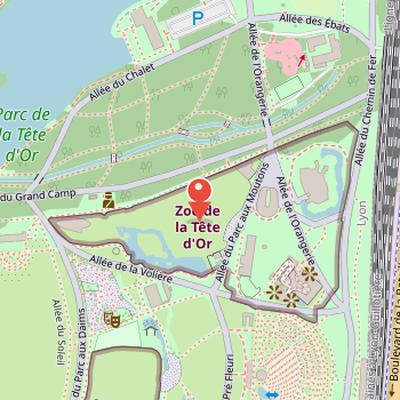
The Jardin zoologique de la ville de Lyon is a municipal French zoological park in Auvergne-Rhône-Alpes, located in the Parc de la Tête d’Or in Lyon. Created in 1858 under the initiative of Rhône prefect Claude-Marius Vaïsse, it began as a free educational farm established under state directives before gradually developing into a menagerie of wild animals. Its early history includes the construction of an aviary in 1858, later renovated in 1880 to house monkeys and exotic birds, and the arrival of brown bear cubs in 1865, housed in the first cage designed by Denis Bülher. The zoo expanded with new enclosures after the 1872 International Universal Exhibition in Lyon and later housed colonial fauna such as jackals, gazelles, ostriches, and kangaroos. Over time, the site also received structures such as a crocodile pavilion in 1894 and a municipal dairy, the vacherie, designed by Tony Garnier in 1902. The zoo currently presents more than 300 animals of 66 species and is a permanent member of the European Association of Zoos and Aquariums (EAZA).
Nearby Objects
-
 Parc de la Tête d'Or 350 m away
 -
 Monument aux morts de l'île du Souvenir 450 m away
 -
 Vélodrome Georges-Préveral 500 m away
 -
 Musée d'histoire naturelle - Guimet 650 m away
 -
 Lycée du Parc 650 m away
Jardin zoologique de la ville de Lyon
The Jardin zoologique de la ville de Lyon is a municipal French zoological park located in Auvergne-Rhone-Alpes, within the parc de la Tete d'or in Lyon. It was created in 1858 under the initiative of the Rhone prefect Claude-Marius Vaissea. The zoo presents more than 300 animals representing 66 species, and its exact number of visitors is unknown because entry is free and unrestricted. However, based on the parc de la Tete d'or's estimated 8 million annual visitors, it is likely the most visited zoo in France.
The zoo is a permanent member of the European Association of Zoos and Aquariums (EAZA) and participates in European programs for endangered species (EEP). It also coordinates one European Endangered Species Program. Xavier Vaillant was its last director, serving from 2012 to 2021.
From Educational Farm to Exotic Menagerie
The Jardin zoologique de la ville de Lyon was created in 1858 by the prefect Claude-Marius Vaisse as a zoological park. At first, it contained only a farm for educational purposes, following State directives, and access was free from the beginning. The collection of wild animals developed slowly, but the park gradually expanded its enclosures and began to receive new animals, notably after the 1872 International Universal Exhibition in Lyon. In 1858, it built an aviary, which was renovated in 1880 to host monkeys and exotic birds.
The park's transformation became more marked after the Lambert farm lease ended in 1874, when it gradually turned into an exotic menagerie. It housed colonial fauna such as jackals, gazelles, ostriches, and kangaroos. In 1865, it received brown bear cubs, which were housed in the first cage designed by Denis Buelher. A second cage was later built on the same model, although it was destroyed in 2006 during the creation of the African plain.
Over time, the original farm became an administrative building. In 1880, animal care responsibilities were entrusted to scientists led by Professor Louis Charles Emile Lortet, and in 1910 zoo management was placed under a veterinarian. Additional structures also reflected this evolution: the crocodile pavilion was built in 1894, and a municipal dairy called the vacherie was constructed in 1902 along the sheep alley, designed by architect Tony Garnier. Between 1922 and 1924, the vacherie was remodeled into a fauverie with cages for lions and panthers.
Renovations and Enclosures
Renovation work at the Jardin zoologique de la ville de Lyon began in 1955 with the creation of larger installations. The changes continued over the following decades with several new structures and enclosures. In 1956, a rockery was built for aquatic birds, followed by a new elephant enclosure in 1964 and a new rotunda for monkeys in 1965. A giraffe pavilion was constructed in 1968, and the aviary built in 1858 was demolished in 1969. During the 1970s, a new fauverie was opened, including a fox enclosure and a reptile gallery. The fox enclosure was renovated again in 1988 to display servals. In 1994, a nursery covering 600 square meters was built near the elephant building. It replaced the first iron cage of 1865, while the cage itself was preserved as a historic monument. Earlier, during the vacherie renovation, an adjacent enclosure had also been created for Loulou, the park's first Asian elephant.
Restructuring and New Direction
In 2001, veterinarian Eric Plouzeau was appointed director of the zoo. That same year, the reptile building located in the middle of the fauverie was closed to the public because it did not meet safety standards. In 2002, the nursery was remodeled for the arrival of spectacled bears. The zoo then inaugurated the African Plain as part of a broader restructuring, with attention to visibility and the design of animal enclosures. Eric Plouzeau left the direction in 2009 and was replaced by veterinarian David Gomis, who had previously served as deputy director of the Parc zoologique et botanique de Mulhouse.
Elephants, primates, and the Forests of Asia
The zoo's recent history was marked by several animal deaths, transfers, and changes in management. Historique recorded the death of the Asian elephant Java at the age of 67, with tuberculosis lesions found at autopsy. The situation became controversial over the immunological status of the elephants Baby and Nepale regarding tuberculosis. In connection with this controversy, director David Gomis resigned and later became technical director at Parc zoologique de Montpellier. Xavier Vaillant, formerly deputy director of Zoo de Pont-Scorff, was appointed as the new director, before leaving the post in August 2021 to direct the zoo of Amiens. Baby and Nepale were transferred to Roc Agel in Alpes-Maritimes, owned by the Grimaldi family, and the zoo then had no elephants present.
Historique also recorded the death of Lulu, described as the oldest Muller gibbon in the world, at the age of 64. Lulu was born in Borneo, captured by traffickers, and arrived at the zoo in Lyon in 1961. On the site of the former elephant enclosures, which were planned for demolition, the Forests of Asia were inaugurated. This new area was designed to host endangered Southeast Asian species. In addition, the zoo transferred two West African crocodiles to Crocoparc Agadir as part of a species conservation program, achieving its first reintroduction through this transfer.
Animal Installations and Species
The Jardin zoologique de la ville de Lyon includes a range of installations that organize its animal collections by habitat and enclosure type. Among the historic features is the hexagonal bear cage, while other areas have been developed for specific groups of animals and birds. The African plain, created in 2006, uses separated enclosures and brings together one hundred thirty different animals. Its savanna section includes watusis, Mrs Gray's kob, Hartmann's zebras, and Kordofan giraffes, with Hartmann's zebras replacing Grevy's zebras in 2011. A wet area houses several bird species, including white pelicans, common cranes, demoiselle cranes, cattle egrets, and pink flamingos. Lemurs, including ring-tailed lemurs, red vari, and black and white vari, live on an island.
Other installations include an eastern pavilion with antelope and zebra lodges, as well as sandy enclosures with rocks and stumps. These enclosures house black-cheeked lovebirds, sand cats, Hermann's tortoises, and radiated tortoises of Madagascar. The zoo also has a Moorish style enclosure originally built for the 1894 Universal Exhibition, which once housed West African crocodiles. Two crocodiles from this group, a male that arrived in 1975 and a female born in 1990, were moved to Crocoparc of Agadir as part of a reintroduction program.
Additional enclosures contain several bird species together, including Ecuador amazons, lilac-crowned amazons, and blue-headed conures. The zoo also has a primate enclosure and the Forests of Asia, inaugurated to host endangered Southeast Asian species. This area houses 30 threatened species from Southeast Asia, including two Malayan tapirs, four northern white-cheeked gibbons, pygmy slow lorises, and a wide range of birds, reptiles, amphibians, and insects such as the moss frog and stick insects.
Animal Enclosures and Species Presentations
The installations and species presented include an old spectacled bear enclosure near the Southeast Asian species area. This enclosure housed two spectacled bear brothers who arrived in 2002, and the last spectacled bear later died of cancer. Between 2019 and 2024, the former bear enclosure was used for a tufted deer originating from southern China. The site also houses fallow deer in a two-hectare space. The current fallow deer group descends from about twenty founders introduced in 1858. During the 2010s, Darwin's rheas were housed together with the fallow deer.
Florida Turtle Basin and Biodiversity Education
In 2006, a Florida turtle collection basin was created near the Lambert farm building. The basin was established for local biodiversity preservation and accepts Florida turtles from private individuals and naturalist associations. The zoo notes that Florida turtles are invasive and can harm European pond turtle populations. To support public understanding of these issues, the zoo partnered with the Ecology Systematics and Evolution Laboratory of Paris-Sud University to create educational panels. These pedagogical displays were designed to raise awareness about biodiversity. Over ten years, the zoo recovered more than two thousand turtles.
Conservation and Academic Partnerships
Conservation des especes at the Jardin zoologique de la ville de Lyon coordinates the European Endangered Species Programme (EEP) for the red ruffed lemur, Varecia rubra. The same body also supports academic work and veterinary theses through partnerships with VetAgro Sup Lyon and the Lyon university center. These activities show the zoo's role in both species conservation and collaboration with higher education institutions.