The Musée d'histoire naturelle - Guimet was a former French museum in Lyon, located at 28 boulevard des Belges, near Parc de la Tête-d'Or. It was part of the city's natural history heritage and displayed the mammouth de Choulans among its collections. The museum later closed in an unspecified year, and its collections were transferred to the musée des Confluences.
The museum was formed by the grouping of various collections. Its history is linked to the Musée Guimet d'histoire naturelle, which originated as a cabinet of curiosities established in the 1620s by Gaspard de Liergues and Balthasar de Monconys. That collection was sold to the municipality in 1772 and became the city's museum, later moved from the Hôtel de Ville to the Palais du commerce et des arts. The museum on boulevard des Belges opened in 1913 under Lyon municipality direction after the building had been transferred to the city in 1909 for natural history collections.
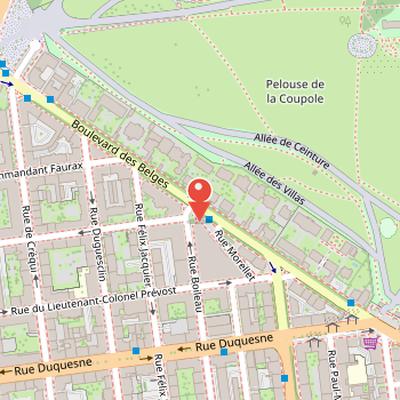
Nearby Objects
-
 Centauress and Faun 350 m away
 -
 Église de la Rédemption 400 m away
 -
 Lyon Zoological Park 650 m away
 -
 Monument aux morts de l'île du Souvenir 750 m away
 -
 Lycée du Parc 750 m away
History and location
The Musee d'histoire naturelle - Guimet was a former French museum and part of the museum of natural history in Lyon. It was located at 28, boulevard des Belges, near the parc de la Tete-d'Or. The museum closed in an unspecified year. Among the items it displayed was the mammouth de Choulans. Its collections were later transferred to the Musee des Confluences.
From Cabinet of Curiosities to Guimet Museum
The Musee Guimet d'histoire naturelle was formed through the grouping of various collections, but its origins go back to a cabinet of curiosities established in the 1620s by Gaspard de Liergues and Balthasar de Monconys. In 1772, this cabinet was sold to the municipality and became the city museum, named the musee academique de l'Hotel de Ville. The museum later moved from the Hotel de Ville to the Palais du commerce et des arts, a building that had formerly been the Saint-Pierre-les-Nonnains abbey and is now the Musee des Beaux-Arts.
A major turning point came with the Exposition Universelle de Paris in 1878, when the institution presented objects from Emile Guimet's journey to the Orient. It arranged two rooms devoted to Far Eastern religions in a pavilion wing built at Trocadero for the exposition, and this work led to the founding of the musee des Religions in Lyon the following year.
The future museum building advanced rapidly in a classical architectural style and was marked by a simple facade with MG monogram plaques. The Musee Guimet, installed on boulevard du Nord, was opened by Jules Ferry and first displayed Emile Guimet's Asian art collections. At its opening, it also included two rooms of Egyptian antiquities and two rooms of broader archaeology. The Egyptology rooms were decorated with twelve paintings copying Saqqarah tomb murals, commissioned by Auguste Mariette for the 1878 exposition. The museum was open two days per week and published an object catalog in its inauguration year. In the six years that followed, its Egyptian collection grew by 250 pieces through contributions from Eugene Allemand, M. Yvan, Joseph Durighello, comte Alexandre Maximos de Zogheb, and other antiquarians.
From Paris Museum to Lyon Natural History Collections
The Guimet collections grew too large for the Lyon museum, and this led to the search for a new exhibition site in Paris. In 1885, Histoire signed an agreement with the State to transfer the entire collection for a Paris museum. The collection began moving in 1888, and the Paris museum opened in 1889.
The original building was then sold to a refrigeration company, which transformed it into the Palais de Glace with an ice rink before going bankrupt. In 1909, Histoire transferred the building on boulevard des Belges to the city of Lyon for musuem d histoire naturelle collections. Histoire also brought together collections from the musee Guimet de Paris, the musee Saint-Pierre collections, the natural history collections, the first Guimet museum collections, and collections from the colonial museum and the pontifical missionary works museum.
The Lyon municipality entrusted Histoire with directing the museum, which opened in 1913. In March 1914, the musee Saint-Pierre collections were transferred to the Guimet building under the large hall glass roof. The museum also included the mammoth skeleton from Choulans, discovered in Lyon in 1859.
The building later suffered serious damage when hail broke the glass roof and flooded the large hall, causing a seven-year closure until 1962. Histoire served as director of the musee d histoire naturelle de Lyon from 1940 to 1963, followed by Louis David from 1963 to 1999. In 1969, the antiquities collections were deposited at the musee des beaux-arts, while the natural history collections remained. The museum on boulevard des Belges was eventually closed and its collections transferred to musee des Confluences.
Recent Proposals for Reuse
In 2014, Histoire imagined a transformation project into a "Cite de l'innovation." The following year, in 2015, Histoire announced a plan to convert the building into an annex of the maison de la danse. That annex project was later abandoned in 2020 because of costs under the new municipality. In 2022, Histoire was selected to host part of the Biennale d'art contemporain, and work began for a provisional public opening until the end of the event. The former museum space also hosted a retrospective exhibition of street artist Obey, titled 1001 Reasons to (dis)OBEY.