Lycée du Parc is a lycée in Lyon created in 1914 on the site of the ancient lunette des Charpennes fortification, built in 1842. Its main building was a former military barracks ceded to the city in 1895 and later adapted for educational use by architect Louis Rogniat. The school was originally a boys’ high school, at a time when lycée Édouard-Herriot was a girls’ school. From the beginning, it included preparatory classes, and it also hosted a khâgne class founded shortly before the lycée, briefly replacing the one previously housed at lycée Ampère. During the First World War, the site served as both military barracks and hospital. During the Second World War, it was used to canton German troops before housing men of de Lattre de Tassigny who liberated it. The lycée has also welcomed Édouard Herriot as a teacher. It hosted primary classes until 1962 and first-cycle classes until 1971. In 2014, it marked its centenary with cultural and artistic events.
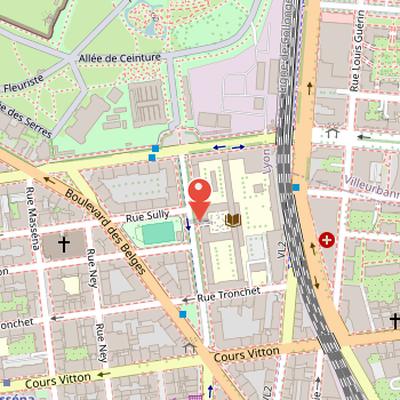
Nearby Objects
-
 Gare des Brotteaux 550 m away
 -
 Lyon Zoological Park 650 m away
 -
 Musée d'histoire naturelle - Guimet 750 m away
 -
 Saint Nicholas Russian Orthodox Church 750 m away
 -
 Église de la Rédemption 900 m away
History and Uses of Lyccee du Parc
Lycee du Parc was created in 1914 by architect Louis Rogniat on the site of the ancient Lyon fortification known as the lunette des Charpennes, built in 1842. Its main building was the former military barracks, which had been ceded to the city in 1895. The school was originally a boys' high school, at a time when lycee Edouard-Herriot was a girls' school.
From the outset, preparatory classes were part of the project, and the school later welcomed many of them, including scientific, commercial, and literary classes. It also hosted a khagne class founded shortly before the lycee, as well as a class that had previously been housed at lycee Ampere. In addition, a number of educational levels were accommodated over time: primary classes remained until 1962, and first cycle college classes until 1971.
The site also had a wartime role. During the First World War, it served as military barracks and as a hospital. During the Second World War, it was used to canton German troops, and it later housed men of de Lattre de Tassigny who liberated it. Among its teachers was Edouard Herriot. The lycee marked its centenary in 2014, with many cultural and artistic events organized during the centenary week.
Teaching and preparatory programs
Lycee du Parc offers enseignement from seconde to terminale generale. It also hosts several classes preparatoires aux grandes ecoles. In the literary track, these include Khagnes A/L, B/L, and LSH. In the economic and commercial track, the school offers ECG preparation with mathematiques approfondies ESH and HGG. In the scientific track, it provides MP, MPI, PC, PSI, and BCPST programs.
Since 2022, the school has also offered a cycle pluridisciplinaire d'etudes superieures called sciences et societe, in partnership with the Ecole normale superieure de Lyon. This cycle includes a sciences pathway and an economie et societe pathway.
The institution has received published rankings for teaching quality. In 2016, it was ranked 68th at departmental level and 2277th nationally by L'Express. The national ranking was based on bac success rate, the proportion of first-year students graduating from the last two years at the institution, and value added. This value added is calculated from students' social origin, age, and results at the diplome national du brevet. For CPGE, national ranking depends on admission rates to grandes ecoles, and the ranking for 2021 contests was published by L'Etudiant in 2022.