Parc de la Tête d'Or is an urban park in Lyon and one of the largest parks in France. Covering 117 hectares in a natural area in the city center, it includes a botanical garden and is managed by the city of Lyon. The park was created by the brothers Eugenio and Denis Bühler and opened in 1857, making it contemporary with Central Park in New York. Its development continued over time with large greenhouses added in 1865, followed by a velodrome, a guard cabin, and a country house in 1894. Fencing was added in 1896, and collection greenhouses in 1899. Between 1914 and 1930, the park contained the monument to the dead on Swan Island. A new rose garden was created between 1961 and 1964. The park has eight entrances, and its last entrance was inaugurated in 2009 near the Cité Internationale esplanade. It also hosts various events, including films, theater, and exhibitions.
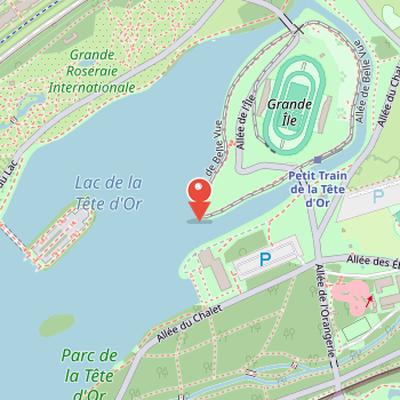
Nearby Objects
-
 Monument aux morts de l'île du Souvenir 150 m away
 -
 Vélodrome Georges-Préveral 200 m away
 -
 Lyon Zoological Park 350 m away
 -
 Museum of Contemporary Art of Lyon 400 m away
 -
 Lyon 25 450 m away
Design, Growth, and Public Use
Parc de la Tete d'Or is an urban park in the city of Lyon and one of the largest parks in France. It covers 117 hectares in a natural area in the city center and is managed by the city of Lyon. The park was created by the brothers Eugenio and Denis Buhler and opened in 1857, making it contemporary with Central Park in New York. It includes a botanical garden, reflecting its landscaped and horticultural character.
The park was enriched in several stages. Large greenhouses were added in 1865, followed by a velodrome, a guard cabin, and a country house in 1894. Fencing was added in 1896, and collection greenhouses were added in 1899. Between 1914 and 1930, the park contained the monument to the dead on Swan Island. A new rose garden was added between 1961 and 1964.
Parc de la Tete d'Or has eight entrances, and its last entrance was inaugurated in 2009 near the Cite Internationale esplanade. In addition to its landscaped features, the park hosts various events, including films, theater, and exhibitions, which contributes to its cultural significance within Lyon.
From Floodplain to Urban Park
The lands that later became parc de la Tete d'Or were known in 1530 as "cabeza de oro" and belonged to the Lambert family. Archives from 1662 mention the domain of Grange Lambert, a possession of the Hotel Dieu and heir of Catherine Lambert. The name "Cabeza de Oro" was linked to a legend about a buried treasure containing a golden head of Christ. Before the park was created, the area was described as a flood zone with isolated dead arms of the Rhone and the Brotteaux swamps of Lyon, conditions that remained until the park was established.
A project for an urban park in Lyon began in 1812, with several sites considered, including Presqu'ile and Fourviere hill. The land, which mostly belonged to the Hospices Civils de Lyon, was eventually selected. In 1845, architect Gustave Bonnet presented a park project for the site and described it as a planned forest, comparable to Bois de Boulogne. Later, prefect and mayor Claude-Marius Vaisse resumed the project in order to create nature for those who did not have it.
The land was bought from the Hospices Civils de Lyon in 1856, and park works began the same year under the Swiss landscapers Denis and Eugene Buhler and engineer Gustave Bonete. Construction lasted five years, although the park opened in 1857 before all the work was finished. Located north of the Brotteaux district and beside the Rhone, the park also required a dike built from soil excavated from the lake to prevent flooding and to create park areas.
Landscape, Lake, and Zoological Areas
Parc de la Tete d'Or was modeled in the English style, with large green areas and undulating terrain. Its plan is triangular, and its boundaries reflect several different urban edges. A dyke separates it from the Rhone, with a walkway along the park connecting to the Amphitheatre garden of the Lyon Convention Center. On the east side, it is bordered by the historic Lyon-Geneva railway line leading to Brotteaux station, while the south edge is lined by villas on Boulevard des Belges, with access easements from gardens through small fenced gates.
The park contains a varied landscape of designed natural spaces and leisure facilities, including a small alpine wooded valley, a viewpoint, a central lake, a wide lawn area, a small forest, educational gardens, and playgrounds. It also includes four rose gardens, a large greenhouse with smaller flowers, and a velodrome. The lake covers sixteen hectares and is supplied by water extracted from the Rhone. Two tree-covered islands emerge in the northern part of the lake: Tamaris island, which is accessible only by boat, and Memories island, which carries a quadrilateral monument.
Memories island, formerly called Swan island, was redesigned by Lyon architect Tony Garnier and sculptor Jean-Baptiste Larrive, Grand Prize of Rome in 1904, as a memorial to fallen soldiers. Their names are engraved on the outer walls of the monument, and the engravings were renovated after 2003. Access is provided by an underground corridor, and the staircase leading to the island is submerged in the lake. Near the lake are two additional islands not part of the lake itself: Gandhi island with walkways, and a nameless island formed by the wooded velodrome and its belvedere. This island can be crossed on one side by a rock bridge and on the other by the historic Swiss Bridge.
The zoological garden was created at the same time as the park. It began as a farm for educational purposes according to state guidelines, with some local fauna, then expanded its facilities and became a true zoo. Today it houses animals from around the world and covers more than 6 hectares. It also maintains a long-standing scientific collaboration with the National Veterinary School of Lyon. In October 2006, the zoo inaugurated La Plaine Africaine, a 2.5-hectare area with 130 different animals, including rare and protected species, designed to combine animal enclosures with decoration while respecting public visibility.
The Velodrome at Parc de la Tete d'Or
Plano's velodrome in Parc de la Tete d'Or was created in 1894 for the universal exhibition held in Lyon that year. Its races were used to showcase the latest bicycle models. In 1909, Lyon mayor Edouard Herriot voted to convert the velodrome into a playground, but the facility survived this proposal and was renovated in 1934. It later underwent a full rehabilitation for the 1989 world championships, which it hosted.
The track is a concrete circuit measuring 333.33 meters, with banked curves reaching a maximum of 43 degrees. It is homologated by the International Cycling Union for international competitions. The velodrome remains an active sporting site: three clubs are based there, competitions are held regularly, and the Rhone-Alpes track cycling championships are organized there every year. Jeannie Longo won two world championship titles at the venue, in pursuit and points race.
Beyond cycling, the central area includes an athletics track and a sports field used for handball, basketball, and volleyball courses. The infrastructure is also used by aggregation schools for initiation and physical education courses.
Rose Gardens and Greenhouse Collections
The origin of the park dates to a donation made in 1805 by Josephine de Beauharnais, who offered a collection of her roses. This early legacy is reflected in the park's four rose gardens and in its broader botanical role. The park contains approximately 15,000 plants, making it one of the richest botanical gardens in Europe, and it attracts experts from all over the world during opening hours.
Its greenhouses are an important part of this identity. Although they are located outside the enclosure and have specific access zones, they remain part of the general botanical garden. The greenhouse complex includes two contiguous areas, the Alpine Garden and the Botanical Garden, and has a total area of 6,500 m2, described as the largest collection in France. The greenhouses help preserve about 6,000 plant varieties.
The first greenhouses were made of wood, but they did not withstand indoor humidity well. New greenhouses were built in 1880 under the direction of Gustavo Bonete. The site also includes notable buildings with iron and glass architecture. An orange greenhouse, an old stone greenhouse, is no longer part of the botanical garden.
The park offers free guided tours from Monday to Friday, and the city of Lyon and its botanical conservatory service organize animation actions linked to visits in Gerland Park.
Tree Collection and Walking Guide
Parc de la Tete d'Or contains more than 8800 trees. According to the available figures, 36.5 percent of them are softwood species, 61.0 percent are hardwood species, and 2.5 percent are rare species. Among the remarkable trees identified in the park are plataneras that reach 40 meters in height, as well as cedars of Lebanon, tulip trees, ginkgo biloba, bald cypress, and giant sequoias. A specially published walking guide to the beautiful trees is available at the park entrance, suggesting that the tree collection is presented as an important feature of the site for visitors.
Access, Mobility, and Leisure Facilities
Parc de la Tete d'Or is open to the public with free entry throughout the park, including the zoo. Special opening hours apply to the Botanical Garden and the zoo. Access is restricted in some areas, including near the new rose garden entrance and the Cite Internationale square entrance, while public access to the velodrome is generally not allowed. The park also provides circulation for persons with disabilities across the site, including the greenhouses, Botanical Garden, and zoo.
The park allows several forms of regulated movement and transport. Vehicle access and internal parking are available near the lake restaurant and the vaulted gate of Villeurbanne, and parking inside the park is reserved exclusively for restaurant customers during meal periods. Bus access through the vaulted gate connects to a dedicated parking area beside the bowling games, with picnic meadows available for groups nearby. Since 2009, bicycles have been permitted through the large vehicle entrances in line with the Velov bike rental system. Skaters are tolerated only in the northern zone near the human rights area.
Parc de la Tete d'Or also contains a wide range of leisure and service facilities. These include Theater Guignol, Le petit Lac with boats for children, a small iron tourist train around the velodrome, a small tire train named lagarto, a mini-golf area, a walking area for childcare ponies, a bowling alley, a duck fishing kiosk, two carousels, a pedal boat port, two restaurants, and two kiosks. The kiosks offer crepes, waffles, cotton candy, and confectionery. Pony carts for children are located at Las Maderas. Horseback riding had been authorized on the large park avenues until the 1970s, and stables were formerly located in the La Doua district across the train tracks in Villeurbanne.
The park also had an early role in vehicle regulation: it originally allowed automobile access, but frequent accidents led to changes, and in 1891 it implemented the first vehicle registration system in the world by numbering cars.