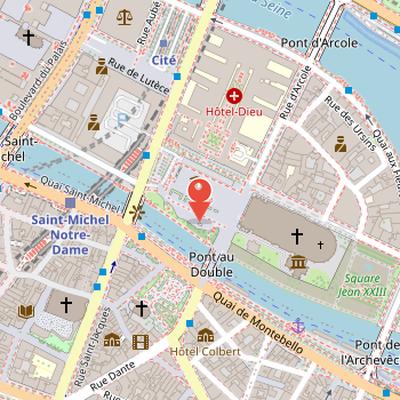
Charlemagne et ses Leudes is a monumental bronze statue situated on the Parvis Notre-Dame – Place Jean-Paul-II in the 4th arrondissement of Paris, near the Seine. Also generally translated as Charlemagne and His Guards or Charlemagne and His Paladins, the group was jointly created by the brothers Louis Rochet and Charles Rochet and cast at the art foundry. The Rochet brothers first conceived the project in 1853, originally with Aachen in mind, and later presented a plaster version at the Universal Exposition of 1867. The completed bronze group was exhibited at the Universal Exposition of 1878. Charles Rochet subsequently offered to cover the cost of erection, and the monument was accepted for a provisional Parisian site on Eugène Viollet-le-Duc’s recommendation. Erected in 1882 on a wooden pedestal designed by Viollet-le-Duc, it received its current stone pedestal in 1908. The statue shows Charlemagne in old age wearing the Imperial Crown of the Holy Roman Empire and holding the Scepter of Charles V, while Roland and Oliver stand beside him as guards.
Nearby Objects
-
 Shakespeare and Company 120 m away
 -
 Notre-Dame de Paris 120 m away
 -
 Saint-Julien-le-Pauvre 140 m away
 -
 Hôtel-Dieu de Paris 200 m away
 -
 Île de la Cité 200 m away
Bronze Statue by Notre-Dame
Charlemagne et ses Leudes is a monumental bronze statue situated on the plaza in front of Notre-Dame in the 4th arrondissement of Paris, France. The work is generally translated as Charlemagne and His Guards or Charlemagne and His Paladins. It is a joint work by the brothers and Charles Rochet (1815-1900). The statue was cast at the art foundry.
From Aachen to Parvis Notre-Dame
The Rochet brothers first conceived a monument to Charlemagne in 1853, and their original intention was to place it in Aachen. They later presented a plaster version at the Universal Exposition of 1867, and the completed bronze group was shown again at the Universal Exposition of 1878, shortly after the death of Louis Rochet. Charles Rochet then offered to pay the cost of erecting the 15-ton group in order to help secure a suitable site in Paris. In January 1879, on the recommendation of Eugene Viollet-le-Duc, the Paris municipal council accepted this offer and approved the Parvis Notre-Dame as a provisional location. The monument was erected there in 1882 on a wooden pedestal designed by Viollet-le-Duc. The City of Paris acquired ownership of the statue in 1895 and reimbursed the founders, and the present stone pedestal was built in 1908. The monument was spared by German occupiers during World War II because of Charlemagne's importance in German nationalistic ideology. In 1973, its replacement by the Pillar of the Boatmen and relocation to Metz were discussed, but these proposals were not carried out.
Placement and Allegorical Design
Charlemagne et ses Leudes is located on the south side of the Parvis Notre-Dame - Place Jean-Paul-II near the river Seine. The statue presents Charlemagne in old age, wearing the Imperial Crown of the Holy Roman Empire and brandishing the Scepter of Charles V, known as the Scepter of Charlemagne. He is accompanied by two standing figures, Oliver and Roland, who serve as guards: Oliver guides Charlemagne's horse and scans for enemies, while Roland carries an olifant, a double-headed axe, and the Durendal sword. Roland's Durendal is modeled on the sword kept at the Royal Armoury of Madrid, and Oliver is shown with a Frankish scramasax and a pike. The two Leudes are given hairstyles and clothing traditionally associated with Gauls or Merovingians.
The composition creates a sense of foreboding through the watchfulness of the two companions, evoking their future demise at the battle of Roncevaux Pass. At the same time, Charlemagne's attitude emphasizes achievements beyond the sacrifice of the two paladins and suggests his enduring legacy. The work is deliberately fictional and anachronistic on several levels in order to underline its allegorical character. This includes the portrayal of Charlemagne with insignia of power that were not meant to be carried on the battlefield, as well as the use of objects from later periods: the Imperial Crown was created more than a century after Charlemagne's death, and the scepter dates from the 14th century. The legend also places the two Leudes' deaths in 778, when Charlemagne was still young.
Political Symbolism in the Composition
The composition carries political and nationalistic symbolism that reflects the Rochet brothers' intention to claim Charlemagne's legacy for France and Napoleon III. It presents an implied affinity between Charlemagne and Napoleon, while reducing the prominence of the Capetian dynasty. This claim also seeks to neutralize the pretensions of French royalist parties, including the Orleanists with Philippe, Count of Paris, and the Legitimists with Henri, Count of Chambord. Roland and Oliver further anchor Charlemagne in French territory and tradition against Belgium and Germany. At the time the statue was being designed, Germany was beginning its unification process. In the composition, Charlemagne raises his French scepter above his German crown in a theatrical gesture.