The Tomb of Francis II, Duke of Brittany, is a funerary monument located in Nantes in the cathedral of Saint-Pierre-et-Saint-Paul. Made in the early 16th century from various noble materials, including Carrare marble, it was created by Michel Colombe and his workshop, with Jean Perréal as architect. Commissioned by Anne de Bretagne to honor the memory of her parents, the monument is considered a masterpiece of French Renaissance sculpture and a memorial to the Montfort dynasty. It also appears as a symbol of the history of Brittany during a pivotal era.
The monument was originally known as the “tombeau des Carmes,” referring to its first location. François II had wished to be buried in the chapel of the Carmes in Nantes, where he was laid to rest alongside his first wife, Marguerite de Bretagne. In 1506, Anne de Bretagne obtained authorization from Pope Julius II to transfer the remains of her mother, Marguerite de Foix, who had been buried in the cathedral since 1487. The tomb was hidden during the French Revolution to prevent its destruction. It has been classified as a historical monument since 1862.
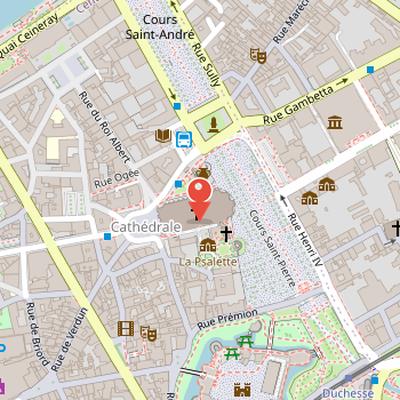
Nearby Objects
-
 Nantes Cathedral 20 m away
 -
 Lamoricière cenotaph 30 m away
 -
 Porte Saint-Pierre 80 m away
 -
 Cours Saint-Pierre and Saint-André 90 m away
 -
 Colonne Louis-XVI 130 m away
The Tomb at Nantes Cathedral
The tomb of Francois II, Duke of Brittany, and his wife Marguerite de Foix is a funerary monument located in Nantes, in the cathedrale Saint-Pierre-et-Saint-Paul. It was created in the early 16th century by the sculptor Michel Colombe, working with his workshop and the architect Jean Perreal. The monument was made using various noble materials, including Carrara marble.
Historical Meaning and Commemoration
The tomb, identified here as Histoire, was commissioned by Anne de Bretagne to honor the memory of her parents. It is regarded as a masterpiece of French Renaissance sculpture and serves as a memorial to the Montfort dynasty. In this role, it also appears as a symbol of the history of Brittany during a pivotal era, giving the monument significance beyond its funerary function.
From the Carmes Chapel to Historical Monument
The monument was originally named the tombeau des Carmes because of its first location in the chapel of the Carmes in Nantes. Francois II had wished for his body to rest there, and he was buried in the chapel alongside his first wife, Marguerite de Bretagne. He owed his title of duke to Marguerite de Bretagne, giving the burial a particular dynastic significance. In 1506, Anne de Bretagne obtained authorization from Pope Julius II to transfer the remains of her mother, Marguerite de Foix, who had been buried in the cathedral since 1487. During the French Revolution, the site was disrupted: in 1791 religious people were dispersed and furniture was sold, and in 1792 the buildings including the church were sold as national property. The three coffins were then moved to the crypt of the cathedral, and the tomb was hidden to prevent its destruction. This safeguarding is sometimes attributed to Jean-Baptiste Ogge or Mathurin Crucy. When the tomb was found in 1800, Mathurin Crucy proposed reusing the work for the base of a commemorative column. The tomb has been classified as a historical monument under immeuble since 1862. It was later completely dismantled by regional cultural affairs services for restoration, including work on the substructures of serpentine and the first layer of white marble affected by salt. Study of the tomb also revealed a box containing bones of three individuals. In 2025, the recumbent effigies of the duke and duchess were exhibited in Saint-Gatien Cathedral in Tours, in homage to Michel Colombe, who had worked in the city.
Architectural Design and Sculptural Program
The tomb consists of a massive rectangular sarcophagus set on a dark green serpentine plinth. Its lateral walls are divided by a dark green serpentine band into two superimposed registers, each containing delicate sculptures placed in small niches. The upper register is decorated with white marble pilasters and arcatures with flattened reliefs, which frame red marble semicircular niches. At the small ends of this upper register are the patron saints Saint Francois d'Assise and Sainte Marguerite, together with Charlemagne and Saint Louis. The upper register also includes the Twelve Apostles, arranged six on each of the two long sides. The lower register contains half-figures of mourners with alabaster faces and hands, dressed in dark serpentine hooded garments and set in white marble shell medallions.
The tomb combines different stylistic elements associated with a high level of prestige. Its execution brought together French sculptors for the statues and Italian sculptors for the ornamentation in the same workshop. The effigies of Francois II and Marguerite de Foix are shown with joined hands and closed eyes, wearing ceremonial costumes with ermine-lined cloaks and fleurdelisee crowns.
Allegorical Representation and Symbolic Attributes
The tomb depicts the duke wearing the insignia necklace of the Order of the Ermine and the Epi. He is represented in armor with a warrior helmet, as a virile virtue, and is often shown leaning against a column or tower in this iconography. The figure extracts a dragon from the crenellated tower or dungeon where it is entrenched, an image that symbolizes moral strength triumphing over vice and temptation. His facial expression reflects a certain inward pain.
The figure is also associated with several symbolic objects. In the right hand, he holds a horse bit as a sign of reasoned conduct, and in another version a compass, symbolizing the need to measure every action. In the left hand, he holds a clock as a reminder to respect time and temper passions, or a mirror as a reflection of all thoughts and as a bearer of wisdom advice. The mirror features a double face representing the wisdom of age.