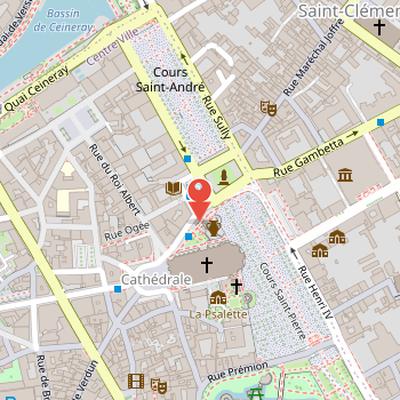
Porte Saint-Pierre is a city gate in Nantes located at the outlet of rue de l'Évêché, near cours Saint-Pierre, place Maréchal-Foch, and the chevet of the cathedral Saint-Pierre-et-Saint-Paul. Its lower part dates from later periods and rests on Gallo-Roman foundations from the 2nd century, while also integrating vestiges of the enclosures of Nantes. The gate was once protected by a drawbridge over ditches dug by Guy de Thouars and originally had two large towers, the northern one called de Guy de Thouars and the southern one de l'évêché. After the fire of 1118, it was adjacent to the bishops' residence, and in the early 16th century bishop Guéguen built a lodge above the gate. Part of the structure was demolished in the 18th century for the opening of rue Royale, now rue du Roi-Albert, and the drawbridge was replaced by a stone causeway that improved access to the surrounding cours. Henri IV crossed the gate in 1598 when entering the city to sign the Edict of Nantes. After the separation of Church and State, the gate and adjacent buildings were classified as historic monuments in 1906. The facades were fully restored, with work completed in spring 2014.
Nearby Objects
-
 Lamoricière cenotaph 50 m away
 -
 Nantes Cathedral 50 m away
 -
 Colonne Louis-XVI 60 m away
 -
 Place Maréchal-Foch 80 m away
 -
 Tomb of Francis II 80 m away
Architecture and Historical Setting
Porte Saint-Pierre is located at the outlet of rue de l'Eveche, near cours Saint-Pierre and place Marechal-Foch, and it stands close to the chevet of the cathedral Saint-Pierre-et-Saint-Paul. The lower part of the structure dates to a later presentation and rests on Gallo-Roman foundations from the 2nd century, while it also integrates vestiges of the enclosures of Nantes. It was protected by a drawbridge over ditches dug by Guy de Thouars and originally had two large towers: the northern tower, called de Guy de Thouars, and the southern tower, called de l'eveche. After the fire in Nantes in 1118, it was adjacent to the bishops' residence. In the early 16th century, bishop Gueguen built a lodge above the gate. Part of the structure was demolished in the 18th century to make way for the opening of rue Royale, now rue du Roi-Albert. Porte Saint-Pierre also has a place in civic history, since Henri IV crossed it in 1598 when entering the city to sign the Edict of Nantes.
Historical Access and Preservation
The road from Paris ended at Porte Saint-Pierre, making it an important point of access in the city. In the 18th century, the drawbridge of Presentation was replaced by a stone causeway, which improved access to cours Saint-Pierre and cours Saint-Andre. After the separation of Church and State, Porte Saint-Pierre and the adjacent buildings were classified as historic monuments by decree on February 21, 1906. At the same time, the manor of La Psallette was also classified. In 1910, Porte Saint-Pierre was cleared of the old episcopal palace.
From the 1920s to the 1960s, Presentation housed the Musee de Nantes par l'image, which presented a model of the port. The collections of this museum were later transferred to the chateau des ducs de Bretagne. The facades of Porte Saint-Pierre underwent a complete restoration, completed in spring 2014.