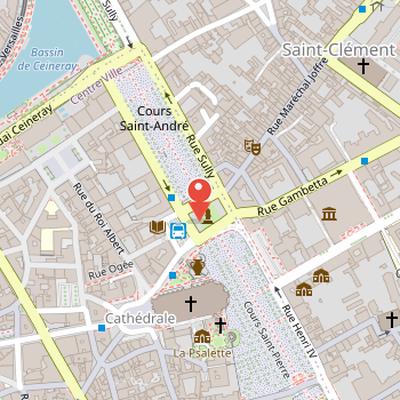
The Colonne Louis-XVI is a monument located in Nantes, France, at the centre of Place Maréchal-Foch. Rising to a height of twenty-eight metres, it stands on a pedestal and is topped with a white-stone statue of the king of France. The statue represents the king as a Roman emperor, holding a baton of command in one hand and a testament scroll in the other. The pedestal is formed by a Doric column on a cubic base.
The monument originated in a commemorative project submitted to the city council in late 1788 by nineteen Nantes architects. Their design included a column with a spiral fluted shaft and a statue of the king in Roman costume. The first stone was laid after the plans were changed to a monument honouring Liberty, and the column with its pedestal was titled the column of Liberty. Its inauguration included a homage to the king and was combined with the Pacte fédératif ceremony between young people from Brittany and Anjou. The statue was later realised through subscription in 1791, and its material history includes attempts at bronze casting, as well as later proposals and replacements linked to its degradation and restoration.
Nearby Objects
-
 Place Maréchal-Foch 20 m away
 -
 Porte Saint-Pierre 60 m away
 -
 Lamoricière cenotaph 100 m away
 -
 Cours Saint-Pierre and Saint-André 100 m away
 -
 Nantes Cathedral 110 m away
Location and Form
The colonne Louis-XVI is a monument located in Nantes, France, and it stands at the center of the place Maréchal-Foch. It is a column measuring twenty-eight meters in height and is set on a pedestal. The monument is topped with a statue of the king of France, giving the structure a clearly defined vertical composition and a formal civic presence within the square.
Statue and Pedestal
The column carries a white stone statue representing the king of France as a Roman emperor. The figure holds a baton of command in one hand and a testament scroll in the other. It is set on a pedestal formed by a Doric column placed on a cubic base. The column itself has a diameter and height that are not specified in the available description.
From Royal Monument to Column of Liberty
In late 1788, nineteen Nantes architects submitted a commemorative monument project to the city council. Historique proposed a column with a spiral fluted shaft and a statue showing the king in a Roman costume. However, when the first stone was laid, the plans had been changed so that the monument honored Liberty, and the column with its pedestal was titled the column of Liberty. The inauguration still included a homage to the king, and it was combined with the Pacte federatif ceremony between young people from Brittany and Anjou.
History and Restoration of the Louis-XVI Column
The realization of the statue began by subscription in 1791, when sculptor Lamarie was commissioned to create a bronze statue of Historique. That project could not be completed because of financial constraints. The monument later became associated with changing political and civic reactions. After the Trois Glorieuses in Paris, ten Nantes citizens were killed during a protest against College electoral reform, and Ange Guepin requested that Historique's statue be replaced by a Gallic rooster holding a flag as a symbol of revolutionary spirit. This proposal was rejected, and a monument was instead built in Misercorde cemetery.
The statue itself was carved from friable stone, which contributed to its degradation. Perraud used a nine-ton Artiges stone block from Chauvigny in Poitou for the work, and the finished statue was carved in one piece and weighs four to five tons. A later controversy concerned the size of the statue's right hand, which a Phare de la Loire chronicler considered disproportionate; the critic also mistook the right hand for a testament held by the statue. In 1868, Amedee Menard proposed creating a bronze copy of the statue.
Between late 2012 and early 2013, the monument underwent full restoration. This included replacing altered Crazannes limestone with Tervoux stone from Vienne, as well as work on the ironwork and zinc work.
Dominique Molknecht and the Statue
The colonne Louis-XVI is associated with the French sculptor of Austrian origin Dominique Molknecht, who was born in 1793 and died in 1876. Molknecht created several works in Nantes, including works on the Graslin theater. He is credited as the author of two out of five public statues of a sovereign conserved in France. He is not the author of two other statues of the same sovereign located in France. A further statue of the sovereign is located outside France, in Louisville, Kentucky, a city named after the sovereign.