Nantes Cathedral is a Catholic cathedral located at Place Saint-Pierre in Nantes, Loire-Atlantique. It serves as the cathedral of the Diocese of Nantes and the seat of the bishop of Nantes. Construction lasted from 1434 to 1891, and the building has been classified as a historic monument since 1862.
The cathedral has a long and complex history on the same site. According to the historical account provided, the location was first occupied by a druidic temple dedicated to Janus or Bouljanus, and three Christian religious buildings preceded the present cathedral. Construction of the first cathedral began in the 6th century under Bishop Evhemerius, and it was consecrated in 567 or 568. The building was later targeted by Normans, burned in 843, and restored and reinforced between 897 and 906. In the modern period, the cathedral was damaged by bombings in Nantes in 1944, and later by fires during restoration work and by a criminal fire that destroyed major interior and decorative elements. Restoration continued until 1985.
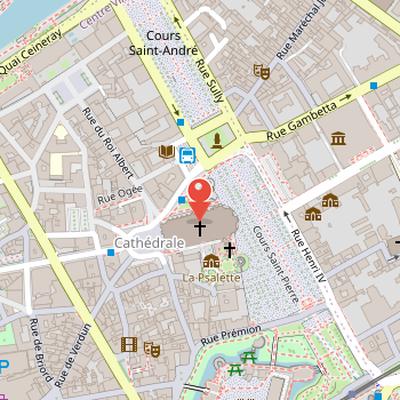
Nearby Objects
-
 Lamoricière cenotaph 10 m away
 -
 Tomb of Francis II 20 m away
 -
 Porte Saint-Pierre 50 m away
 -
 Cours Saint-Pierre and Saint-André 90 m away
 -
 Colonne Louis-XVI 110 m away
Construction, Damage, and Restoration
Nantes Cathedral is a Catholic cathedral located at Place Saint-Pierre in Nantes, Loire-Atlantique. It serves as the cathedral of the Diocese of Nantes and the seat of the bishop of Nantes, a role now held by Laurent Percerou. Construction of the building lasted from 1434 to 1891, and it has been classified as a historic monument since 1862.
The cathedral has also undergone several episodes of damage and restoration. It was damaged by bombings in Nantes in 1944, when a bomb hit the sacristy and damaged the apse and three chapels. During restoration work, an accidental fire destroyed most of the roof. Restoration continued until 1985, and celebrations were held at the chapel Notre-Dame-de-l'Immaculee-Conception while the cathedral was under restoration. A later criminal fire destroyed the 17th-century organ, the large west facade stained glass window from 1498, and various furniture elements. The damage from that fire was estimated at over 40 million euros.
From Early Christian Site to Gothic Completion
The site of Nantes Cathedral has a long religious history. According to Histoire, it was first occupied by a druidic temple dedicated to Janus or Bouljanus, and three Christian religious buildings preceded the current cathedral on the same ground. The first true church was established to the east near the Gallo-Roman enclosure, with its choir very close to the ramparts. Construction of the first cathedral began in the 6th century under bishop Evhemerius, and it was consecrated in 567 or 568, or on an unspecified date. Venance Fortunat admired and described this early cathedral, and excavations in the 20th century later confirmed its richness and magnificence.
The cathedral became a target for the Normans in the 9th and 10th centuries. On June 24, 843, bishop Gohard was massacred and the cathedral was burned during a Norman invasion. Bishop Fulquerius restored and reinforced the building between 897 and 906, but only the crypt under the choir and some capitals preserved at the Musee Dobree remain from that period. One of these capitals shows a bearded figure with two pairs of eyes wearing a loincloth, together with a sphinx with a human head and a dragon with a tail ending in a fire-breathing head.
The current building began under Guillaume de Dammartin and continued by Mathurin Rodier under duke Jean V and bishop Jean de Malestroit. The first stone of the present cathedral was laid on March 4, 1434. Histoire places this work in the mid-15th century, a favorable period because Brittany had regained commercial prosperity through an opportunistic diplomatic policy that kept it relatively uninvolved in European conflicts. A large cathedral also served to legitimize ducal power after the Wars of Succession of Brittany. Nantes and Quimper had similar facade projects initiated by Jean V. The central portal was completed in 1481 for grand masses, and Henri IV crossed it in 1598 to sign the Edict of Tolerance in Nantes.
The cathedral facade was finished by the end of the 15th century, while the towers were completed in 1508. The great stained glass window, commissioned by Duchess-Queen Anne and installed in 1498, depicted Anne and her mother Marguerite de Foix, but it was destroyed in the cathedral fire on July 18, 2020. The nave and collateral aisles were completed in the early 16th century, and the Gothic vault of the nave, the south transept arm, and the flying buttresses were completed in the 16th century. A project plan also existed to add a transept and a short chevet linked to the city walls.
Fire, War Damage, and Restoration
Nantes Cathedral has undergone repeated damage and restoration in the modern period. It was hit by violent bombings on June 15, 1944, which led to restoration work on the building. The cathedral also suffered a major attic fire caused by mishandling of a blowtorch by Clair Brevet. That fire destroyed much of the roof structure and caused numerous other damages. An eight-year judicial process followed, after which the State was held responsible because it had failed to clean inflammable dust before workers entered the site.
Restoration progressed in several stages. Reconstruction techniques made it possible to reopen the choir in 1975 during a solemn office. A provisional choir was completed ten years later, and the definitive reconstruction of the choir was finished in 2013. The cathedral's current appearance is also the result of a full renovation by architects Jean-Marie Duthilleul and Benoit Ferre. As part of these works, the west facade was reconstructed to its original 19th century appearance and was completed in September 2008. Similar work was planned for the east facade of the south tower, the north transept portal, and the chevet.
The cathedral also experienced another fire at around 5 A.M., which was brought under control around 6 A.M. The first damage assessment reported the total destruction of the tribune grand organ from the 19th century, supposed instability of the platform supporting it, and the destruction of a 19th century stained glass window. The tomb of Duke Francois II of Brittany and his wife Marguerite de Foix narrowly escaped the fire. Following the incident, Prime Minister Jean Castex visited the site with Gerald Darmanin and Roselyne Bachelot, and the government announced the fastest possible reconstruction with state participation as building owner. Three fire origins were identified: one at the organ and one on each side of the nave.
Investigation and Legal Aftermath
After the fire, Nantes public prosecutor Pierre Sennes said that a criminal fire investigation had been assigned to the judicial police. Emmanuel Abayisenga later confessed to starting the fire. He was identified as a 39-year-old Rwandan asylum seeker whose residence permit had not been renewed, and he had been ordered to leave France since late 2019. He was charged with property destruction by arson, held, and then released.
At trial, the prosecutor linked the fire to anger and revenge related to his administrative status. The state lawyer estimated the damage at more than 40 million euros. Abayisenga was also described as psychologically fragile. He was later sentenced to four years in prison. The record also notes that, during conditional freedom, he committed the murder of priest Olivier Maire in Saint-Laurent-sur-Sevre.
Reopening After Restoration
According to Histoire, Nantes Cathedral reopened after five years of restoration during ceremonies attended by Mayor Johanna Rolland and Culture Minister Rachida Dati. Bishop Laurent Percerou solemnly reopened the cathedral and presided over the organ revival and vespers. He also celebrated the first mass, attended by many clergy and faithful from the diocese. Although the cathedral has reopened, work is still continuing, with completion expected in 2028.
Façade, Tombs, and Crypts
Nantes Cathedral is marked on its facade by two massive towers with terrace tops and by five richly decorated portals arranged as three central portals and two lateral ones. From north to south, the portals are dedicated to the Enfants nantais, Saint Pierre, the Last Judgment, Saint Paul, and Saint Yves. The sculptures in the portal voussures serve historiographical purposes linked to the figures to whom the portals are dedicated.
The cathedral also contains several important funerary monuments. It houses the tomb and gisants of Duke Francois II of Brittany and Marguerite de Foix, made by Michel Colombe and Jean Perrreal. This marble tomb, created from 1502 to 1507 and installed in 1817, is decorated with twelve apostles and four allegorical female figures representing the cardinal virtues. Another funerary monument is the cenotaph of General de Lamoriciere, erected in 1878 with papal homage.
Inside, the building contains multiple paintings and a range of stained glass programs. Contemporary abstract stained glass was commissioned by Monuments Historiques and represented by chief architect Pierre Prinet. Brigitte Simon worked on the lower north collateral from 1968 to 1974, Anne Le Chevallier produced stained glass in the north transept and the chapels of Saint-Jean Baptiste and Sacre Ceur from 1977 to 1982, and Jean Le Moal collaborated with Anne Le Chevallier on the choir stained glass from 1978 to 1988.
The cathedral also includes two crypts. One is a Romanesque crypt from the 11th century, dating to the era of the second cathedral. It has a rectangular martyrium ending in an apse, surrounded by an ambulatory corridor that ends in a dead end. Four thick Romanesque columns stand at the center of the martyrium and supported the vault, while the ambulatory allowed relics in the martyrium to be viewed through three fenestrellae pierced in the thick wall. The vault was later destroyed to level the floor during construction of the neo-gothic choir and replaced by the present flat ceiling. A larger crypt was also created to support the new choir, and four rooms in this crypt display the history of the cathedral.
The cathedral contains liturgical objects such as ciboria, chalices, and censers, as well as the crosier of Fournier, bishop of Nantes from 1870 to 1877, made by Francois Evellin in 1870 and classified as a historical monument object in 1982.
Bells and Clock Carillon
Nantes Cathedral has a south tower containing a set of eight electrically rung bells. These bells include Jeanne Antoinette, cast in 1842 or 1843 by Bollee Freres in Le Mans and tuned fa # 2; Francoise Therese, cast in 1841 by Guillaume-Besson in Angers and tuned sol # 2; Josephine, cast in 1842 or 1843 by Bollee Freres in Le Mans and tuned la # 2; Julie Felicite, cast in 1841 by Guillaume-Besson in Angers and tuned si 2; Marie Francoise, cast in 1841 by Guillaume-Besson in Angers and tuned do#3; Perrine Marie, cast in 1841 by Guillaume-Besson in Angers and tuned re # 3; Emilie, cast in 1841 by Guillaume-Besson in Angers and tuned fa 3; and Louise, cast in 1841 by Guillaume-Besson in Angers and tuned fa # 3. The cathedral also has a clock carillon of twelve fixed bells suspended in a west-facing bay of the south tower. These carillon bells were cast in 1843 by Bollee Freres in Le Mans and sound the notes sol # 3, la # 3, si 3, do # 4, re # 4, fa 4, fa # 4, sol # 4, la # 4, si 4, do 5, and do# 5. The building also contains a bell that is currently removed.
The Cathedral Organs
Nantes Cathedral had an organ present since the time of its construction. Its original organ was created by Jacques Girardet in 1619 for the central part and positive section, while the side parts were made by Adrien Lepine in 1768. The organ was rebuilt in 1784 by Francois-Henri Clicquot, the royal organ builder, and at that time it had 49 stops on 5 manual keyboards and a pedalboard. During the French Revolution, organist Denis Joubert helped preserve it through participation in revolutionary festivals.
The grand organ was partially restored by Geiger from Nantes starting in 1833, and this restoration was completed in 1893. It was then damaged by the violent bombing of Nantes on May 29, 1944. A war damage compensation made possible a new restoration by the manufacture Beuchet-Debierre in Nantes, and the instrument was inaugurated on July 21, 1954, with the number of stops increased to 74. In 1972, Joseph Beuchet and his workers risked their lives to cover the organ, protecting it from firemen's water and preventing pipe damage, although further repairs were still needed after the fire. Felix Moreau served as titulaire from 1954 to 2013 and remained honorary titulaire until his death on July 31, 2019; the current titulaires are Marie-Therese Jehan, Michel Bourcier, and Mickael Durand. The great organ, which had electropneumatic key and stop action with a console en fenetre, was completely destroyed by arson on January 28, 2020.
The choir organ, called the petit orgue, was completed by Louis Debierre in 1897 with 31 stops. It was damaged by the bombings of 1944 and the fire of 1972, then restored and returned to function in 1985. Its instrumental part has been listed as a historic monument since July 10, 1986, and it uses electric key and stop action.
Nantes Cathedral in Film
Nantes Cathedral has appeared in several film scenes, including in Une chambre en ville by Jacques Demy in 1982 and in Cessez-le-feu by Emmanuel Courcol in 2017. These cinematic appearances show the cathedral as a recognizable part of the visual setting in films made over several decades.