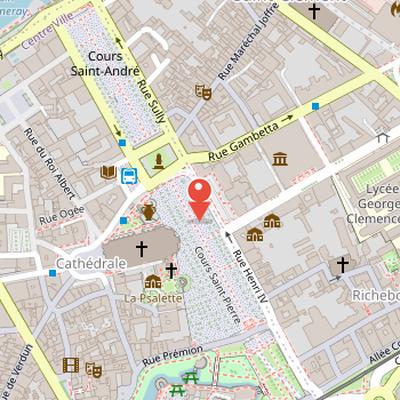
Cours Saint-Pierre and Cours Saint-André are public promenades in Nantes and were among the city’s first public promenades. They were established on former vacant lands outside the city walls. Located in the city center, they consist of two courtyards, Saint-Pierre to the south and Saint-André to the north, arranged in a row on a slope and separated by Place Maréchal-Foch.
Together, the two courtyards form a wide, tree-planted perspective between Quai Ceineray and Place Duchesse-Anne. Quai Ceineray faces the Erdre River, while Place Duchesse-Anne was formerly bordered by a branch of the Loire River; only the Canal Saint-Félix remains of that branch. The promenade can be reached from Rue Prémion, opposite Place Duchesse-Anne, by a wide staircase at the south end, decorated in 1897 with a war memorial by Georges Bareau dedicated to soldiers from the department who fell in the 1870 war. Another staircase at the southwest corner also leads to Rue Prémion. The west side is bordered by Porte Saint-Pierre, the cathedral chevet, the Manoir de la Psallette, and neighboring walls, with remains of Gallo-Roman and medieval city walls visible there. The east side borders Rue Henri-IV, on a slope, with stairs connecting the two.
Nearby Objects
-
 Nantes Cathedral 90 m away
 -
 Lamoricière cenotaph 90 m away
 -
 Tomb of Francis II 90 m away
 -
 Porte Saint-Pierre 100 m away
 -
 Colonne Louis-XVI 100 m away
Early Public Promenade in Nantes
The cours Saint-Pierre et Saint-Andre is located in Nantes. It was among the first public promenades in the city, and it was established on former vacant lands outside the city walls. This origin links the site to an early phase of urban public space formation in Nantes, when open land beyond the fortified boundary was adapted for public use.
Cours Saint-Pierre and Saint-Andre
Cours Saint-Pierre and Saint-Andre is located in the city center of Nantes. It consists of two courtyards, Saint-Pierre to the south and Saint-Andre to the north, arranged in a row on a slope and separated by Place Marechal-Foch. Together, they form a wide tree-planted perspective between Quai Ceineray and Place Duchesse-Anne. Quai Ceineray faces the Erdre River, while Place Duchesse-Anne was formerly bordered by a branch of the Loire River, of which only the Canal Saint-Felix remains.
The ensemble can be reached from Rue Premion facing Place Duchesse-Anne. A wide staircase leads up from Rue Premion at the south end, and it was decorated in 1897 with a war memorial by Georges Bareau dedicated to soldiers from the department who fell in the 1870 war. Another staircase at the southwest corner also connects to Rue Premion. On the east side, Rue Henri-IV runs along the slope and is reached by stairs from the site.
The west side is bordered by Porte Saint-Pierre, the chevet of the cathedral, the Manoir de la Psallette, and the walls of neighboring properties. Remains of the Gallo-Roman and medieval city walls are visible there. The north and south sides are both bordered by Place Marechal-Foch. The northern courtyard is also framed by Rue Sully on the east and Rue Tournefort on the west, both on slopes and both connected by stairs to the courtyard. It ends with a parapet overlooking Quai Ceineray.
First World War Memorial
A war memorial dedicated to the victims of the First World War is located on a retaining wall below the parapet at Situation et acces. Designed by Camille Robida, it takes the form of a list of the names of Nantes residents who died in the conflict. Its placement on the wall makes it a visible part of the site, while its memorial format gives the location a commemorative function.
Origins of the Name
Cours Saint-AndrA owes its name to a chapel founded in the 16th century, which was located on what is now rue Prefet-Bonnefoy. Cours Saint-Pierre takes its name from the first name of the nearby cathedral. This same name is also used for the square in front of the cathedral and for the Porte Saint-Pierre. The two cours therefore reflect nearby religious landmarks that shaped their identity.
From Antiquity to the Fairgrounds
The present courtyards of cours Saint-Pierre and Saint-André occupy an area that was once a vast wasteland in Antiquity. This landscape was marked by two mottes, Saint-Pierre and Saint-André, which served mainly defensive functions. The eastern side of the city lacked the natural barriers provided elsewhere by the Loire and Erdre rivers, and these motte areas were therefore left fallow to complement the city walls and dry moats.
The area was crossed by a Roman road near place Maréchal-Foch. From the 1st century AD, this road led to Juliomagus, the origin of Angers. Gallo-Romans placed funerary steles around the road, and steles were later reused in the floor of the Saint-Pierre gate during the construction of the Gallo-Roman enceinte in the 3rd century. The site also served as a Merovingian necropolis near the hotel d'Aux, rue Labouchere, and maison Minee.
In the Middle Ages, the northern part of cours Saint-Andre housed the Saint-Cyr-et-Sainte-Julitte cemetery, and this northern area later hosted a Protestant cemetery. The main landowner was the cathedral chapter, which controlled several uses of the land. In 1528, it granted land along the rampart of motte Saint-Andre for a rope factory, while requiring rent payment. The chapter also installed a gibbet on motte Saint-Andre in 1552, and executions took place there in 1555, 1640, 1668, and 1701.
The area was also associated with four fairs held on the days of Saint-Clair, Saint-Andre, Saint-Marc, and Saint-Antoine. These fairs were officially recognized by the king of France, and the cathedral chapter collected income from them. Motte Saint-Andre hosted cattle merchants during the fairs, while motte Saint-Pierre hosted potters and haberdashers. In 1760, the fairs moved to place Viarme, and the bastion of motte Saint-Pierre was destroyed. The motte was then leveled, covered with sand, planted with 300 elms, and enclosed by a wall.
Statues and River Works
According to the historical account, Mathurin Crucy, as successor to Ceineray, decided to install four statues at the two ends of the cours. Dominique Molknecht executed the statues of Bertrand du Guesclin and Olivier de Clisson in 1820, and these were installed at the north of cours Saint-Andre. Two statues representing Anne de Bretagne were made in 1822 and installed at the south of cours Saint-Pierre. The last two statues were removed in 1896 and reshaped in harder stone.
The same history also records major changes to the nearby water system. Before the filling works began in 1926, the Loire passed beneath the chateau des ducs de Bretagne. The canal Saint-Felix borders place Duchesse-Anne near the current tramway station. From 1929 to 1933, the Saint-Felix tunnel was dug beneath the cours to divert the Erdre river from its natural bed. The Erdre now flows into the shorter canal Saint-Felix by about 100 meters.
Historical Background
The Historique notes that the project was part of the German war debt resulting from World War I. It also identifies the engineer Karl Hotz as the supervisor of the project. Hotz is described as the future head of the Nantes SD under German occupation during World War II. The same source states that he was assassinated near rue du Roi-Albert, and links this event to the execution of 48 hostages in Nantes, Paris, and Chateaubriant.
Postwar Uses and Later Changes
After World War II, the cours were occupied by temporary barracks: those on Cours Saint-Andre were built in stone, while those on Cours Saint-Pierre were built in wood. These barracks served as shops for merchants affected by the bombings that devastated the city center. Much later, the 1998 World Cup gave Cours Saint-Andre a temporary transformation into a Copacabana beach setting, and Cours Saint-Pierre hosted one of two giant screens used to show live matches. In 2006, an underground parking structure was completed under Cours Saint-Andre, replacing surface parking, and the cours regained their original appearance after the work. Today, the area is planted with chestnut and oak trees. The spring fair takes place each year only on Cours Saint-Pierre, while the September fair extends across both cours.