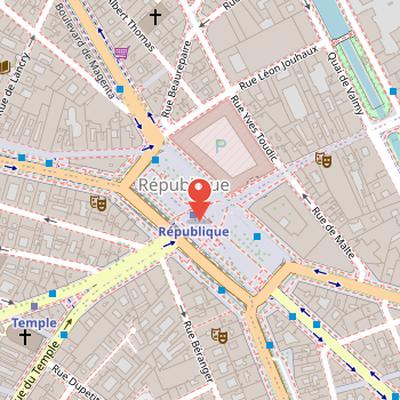
The Monument to the Republic, also known as Il Monumento alla Repubblica, Monument à la République, and Statua della Repubblica, is a monumental statuary complex created by Léopold and Charles Morice and inaugurated in 1883 in Place de la République in Paris. It stands at the center of the square, at the convergence of the III, X, and XI arrondissements, aligned with rue du Temple to the southwest and rue du Faubourg-du-Temple to the northeast. The ensemble represents an allegory of the French Republic.
At its core is a 9.5-meter bronze figure of the Republic personified as Marianne, cast by the Thiébaut Frères foundry. She stands on a 15.5-meter stone pedestal designed by Charles Morice. The statue is shown upright, draped in a classical toga, wearing a Phrygian cap and laurel crown, and holding an olive branch and a tablet inscribed “Diritti umani.” The pedestal base includes three stone statues symbolizing Liberty, Equality, and Fraternity, twelve bronze bas-reliefs, a bronze lion, and decorative inscriptions and medallions. A cylindrical basin added in 2013 surrounds the monument at ground level.
Nearby Objects
-
 Place de la République 30 m away
 -
 Cirque Olympique 50 m away
 -
 Temple 250 m away
 -
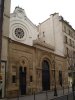 Synagogue de Nazareth 300 m away
 -
 École Duperré 300 m away
Monument Name and Inauguration
The Monument to the Republic is also known as Il Monumento alla Repubblica, Monument a la Republique, and Statua della Repubblica. It is a monumental statuary complex created by Leopold and Charles Morice. The work was inaugurated in 1883 in Place de la Republique in Paris, France. It represents an allegory of the French Republic.
Location of the Monument to the Republic
The Monument to the Republic stands at the center of Place de la Republique in Paris, at the convergence of the 3rd, 10th, and 11th arrondissements. Its position also follows the alignment of rue du Temple to the southwest and rue du Faubourg-du-Temple to the northeast. This placement gives the monument a central role within the square and links it directly to the surrounding street pattern.
Design and Symbolism
The Monument to the Republic is a large sculptural ensemble centered on a bronze allegory of the Republic, or Marianne, standing 9.5 meters tall on a 15.5-meter stone pedestal. The pedestal, designed by architect Charles Morice, is built in two stacked cylindrical sections: a lower, wider base about 4 meters high and a slimmer upper section that supports the main statue. The whole monument has a base diameter of about 13 meters.
Marianne is shown upright and draped in a classical toga, with a belt securing a sword. She wears a Phrygian cap, symbol of liberty, and a laurel crown. In her right hand she holds an olive branch, representing universal peace, while her left hand rests on a tablet inscribed with the words Diritti umani. The bronze castings were made by the Thiiebaut Freres artistic foundry in 1883.
At the pedestal base are three stone statues symbolizing Liberty, Equality, and Fraternity. The base also includes a bronze wreath around the perimeter, the city of Paris emblem, and the dedication inscription Alla gloria della Repubblica francese - La citta di Parigi - 1883. Two decorative medallions inscribed Lavoro and Pace are placed between the figures, and they are adorned with fasces symbols representing republican authority and civic cohesion.
Around the pedestal at eye level are twelve bronze bas-reliefs by sculptor Leopold Morice. They form a visual chronology of major events in French Republic history from 1789 to 1880. The ensemble also includes a bronze lion statue 3 meters tall at ground level, accompanied by an election urn. The lion symbolizes strength and vigilance linked to universal suffrage, while the urn refers to the right to vote. In 2013, the monument was additionally surrounded at ground level by a cylindrical basin about 1 meter wide.
From Fortress Bastion to Urban Square
The area now occupied by Place de la Republique was once the bastion of Porte du Temple, part of the fortifications of the city wall of Charles V. The square assumed its current configuration in the 19th century, during the period of urban restructuring promoted by Baron Haussmann under the Second Empire. In 1811, it was named Place du Chateau-d'Eau and was adorned with the fontaine du Chateau d'eau by Pierre-Simon Girard. This fountain remained a defining feature of the square until 1985, when it was moved to La Villette in Place de la Fontaine-aux-Lions. It was then replaced by a larger fountain designed by Gabriel Davioud.
Design and Historical Development
The Monument to the Republic was conceived in the political context that followed the proclamation of the Third Republic in 1870, after the fall of the Second Empire. In 1878, the Paris city council proposed a Republic monument for the eastern part of the city, and the order for the work was issued in 1879. Administrative management of Paris was then mainly entrusted to the Prefect of the Seine, and the council backed a Republic figure wearing a Phrygian cap even though the government prohibited this detail.
A competition for the monument was won by the Morice brothers, with Leopold Morice responsible for the statue and Charles Morice for the base. Jules Dalou placed second and later created Le Triomphe de la Republique, which was installed at Place de la Nation and inaugurated in 1899. Both monuments were cast at the Thiiebaut Freres artistic foundry.
The project was publicly presented in stages. A plaster model of the monument was shown in the square on July 14, 1880, an event later immortalized by Alfred Roll in a painting completed in 1882. The bronze monument, also cast by Thiiebaut Freres, was inaugurated on July 14, 1883. The square was officially renamed Place de la Republique in 1889.
The monument originally carried four large iron flagpoles, each 25 meters tall with bronze bases. These were removed in 1988 because of structural safety concerns in storms. During urban redevelopment in 2013, the base was surrounded by a cylindrical water basin. The entire monument was officially listed as a French historical monument on January 28, 2021.