Place de la République is a public square in Paris, France, situated between the 3rd, 10th, and 11th arrondissements. Covering 3.4 hectares, it marks the junction of several important arteries in the capital and serves as an important public transportation hub. It has been named in honor of the French Third Republic since 1879 and was previously called Place du Château-d'Eau. The square is one of the most emblematic in the city and is associated with the symbol of the French Third Republic. It frequently serves as a venue for popular, cultural, and political demonstrations, including gatherings promoted by unions, associations, and left-wing political organizations. Fully renovated and revitalized between 2010 and 2013, it is currently accessible exclusively to pedestrians and cyclists.
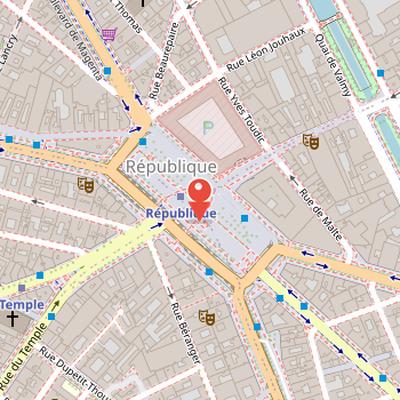
Nearby Objects
-
 Cirque Olympique 20 m away
 -
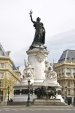 Monument to the Republic 30 m away
 -
 Temple 250 m away
 -
 Synagogue de Nazareth 300 m away
 -
 École Duperré 300 m away
Place de la Republique
Place de la Republique is a public square in Paris, France, located between the 3rd, 10th, and 11th arrondissements. It covers 3.4 hectares and marks the junction of several important arteries in the capital, which also makes it an important public transportation hub. Since 1879, it has carried the name of the French Third Republic, replacing its former name, Place du Chateau-d'Eau. The square is one of the most emblematic in the city and is associated with the symbol of the French Third Republic.
The square is frequently used as a venue for popular, cultural, and political demonstrations. It regularly hosts demonstrations promoted by unions, associations, and left-wing political organizations, reflecting its role as a public gathering place in Paris. Between 2010 and 2013, Place de la Republique was fully renovated and revitalized. It is currently accessible exclusively to pedestrians and cyclists, which shapes its present use as an urban public space.
From the Temple Enclosure to the Modern Square
Place de la Republique occupies the former site of the Porta do Templo, an exit gate of Paris that had existed since the 12th century. The gate stood in front of the headquarters of the Order of the Templars, a complex that included a church, a tower, a stable, and lodgings for templar monk-soldiers. The site also served as storage for the French royal treasury. Although the Templars were later dissolved and the headquarters acquired other uses, the tower remained standing for many centuries before it was demolished in 1808 by Bonaparte after the French Revolution. The area continued to be known as Temple, preserving the name in Rue du Temple, one of the oldest streets in Paris. The land freed by the former complex then became a junction of several boulevards. A symbolic step in the creation of the square came in 1811 with the installation of the Fontaine du Chateau d'eau at the junction. Designed by architect Pierre-Simon Girard, the fountain formed a traffic island shaped as a roundabout, was adorned with cast bronze lions made at the Creusot foundry, and also supplied water to nearby residents. It helped beautify the neighborhood and attracted real estate activity. The Esplanade du Chateau d'eau became increasingly frequented and urbanized, while Boulevard du Temple developed as a festive and popular address with theaters, including the Theatre-Lyrique founded by Alexandre Dumas in 1847. In 1854, the Caserne du Chateau d'Eau, later called Caserne Jean-Verines, was built for 3,200 men to centralize troops previously spread across the city. The barracks, occupied by the Republican Guard since 1947, still remain on the site and continue to shape the square's appearance.
The Magasins reunis Department Store
Historia designed a large department store for the Magasins reunis network on the right side of the barracks. The building was conceived as a homogeneous addition to the barracks and was intended as an ancestor to Galeria Lafayette. Historia planned it to bring luxury from the west side to the east side of the city, while also ensuring that it could be easily converted into residential use if the commercial gallery failed. The store opened but soon went bankrupt, which was linked to the predominantly popular character of the neighborhood. Even so, Historia treated the Magasins reunis building as a permanent part of the local landscape, together with the barracks building.
Republican Monument and Public Space
The history of Place de la Republique is closely tied to the political identity of the Third French Republic, established in 1870 as what História describes as the first actual republican government in France. In this account, the period is presented as a republican moment defined by democratic identity, secularism, and the right to strike, and as the birth of France as a political nation with the first socialist government experience. These values also shaped Parisian urbanism by reaffirming the square's popular character.
Before the monument now associated with the square, the state planned to create a picturesque garden there, intended to contrast with what was described as previous elitist monotony. In 1883, a large Monument to the Republic was established on the site of the second lion fountain, which was dismantled and moved to Place Felix Eboue near the Daumesnil metro station. The chosen location was then known as Place du Chateau d'eau. The municipal council described it as frequented by a working population devoted to the values of the republic, and the aim was to make it a site of opposition to Place de la Concorde and other bourgeois public spaces in the west of Paris, which were said to benefit only the wealthy and idle.
Six years after the statue's inauguration, the square was renamed Place de la Republique. História notes that it remained a popular venue for mass mobilizations in the capital, especially nationalist mobilizations linked to republican values. The square later received a reform that gave it the configuration it retained until 2010. Under this plan, the monument to the Republic was installed as a traffic island between two garden sections, and the architectural arrangement transformed the site from three fragmented sectors into a large open space dedicated to leisure, meetings, and pedestrians.
The reform was not unanimously accepted by Parisians. While some considered it satisfactory, a significant portion reacted with indignation. Le Figaro described the result as aesthetically banal and compared the square to a second-rate German industrial town center. The newspaper also called the project a tragic error and official vandalism, arguing that it showed disrespect for the site's historical memory and denouncing the installation of dubious modernism. It also raised concerns about the future of traffic after the closure of the roundabout around the Monument to the Republic, as well as the fate of two small traditional Dolphin Fountains removed from their long-standing location. These fountains were relocated to the Champs-Elysees avenue, with one placed in a water basin next to the Grand Palais and the other beside the Petit Palais near the Champs Elysees-Clemenceau metro station exit.
Since its reopening, the square has served as headquarters for diverse cultural and festive events. Among its civic uses, the Marcha Republicana stands out as the most remarkable, described as unprecedented and as the largest demonstration in French history, held in response to the terrorist attacks in Paris in January 2015.
The Monument to the Republic
The Monument to the Republic is a large statuary ensemble located at the center of the square. It was designed by the brothers Leopold Morice and Charles Morice, and its model won the public contest organized in 1879. A provisional plaster model was inaugurated in 1880, followed by the definitive bronze version in 1883. Two inauguration ceremonies were held on different July 14 dates.
The monument is organized in three distinct parts: the statue of the Republic at the top, the column in the middle, and the pedestal at the base. The main figure is a colossal statue representing the Republic, also called Marianne in France, measuring 9.50 meters in height. It stands on a stone column 15 meters tall. The statue holds an olive branch above its head in its right hand and a tablet inscribed "direitos do homem" in its left hand.
The column is decorated with three allegorical statues representing Liberty, Equality, and Fraternity. Beneath the colossal statue, it is adorned with bronze flowers and a wreath at the statue's feet, and the front face displays the Paris city coat of arms below the wreath. The column is inscribed with "A la gloire de la Republique Francaise - La ville de Paris - 1883".
The pedestal is surrounded by 12 bronze bas-reliefs representing key dates and events of the French Republic. At the pedestal level, there is also a lion and an electoral urn. In 2013, the monument was surrounded by a cylindrical fountain, adding a further element to the ensemble.
Symbolic Program and Pedestal Design
The monument at place de la Republique combines symbolic figure, sculptural reliefs, and pedestal elements to present a clear republican program. Its head is crowned with a laurel wreath and a Phrygian Cap, the latter symbolizing liberty. The Phrygian Cap was politically contested: the central French government initially banned its display, while left-wing moderates found it disagreeable because of its association with the sans-culottes movement of 1793. During the decision over the monument's representation, the Paris municipal council had a left-radical majority and insisted on including the Phrygian Cap to assert its heritage from the Commune de Paris. In 1880, the figure was regarded as provocative, and President Jules Grevy feared that its symbol could trigger an eruption of violence.
The pedestal is made of stone and decorated with twelve bronze high-reliefs by Leopold Morice, linked by rosettes. These reliefs are placed at the eye level of passersby and form a chronology of key events in French republican history between 1789 and 1880. Among the events shown are the Tennis Court Oath, the abolition of slavery, the extinction of the monarchy, and the Taking of the Bastille. Each relief has the date of the represented event displayed above it. At ground level, a standing lion in an alert posture faces an electoral urn, symbolizing the people's strength and power exercised through universal suffrage. The lion was removed for maintenance between 2010 and 2013 and then re-installed.