Saint William's Church, also called Wilhelmerkirche in German, is a Gothic church in Strasbourg located at the junction of the Bateliers and Pêcheurs quays, on the edge of the Ill river. It has hosted Lutheran worship since 1534 and belongs to the Union of Protestant Churches of Alsace and Lorraine. The church is notable for its unusual, skewed appearance on the exterior and for an interior that combines Gothic and Baroque styles. Its vestibule includes a Gothic portal, and fragments of a rood screen from 1485 are visible. The building, including the rood screen and stained glass windows, is registered as a historic monument. The parish also promotes LGBT people through the Inclusive Antenna Saint-Guillaume.
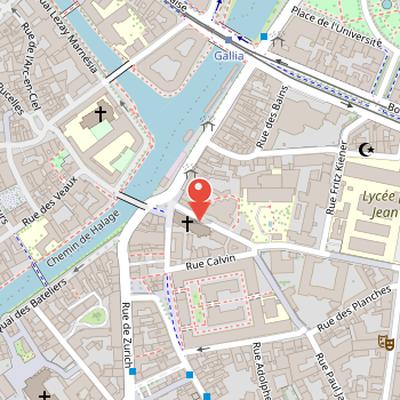
Nearby Objects
-
 Haute école des arts du Rhin 110 m away
 -
 Saint Stephen’s Church 200 m away
 -
 Musée archéologique de Strasbourg 400 m away
 -
 Musée des Beaux-Arts de Strasbourg 450 m away
 -
 Palais Rohan 450 m away
Architecture and Setting
Saint William's Church, also called Wilhelmerkirche in German, is a Gothic church in Strasbourg. It stands at the junction of the Bateliers and Pêcheurs quays, in a picturesque position on the edge of the Ill river. The church has hosted Lutheran worship since 1534, giving it a long-standing role in the religious life of the city.
Architecturally, the exterior has a skewed appearance, while the interior combines Gothic and Baroque styles. This mix of forms gives the church a distinct character within Strasbourg's historic landscape. The parish is a member of the Union of Protestant Churches of Alsace and Lorraine, and the church also promotes LGBT people through the Inclusive Antenna Saint-Guillaume.
History and Architecture of Saint William's Church
Saint William's Church originated as part of a convent of Guillemites monks established in a marshy area outside the city walls around 1298. The elongated building was consecrated in 1301 and completed in 1307, and it remains the only surviving element of the former ensemble. The church was built entirely of brick and is described as having a single nave design, with a gabled roof, a vaulted nave, and a deep polygonal choir with tall windows. Its position is slightly askew because of unstable soil conditions.
The church became associated with the citys river workers when the Bateliers corporation, near the port and docks, chose it as a parish in 1331. In the 15th century, the convent entered a less prosperous period, and in 1524 the Bateliers requested an evangelical preacher. Despite opposition from the monks, the convent held its first Protestant service in 1534. After the convent closed in 1553, it was converted into a dormitory for the prestigious gymnasium, and the church became one of the seven Lutheran parishes of the city.
Later additions altered the exterior. The bell tower was constructed in 1667 as a spire linking the three gables of the main facade, while the old trapezoidal porch made the tower asymmetrical. Inside, the vestibule contains a Gothic portal, and fragments of a rood screen from 1485 are visible. The church, including the rood screen and stained glass windows, is registered as a historic monument.
Choir and Inclusive Ministry
In 1885, the organist Ernest Munch founded the Saint-Guillaume choir at Saint William's Church. The choir later gained a reputation beyond Alsace and was conducted by figures including Wilhelm Furtwangler and John Eliot Gardiner. The church also became known for inclusive initiatives in the 21st century. In 2013, pastor Christophe Kocher organized a prayer before Strasbourg's Pride March. In 2016, the church founded the inclusive Saint-Guillaume branch as a welcoming place for LGBTQ+ Christians and invited pastor Nadia Bolz-Weber to preach at its founding. After UEPAL authorized it in 2019, the church committed itself to blessing same-sex couples.
Interior Furnishings and Memorials
Saint William's Church contains a rich group of preserved liturgical furnishings and funerary monuments. The main altar was made in stucco in 1767, and it is accompanied by a wrought iron enclosure created in 1803. The pulpit, dated 1656, is carved and gilded wood and is designed in cartilage style, supported by a pelican. A carved, polychrome painted, and gilded chestnut panel from the first quarter of the century and a panel representing the conversion of Guillaume d'Aquitaine are also part of the church's furnishings; the latter is classified as a historical monument as an object. The celebrant's seat, carved in wood in 1672, adds to this ensemble. The main altar, the wrought iron enclosure, and the pulpit have been listed as historical monuments since 1987 as objects.
The church also preserves numerous medieval funerary slabs in the nave and behind the choir. Among the memorials is the double tomb of brothers Philippe and Ulrich von Werd, landgraves of Alsace, made in red sandstone with superimposed gisants by the sculptor Woelflin of Rouffach. It is decorated with an enfeu and a mural painting. North of the nave are enfeus dating from the end of the 14th century, including a carefully made enfeu representing a dog on the left side, sometimes attributed to Hans Hammer, architect and sculptor at Notre-Dame Cathedral. Another important commemorative set consists of twenty-eight polychrome gilded metal armorial plaques honoring parish administrators, including Strasbourg bourgeois, council members, pastors, and deacons. Each plaque records election details and ages, and around 1900 they were assembled on a wooden panel with a twenty-ninth plaque for Henri de Mullenheim. These plaques are classified as historical monuments as objects.
Architectural features also reflect the church's historical adaptation. The porch was restored in 1488 during the convent's restructuring, with statues removed and only canopies and corbels preserved. Its corbels show both religious and profane scenes, including Saint Margaret and the dragon and a welcoming mermaid. The porch is the only vaulted part of the church, with rib vaults and a celestial vault whose keys are decorated with the sun, moon, and stars. Tribunes were constructed in 1589 and 1636 to accommodate Protestant faithful in an expanding district.
The Jubee and Choir Arrangement
Saint William's Church includes a jubee dating from 1485, which cuts the choir in its middle. At first, this architectural feature separated the monks' choir from the nave used by the faithful. In 1656, the jubee was moved backward and its sides were truncated. Even in this altered form, it still preserves the beginning of the bays that were destroyed.
Organ and Interior Features
Saint William's Church includes sculpted keystones representing God the Father and the symbols of the four Evangelists. Its interior houses an oak organ by Andre Silbermann, identified as the oldest Silbermann organ in Strasbourg remaining in place. Only the 1728 baroque organ case survives in its original state. The grand organ and the positive have been classified as historical monuments since 1975 as objects. The church's good acoustics have also supported classical music performances and Johann Sebastian Bach's passions since the end of the 20th century. Cyril Pallaud has served as titular organist since 2019.
Stained Glass and Interior Paintings
Saint William's Church contains a rich interior ensemble of paintings and stained glass. The architecture includes a set of four paintings by Andre Widemann, painted in 1745-1746, each placed in rococo frames and representing the Deposition of the Holy Cross, Saint James the Greater, Saint Andrew, and Saint Simon. It also preserves a painting of the Last Supper dating from the second half of the 16th century.
The nave is lit by many stained glass windows from the golden age of Gothic and late Gothic. The west window in the choir entrance is described as the last witness of the first glazing around 1310. It formerly stood in the choir axis and depicted the Life of Christ from the Annunciation to the Resurrection, with the Jesse Tree at the base. The nave windows show marks of third quarter 19th-century restorations, and the stained glass later suffered from natural disasters, wars, and mutilations by 20th-century restorers. The north panels remain almost intact.
Among the stained glass windows, the third window from the back shows the hagiography of two saints named Saint William. On the left, Saint William of Aquitaine abandons military life for asceticism, while on the right Saint William of Malavalle appears as a pilgrim and hermit. This set is attributed to the Master of Walbourg and dates from 1461. The first two windows show the life of Saint Catherine of Alexandria, with scenes attributed to Pierre Hemmel d'Andlau. Two other stained glass windows were later added to the north side: a smaller Swiss-style window representing the Crucifixion with extreme minuteness, and a more monumental Calvary. Another window represents the Marriage at Cana and includes portraits of Protestant personalities from the late period.
At the back of the nave, a door on the left leads to the sacristy, which contains several interesting objects. These include an engraving on the left showing the facade of the church before 1667 and a painting on the right wall by a parishioner presenting an interior view of Saint-Guillaume from the 17th century. The church also features a fully painted rood screen and galleries covered with paintings that are difficult to recognize.
Bell Tower and Inscribed Stone
Saint William's Church is notable for its bell tower, which can appear off-center from some angles. The tower is topped with a weathercock and a cross-shaped anchor. The anchor recalls the former association of the parish with the boatmen's brotherhood in the 17th century. Near the weathercock, an inscription is engraved in stone, described as the last trace of convent buildings constructed in 1502. The stone bears the phrase, 'Wolt ich arbeiten, ich wer ein Wilhelmer worde.' The church also has a bronze bell cast in 1755 by Ernest Frédéric Puffendorff, which is classified as a historical monument as an object. The anchor on the bell tower also gave its name to Ancre beer brewed by Brasserie de l'Espérance.