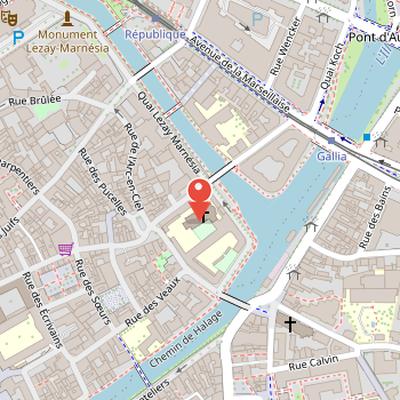
Saint Stephen’s Church is located at Place Saint-Étienne in the episcopal college courtyard in Strasbourg’s historic center. Classified as a historical monument since 1862, it has a long and layered history tied to the religious development of the site. The area was originally a Roman sanctuary dedicated to Mercure and was used by Christians from the 4th century. A basilica was built there in the 5th century, and the site later saw the first cathedral of the city built by Bishop Arbogast in the 6th century. The crypt contains remains of the 5th-century Roman basilica. The abbey church was rebuilt in 1220 in Romano-Gothic style, and the monastery later became a chapter of secular canonesses in the 16th century. After being returned to Catholic worship in 1687, the building underwent further changes of use, including conversion into a municipal theater in 1805 and occupation by a minor seminary from 1821 to 1874.
Nearby Objects
-
 Saint William's Church 200 m away
 -
 Haute école des arts du Rhin 250 m away
 -
 Musée Tomi Ungerer 250 m away
 -
 Palace of the Alsace-Lorraine Diet 300 m away
 -
 Hôtel des Deux-Ponts 350 m away
Location and Heritage Status
Saint Stephen's Church in Strasbourg is located on Place Saint-Etienne, in the courtyard of the episcopal college in the historic center of Strasbourg. The church has been classified as a historical monument since 1862, which highlights its recognized heritage value within the city.
From Roman Sanctuary to Church
The site of Saint Stephen's Church in Strasbourg has a long history of reuse and rebuilding. It was originally a Roman sanctuary dedicated to Mercure, and Christians began using the site from the 4th century. A basilica was built there in the 5th century, and in the 6th century Bishop Arbogast had the city's first cathedral constructed on the site. The crypt of the present complex contains remains of the 5th-century Roman basilica, and in 1956 a Merovingian apse was discovered under the old tower foundations. A tradition recorded in the Strassburgische Cronica de Königshofen said the church stood on the ruins of a Roman count's fortified palace.
The Benedictine abbey was founded in 718 by Duke Adalbert d'Alsace, with Saint Attale, his daughter, as the first abbess. A charter by Lothaire from 845 mentioned a founding date of 722, although Jean-Jacques Hatt identified this charter as falsified. The abbey church was rebuilt in 1220 in Romano-Gothic style. In the 16th century the monastery was transformed into a chapter of secular canonesses, and in 1541 the canonesses revolted against the bishop's authority and converted to Protestant Reformation.
After Strasbourg was besieged and surrendered in 1681, the site was returned to Catholic worship in 1687. The Antonins occupied it first, then the Visitandines replaced them in 1702. The Visitandines opened a boarding school for noble girls in 1718. Religious women were expelled in 1792, the church lost its bell tower in 1802, and in 1805 the building was converted into a municipal theater. From 1821 to 1874, the building was occupied by a minor seminary.
Wartime Reassignment of Worship
In 1940, Adolf Hitler forbade worship at Strasbourg Cathedral and intended to convert it into a national monument. As a result, parishioners of the cathedral were directed to the Saint-Etienne college chapel. In 1942, Archpriest Eugene Fischer was installed there, marking the chapel's role in the relocation of worship during this period.
Damage and Reconstruction
Allied bombings in 1944 caused severe damage to Saint Stephen's Church, destroying the roof, pulpit, altar, organ, paintings, statues, and benches. Only the choir and nave remained standing after the attacks, and the building retains only the original wide vaulted transept with triple apse. In 1961, the church received a new nave with slender pillars and an exposed frame, while its facade was replaced by a bossage stone wall. The year 2018 marked the 1300th anniversary of the foundation of the abbey associated with the church.
The Church Organ
The nave of Saint Stephen's Church received an organ in 2016. This instrument had previously served as the old organ of the Strasbourg conservatory of music. It was made by Curt Schwenkedel in 1963 and had remained unused since 1995, when the Strasbourg conservatory moved from the former palace of the Diet of Alsace-Lorraine.