Le Zouave du pont de l'Alma, also called Le Zouave, is a stone statue created by Georges Diebolt in 1856. It is one of four sculptures representing troops from the Crimean War and was originally fixed on the piers of the former Pont de l’Alma in Paris. It is the only sculpture still remaining at the original Pont de l’Alma location.
The statue shows a soldier in a zouave uniform of North African regiments, with a fez, a short fitted jacket without buttons, a wide cloth belt, baggy trousers, gaiters, and leg guards. The figure is leaning against flags, resting on a rifle, and looking to the right in a slightly tilted position. It is often presented as representing André-Louis Gody, though other sources name a Breton called Nérigot or Bérizot as the model.
The bridge was named after the Battle of Alma in Crimea, and the Zouave has remained on the upstream side of the bridge through later reconstruction.
Nearby Objects
-
 Flame of Liberty 90 m away
 -
 Place Diana 100 m away
 -
 Paris Sewer Museum 140 m away
 -
 Paris sewers 140 m away
 -
 Holy Trinity Cathedral 200 m away
Le Zouave and the Pont de l'Alma
Le Zouave, also called the Zouave du pont de l'Alma, is a stone statue created by Georges Diebolt in 1856. It was one of four sculptures representing troops from the Crimean War. The statue was originally fixed on the piers of the former pont de l'Alma in Paris. It is the only sculpture that remains today at the original pont de l'Alma location.
The Figure and Its Soldier Model
The statue is often presented as depicting André-Louis Gody, who was born in 1828 in Gravelines and died there in 1896. According to one account, Napoleo n III reportedly noticed him during a review, which led to his being taken as the model for the work. Other sources, however, identify a Breton named Nergot or Berizot as the model.
In the sculpture, the figure is shown in a zouave uniform associated with North African regiments. The costume includes a fez, a short fitted jacket without buttons, a wide cloth belt, baggy trousers, gaiters, and leg guards. The pose is informal and slightly inclined: the figure leans against flags, rests on a rifle, and looks to the right with a slight tilt.
The Zouave and the Alma Bridge
The bridge takes its name from the Battle of Alma in Crimea, won in 1854 by English, French, and Ottoman Turkish forces against the Russians. The Zouaves regiment was noted in that battle for capturing enemy cannons, which helps explain the statue's association with the bridge. The bridge was rebuilt between 1970 and 1974 because the original structure was too narrow and was settling. During this reconstruction, the Chasseur a pied, Artilleur, and Grenadier statues were moved to other sites, while only the Zouave statue was preserved. The new bridge was built with only one pier on the right bank. Histoire also states that the Zouave statue was not moved from downstream to upstream during the works; historian Jean-Luc Pinol and a 1924 flood photograph indicate that it had already been on the upstream side of the bridge.
Location at the Pont de l'Alma
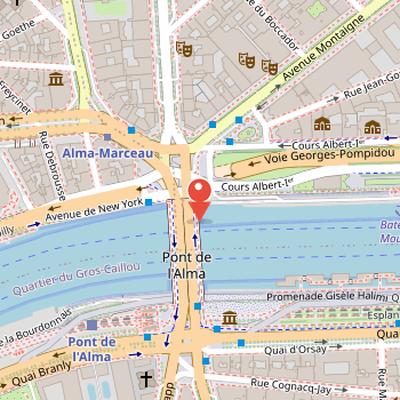
The Zouave du pont de l'Alma is located at Le Zouave, at the foot of the Pont de l'Alma. It stands on the upstream side of the bridge pile on the right bank side. Its position has always been on the upstream side of the Pont de l'Alma. The site is served by the Alma-Marceau metro station.
Flood Marker and Popular Reference
The Zouave du pont de l'Alma has become a familiar popular marker for the level of the Seine in Paris. A common tradition holds that when the Zouave has its feet in the water, the river is in flood. During the historic flood of 1910, the water rose to the statue's shoulders, making it a widely noted reference point for the scale of flooding.
Its present level is linked to changes made during the 1970 bridge reconstruction and the statue's relocation, although there is uncertainty about whether it was raised or lowered. Culture populaire notes that different reference systems help explain this uncertainty. It uses the NGF-IGN69 reference from 1969, which is higher in Paris, and records two possible errors stemming from differences between City of Paris and IGN map NGF levels. The City of Paris gives the difference between NGF-Lallemand and NGF-IGN69 as 0.378 meters, while the IGN map gives 0.336 meters. For this reason, comparing the importance of floods on the basis of the latter measurement is considered unreliable. For scientists, the reference scale is the hydrometric scale at the Pont d'Austerlitz.
The statue has had its feet in the water during several floods, including those of 1910, 1924, 1945, 1955, 1982, 1988, 1995, 1999, 2001, 2013, 2016, and 2018. Beyond flood monitoring, the Zouave has also entered popular culture through references such as La Croix's note that Louis Duval-Arnould physically resembled the statue, Xavier Vallat's use of the nickname Zouave for a political colleague because of a small beard, the song Le Zouave de ma grand-mere by Jeanne Aubert, and Roger Bordier's 2001 novel named after the statue.