The BnF Museum, also known as the Cabinet des médailles and Cabinet du roi, conserves, communicates, and showcases the numismatic and antiquities collections of the Bibliothèque nationale de France. It is the heir of the Cabinet des médailles des rois de France and is considered one of the oldest French museums. The institution opened to scholars in the mid-18th century and to a wider public in 1791, while keeping its original name.
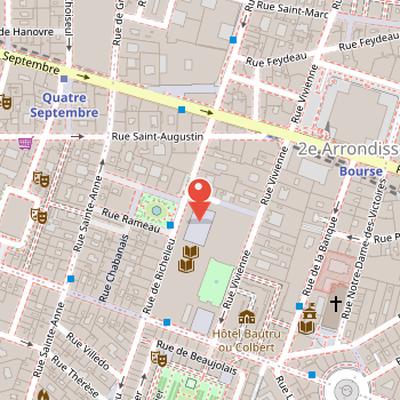
Its collections include jewelry, engraved stones, sculptures, ceramics, and medals. They were assembled by French kings since the Middle Ages and initially served royal pleasure and as a metal reserve. The collection was distinguished from the royal domain and heritage at Château de Fontainebleau by François, while Catherine de Médicis continued the first collection after him. Charles IX created the office of garde particulier des médailles et antiques du roi for its protection, and Pierre-Antoine de Rascas de Bagarris was the first notable garde appointed by Henri IV. The cabinet later expanded under Gaston d’Orléans, including Childéric’s treasure, and was transferred through several royal sites before opening in Paris. It is located at 58 rue de Richelieu and 5 rue Vivienne, in the 2nd arrondissement of Paris.
Nearby Objects
-
 Galerie Vivienne 160 m away
 -
 Théâtre du Palais-Royal 200 m away
 -
 Notre-Dame-des-Victoires 200 m away
 -
 Théâtre des Bouffes-Parisiens 250 m away
 -
 Equestrian statue of Louis XIV 300 m away
History and Location of the BnF Museum
The BnF Museum conserves, communicates, and showcases the numismatic and antiquities collections of the Bibliotheque nationale de France. It is also known as the Cabinet des medailles and the Cabinet du roi, and is the heir of the Cabinet des medailles des rois de France. As one of the oldest French museums, it opened to scholars in the mid-18th century and to a wider public in 1791. The museum kept its original name and is located at 58 rue de Richelieu and 5 rue Vivienne, in the 2nd arrondissement of Paris.
The Cabinet of Histoire and its Collections
The collections known as Histoire include jewelry, engraved stones, sculptures, ceramics, and medals, and they are now held at the Bibliotheque nationale de France. They were assembled by French kings from the Middle Ages onward and first served both royal pleasure and the function of a metal reserve. At Chateau de Fontainebleau, Francois distinguished the collection from the royal domain and heritage, giving it a clearer place within the crown's possessions. Catherine de Medecis continued the first collection after Francois, and Charles IX later created the office of garde particulier des medailles et antiques du roi to protect it. Under Henri IV, Pierre-Antoine de Rascas de Bagarris became the first notable garde, and the cabinet expanded further under Gaston d'Orleans through many acquisitions, including Childic's treasure, which Leopold gave to Histoire in 1665. Abbé Breunot was appointed intendant of the cabinet, but he was attacked and killed by an intruder at Saint-Germain-en-Laye. The cabinet was then transferred to Chateau de Versailles, where a room was prepared for it and renovations supervised by Louvois in 1685 at a cost of 2900 livres. An illustrated critical inventory was later published by scholars. In 1717, Abbé de Louvois decided to move the cabinet from Versailles to Paris, and in 1741 it was relocated to the Hotel de Nevers on Rue de Richelieu, where it opened to the public.
Le Salon Louis XV and the Histoire Department
From 1720 to 1740, Jules-Robert de Cotte renovated the Histoire cabinet into Le Salon Louis XV. This room was destroyed in the 1860s during neighborhood redevelopment, but parts of it survived in the Histoire museum, including medal cabinets and paintings by Boucher, Natoire, and Van Loo. Between 1890 and 1913, Jean-Louis Pascal designed and built the current Histoire department, placing it in the new wing of the library on Rue Vivienne. Together with Ernest Babelon, he also recreated Le Salon Louis XV for Histoire, and the recreated salon was inaugurated in 1917.
Growth and relocation of the BnF Museum
The museum gained increasing renown through numerous donations and legacies, which expanded its collections over time. In 1776, the abb'e Barth'elmy added Joseph Pellerin's collection of ancient Greek coins by acquisition, and also incorporated antiques from the count of Caylus. Later, in 1862, antiques from the duke of Luynes were added. The museum, then known as Histoire's Cabinet, was an integral part of the Imperial Library and then the National Library. In 1917, it was installed on the first floor of the National Library building facing rue Vivienne. A later renovation plan for the Richelieu site provided for a larger museum, including the galerie Mazarine, the salle des Colonnes, and other rooms. The museum exhibits collections from all departments of the BNF, and it opened in an unspecified year.
Theft and Losses at the BnF Museum
Two major thefts occurred at the museum located in Histoire. The first took place at night while firefighters guarding under Histoire's Cabinet were sleeping. Thieves entered Histoire's Cabinet by using poles through the Colbert arcade. The stolen items were later listed in France and included the Grande sardonys, the Vase des Ptolemees, and the Calice Suger. Eight objects regarded as unsellable were taken in this theft, and the gold foot of the vase was never recovered. It had been melted down by the fence who received it.
A second theft occurred in early year, on the 6th day of that month. Among the stolen objects were gold coins, medals, the Coupe de Charlemagne, the royal ring of Childeric, and the sceptre of Louis le Debonnaire. Vidocq was called to investigate and uncovered a network involving a former convict and a Parisian jeweler linked to Delphine Jacquot d'Andelarre, who kept stolen pieces at her home before escaping to Switzerland. The museum suffered considerable losses, including collections of medallions of Louis XIV, some of Barthelemy's acquisitions, and a gold coin of 36 solidi weighing 164 grams from Emperor Justinian. Most of the pieces from the treasure of Childeric disappeared in the second theft. Conservator Raoul-Rochette was threatened with suspension but kept his position with help from Jean-Antoine Letronne.
Publications et recherches
Publications et recherches houses a significant documentary collection related to its collections, composed of books. It serves as the national reference for expertise in numismatics and glyptics, and it is also the headquarters of the Societe francaise de numismatique. The unit created the Trouvailles monetaires program in 1978 to list, study, value, and publish monetary discoveries in France. It has published the series Tresors monetaires, which includes 29 volumes and two supplements from 1979 to 2022, as well as the BNCMR (Bibliotheque Nationale. Catalogue des Monnaies de l'Empire Romain) from 1976.
Quelques Tresors at the Cabinet des Medailles
Quelques Tresors is a group of celebrated objects held at the Cabinet des medailles in Paris. The ensemble includes a Roman sardonyx cameo showing Julius Caesar, Augustus, Tiberius, and Germanicus, with a decorative mount from the 16th century, as well as a separate cameo of Augustus and the cameo of Valerian and Shapur. Among the historic and artistic pieces are the throne of Dagobert, the cup with centaur from the treasure of Berthouville, and the ivory chessboard of Charlemagne. The collection also contains the Coupe de Chosroes, also called the Coupe de Salomon, the vase of Geryon, and the famous cup of the Ptolemies. Other items include the treasure of Gourdon, the patere of Rennes, described as Roman goldsmith work, a marble crucifixion, and an Etruscan mirror featuring Herakles and Minerva. It also holds the cup of Arcesilas, a Greek kylix from Sparta painted by the painter of Arcesilas, the oliphant of the Carthusian monastery of Portes made of ivory, and the cameo of Valerian and Shapur. Together, these works represent a varied assemblage of ancient, medieval, and later objects preserved as part of the museum's treasure collections.
Selected Coins in Quelques Tresors
Quelques Tresors presents a small group of notable ancient coins from different cultures and periods. Among them are the Eukratideion, a gold coin of Bactria issued by King Eucratides I in the 2nd century BCE, and a gold stater of Vercingetorix. The display also includes Aes signatum, described as one of the oldest coins of Rome, made of bronze in the 3rd century BCE. Other highlights are a decadrachm of Syracuse by Evainete, considered a masterpiece of Greek numismatics, and a decadrachm or 5 shekels of Alexander the Great from an uncertain workshop. The group is completed by an aureus, a gold coin of Augustus.
Changing Custodians of the Cabinet
The BnF Museum was shaped by a long succession of custodial titles and responsibilities. In 1601, the role of intendant des medailles et antiques du roi is recorded, followed in 1660 by intendant du Cabinet des medailles et antiques du roi. By 1666, the position had become commis a la garde de la Bibliotheque et du Cabinet des medailles du roi, and under Louis XV the title of garde du Cabinet des medailles du roi was used. After 1795, the organization of the place included a conservateur-professeur and a conservateur-bibliothecaire, while a president du conservatoire or directeur oversaw the Cabinet des antiques et medailles. Rivalries among personnel continued until 1848, after which a conservateur en chef was appointed as director of the department of collections. These changes show a management history marked by evolving titles, shifting authority, and internal competition.