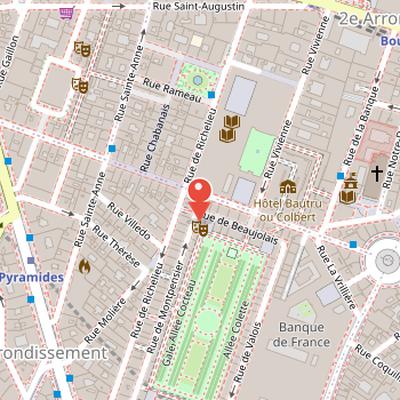
The Théâtre du Palais-Royal is a Parisian theatre with 750 seats, located at 38, rue de Montpensier, at the northwest corner of the Palais-Royal. It stands in the Galerie de Montpensier, at the intersection with the Galerie de Beaujolais. The building has a long history of changing functions and names. Originally called the Théâtre des Beaujolais, it was a puppet theater built in 1784 by architect Victor Louis. In 1790, under the management of Mademoiselle Montansier, it became the Théâtre Montansier and presented comedies and Italian operas translated into French. The stage and auditorium were enlarged in 1791 to increase capacity to 1,300 seats. After the 1807 Napoleonic theater decree, the theatre hosted light shows, and in 1812 it was converted into a café with shows. Renovated after the July Revolution and reopened as the Théâtre du Palais-Royal, it later became known for comedies, operettas, and other theatrical performances.
Nearby Objects
-
 Galerie Vivienne 150 m away
 -
 Cabinet des médailles 200 m away
 -
 Notre-Dame-des-Victoires 250 m away
 -
 Equestrian statue of Louis XIV 250 m away
 -
 Place des Victoires 250 m away
Location and Setting
The Theatre du Palais-Royal is a Parisian theater with 750 seats. It is located at 38, rue de Montpensier, at the northwest corner of the Palais-Royal. The theater is situated in the Galerie de Montpensier, at the intersection with the Galerie de Beaujolais. Its placement within this part of the Palais-Royal complex gives it a clearly defined urban setting in central Paris.
Early History and Changing Uses
The site that became the Théâtre du Palais-Royal began in 1784 as the Théâtre des Beaujolais, a puppet theater with about 750 seats designed by Victor Louis. In 1790, it was managed by Mademoiselle Montansier and renamed Théâtre Montansier, with performances of comedies and Italian operas translated into French. Louis enlarged the stage and auditorium in 1791, raising the capacity to 1,300 seats. After the 1807 Napoleonic theater decree, the venue was used for light entertainments including acrobatics, tightrope dancing, trained dog acts, and Neapolitan puppets. In 1812, it was converted into a cafe with shows. Following the July Revolution of 1830, Dormeuil and Poirson renovated it according to designs by architect Louis Regnier de Guerchy, and it reopened as the Théâtre du Palais-Royal with a license for comedies, vaudeville, and comedies meles d ariettes.
Theatre Programming and Repertoire
The Théâtre du Palais-Royal developed a strong identity through its repertoire of comedies and later more varied theatrical works. It presented early works by Hervé, who later became its principal conductor, and hosted the world premiere of Offenbach's Pascal et Chambord in 1839. The theatre became especially well known for the comedies of Eugene Labiche. In 1864, it abolished genre restrictions and began staging more ambitious productions, including operettas. Among its Offenbach performances were La demoiselle de Nanterre in 1862, Le brresilien in 1863, La Vie parisienne with Zulma Bouffar in 1866, and Le chateau a Toto with Bouffou in 1868. It also featured actresses such as Hortense Schneider and Virginie Dejazet.
The theatre's building underwent complete reconstruction in 1880 under architect Paul Sedille, when its only emergency exit was constructed. In the 20th century, Gustave Quinson directed the theatre from 1912 to 1942, presenting comedies by Tristan Bernard and Maurice Hennequin. Performers associated with the theatre included Mistinguett and Raimu. In the 1950s, it produced Paul Claudel's comedy Le soulier de satin with Jean-Louis Barrault and Madeleine Renaud, and later revived boulevard comedies by Marcel Achard, Feydeau, and Sacha Guitry. Other actors connected with the theatre included Daniel Auteuil, Jean-Claude Brialy, Jean-Claude Carriere, Pierre Dux, Edwige Feuillere, and Jean Marais. The theatre continues to stage comedies and other theatrical performances.
From Puppet Theater to Permanent Garden Complex
The Theatre des Beaujolais began in 1753 as a puppet theater in the northwest corner of the Palais-Royal gardens. It was created for children, including those of the Palais-Royal owner, the Duke of Orlans. In 1780, the property was transferred to Louis Philippe Joseph d'Orleans, Duke of Chartres, who expanded the site and made it permanent. The new project was designed by the architect Victor Louis, who also designed the Grand Theatre de Bordeaux. Construction began in 1781.
The redesigned complex was arranged as a garden surrounded on three sides by six-story condominiums. Shops, restaurants, and entertainment venues faced an interior colonnade, giving the site a mixed public character. The new garden complex opened to the public in 1784, and the inaugural performance took place on October 23, 1784. After this performance, it became popularly known as the Theatre des Beaujolais. Its official name was Theatre des Petits Comediens de Son Altesse Serenissime Monseigneur le Comte de Beaujolais, given by the Count of Beaujolais, the youngest son of the Duke.
Performance Style and Decline
Under the direction of Jean-Nicolas Gardeur, Théâtre des Beaujolais moved away from its original puppet shows, which had begun to lose popularity as adult entertainment. Gardeur replaced the puppets with child actors, while adult performers remained hidden behind the scene and delivered the dialogue. The children stayed silent on stage, and the adult actors moved in felt slippers to avoid making noise. A 1788 English tourist described the result as creating a perfect illusion that the voices were coming from the stage. Delomel later served as director, but from 1789 the theater saw declining audience numbers and entered a financial crisis.
Reopening and Early Success Under Montansier
Theatre Montansier, who had directed the theater of Versailles before following the royal family to Paris, obtained the lease of Delomel's theater near the Palais des Tuileries through his connections with the royal family. He reopened the Palais-Royal theater on 12 April 1790 with the opera buffa Les Epoux mecontents by Storace and Dubuisson. The company soon achieved major success with Le Sourd, ou L'Auberge pleine by Pierre Jean Baptiste Choudard Desforges, first performed on 30 September. This work proved especially profitable, bringing in about 500,000 francs, including 251 performances at Theatre Montansier. The theater also began presenting Italian operas translated into French, competing with the Opera. Box office sales quickly exceeded the building's capacity, leading Montansier to commission Victor Louis to enlarge the stage and auditorium during the Easter break of 1791. The hall was increased to 1,300 seats, and the stage was doubled in both height and width.
Political Controversies and Revolutionary Activity
ThEatre Montansier was closely associated with the political tensions of the Revolutionary period. It was accused anonymously in libelles of dissoluteness with HonorE Bourdon de Neuville and of associations with Maria Antonietta. It was also charged with hiding weapons intended for counter-revolutionary activity. In response, the theatre expressed sympathy for the new revolutionary government in an effort to counter these accusations.
During 1792, after the declaration of war on Austria and the manifesto of Brunswick, Théâtre Montansier assembled a contingent of soldiers for the defense of France. She also persuaded General Charles François Dumouriez to allow her and her company to accompany the French army during the invasion of the Austrian Netherlands. Her company may have assisted at the Battle of Jemmapes on 6 November 1792 and entertained the troops. In Brussels, she created a theater presenting patriotic and propagandistic performances, including revolutionary comedies by Fabre d'Eligntine, Joseph Laignelot, and Jean-Marie Collot d'Herbois, although these efforts did not fully satisfy critics.
After returning to Paris, the company was accused of hiding migrants in a fictitious third underground floor of the Palais-Royal theater. Théâtre Montansier was later imprisoned on 25 Brumaire (15 November) by the Terror regime on charges of receiving funds from the English and the queen and of setting fire to the Bibliotheque nationale. After ten months, she was declared innocent, released, and granted large financial compensation.