Notre-Dame-des-Victoires is a minor basilica located on rue Notre-Dame-des-Victoires in the 2nd arrondissement of Paris. It began as an abbey church and was constructed between 1629 and 1740 in the French classical style. The church was named by King Louis XIII and dedicated to his victory over the Protestants at La Rochelle in 1628. Its history is marked by successive phases of construction and rebuilding, with several architects contributing over more than a century.
The basilica is especially known for the ex voto offerings left by the faithful. More than 37,000 devotional plaques, silver and gold hearts, and military decorations have been placed there. The church has also been associated with important religious figures and events, and it remains a place of prayer for the Community of Benedictines of Sacré-Cœur, Paris. The closest Métro station is Bourse.
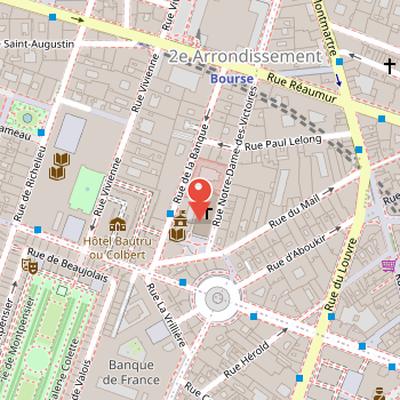
Nearby Objects
-
 Galerie Vivienne 80 m away
 -
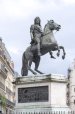 Equestrian statue of Louis XIV 100 m away
 -
 Place des Victoires 100 m away
 -
 Cabinet des médailles 200 m away
 -
 Théâtre du Palais-Royal 250 m away
History and Devotional Character
Notre-Dame-des-Victoires is a minor basilica on rue Notre-Dame-des-Victoires in the 2nd arrondissement of Paris. It began as an abbey church and was constructed between 1629 and 1740 in the French classical style. King Louis XIII gave the church its name and dedicated it to his victory over the Protestants at La Rochelle in 1628. The basilica is especially known for the ex voto offerings left by the faithful. More than 37,000 devotional plaques, silver and gold hearts, and military decorations have been placed there. The closest Metro station is Bourse.
History and Religious Significance
In 1629, the Discalced Augustinians established the Notre-Dame-des-Victoires convent on three hectares at Place des Petits-Peres and Rue de la Banque. King Louis XIII laid the first stone and dedicated the church as a monument to victories over Protestants, especially the Siege of La Rochelle in 1628. A larger church was begun in 1656 to a plan by Pierre Le Muet, and over the next 111 years four other architects, Liberal Bruant, Robert Boudin, Gabriel Leduc, and Sylvain Cartaud, contributed to its completion. Cartaud designed the expanded nave, facade, and domed roof. The new church was consecrated in 1740.
The church later gained wider fame for its library, which held more than forty-thousand works. Wolfgang Mozart prayed there in 1778. During the French Revolution, the church was closed and the library was scattered. It was then used as headquarters of the national lottery and later as the first home of the Paris Bourse, before being returned to church authorities in 1809. The monastery buildings were destroyed in 1858 and replaced by a police station and mayor's office. The church was closed and pillaged again during the Paris Commune in 1871.
Notre-Dame-des-Victoires also became associated with important Catholic movements and figures. In 1838, Fr. Desgenettes submitted an inspiration to the Holy See that led Pope Gregory XVI to establish the Archconfraternity of the Immaculate Heart of Mary. By 1870, the archconfraternity had 22 million members worldwide. Many French Catholics, including Marie-Alphonse Ratisbonne, Ven. Francis Libermann, and refounders of the Holy Ghost Fathers, were connected with the church. Cardinal John Henry Newman gave thanks there for his conversion, and Therese Martin prayed there for Our Lady's help in realizing her vocation. The church currently serves as a place of prayer for the Community of Benedictines of Sacre-Coeur, Paris.
The Church Facade
The church facade of Notre-Dame-des-Victoires was completed in 1737 by architect Jean-Sylvain Cartault in the French classical style. Its design was borrowed from the Church of the Gesu in Rome and follows a model derived from a Roman temple, a form that was especially popular for churches in Paris in the late 17th century and early 18th century.
The lower level is decorated with pilasters with Ionic capitals, while the upper level uses pilasters with Corinthian acanthus leaf decoration. The corners are reinforced with sloping buttresses shaped like reversed consoles, topped by obelisks or small towers. At the top, a triangular fronton is ornamented with sculpted palm leaves and drapery.
The fronton also displays the royal coat of arms with fleurs-de-lis, surrounded by a cordon representing the Order of the Holy Spirit, and crowned with a symbol representing King Louis XIII and his victories. The church name is derived from this crown. A feature on the exterior was installed around 1827 after winning a bronze medal.
Interior Layout and Decoration
The interior of Notre-Dame-des-Victoires measures 62 meters in length, 24.5 meters in width, and 15 meters in height to the vaults. It has a long nave lined with columns that form an arcade of rounded arches. The arrangement was inspired by the Church of the Jesu in Rome, with the aim of bringing the congregation closer to the altar. The choir occupies about one third of the church and is marked by finely carved 17th-century stalls on both sides.
The interior combines classical elements and Baroque decoration. Cornices are decorated with sculpted roses, and the columns have Ionic capitals. Baroque ornamentation includes garlands of flowers, seashells, and cherubs. The ceiling vaults also feature expressive sculpture, including a central vault over the transept with a flight of angels, while Christian symbols are merged with decorative designs.
The altar is a 20th-century work designed by Madeleine Diener. It includes sculpted portraits of eleven important 19th-century religious figures connected to Notre-Dame-des-Victoires, and it is topped by a crucifix carved from a single piece of ivory from the 17th century. Chapels are located on both sides of the nave and transept, and each has a central collateral aisle allowing passage from chapel to chapel.
Interior Chapels and Devotional Art
The interior of Notre-Dame-des-Victoires includes several dedicated chapels that shape its devotional character. The largest chapel is the Chapel of the Virgin, located at the transept. It is dedicated to the Sacred and Immaculate Heart of the Virgin Mary and decorated with a statue of Mary holding the Christ child, both wearing crowns. Special permission had to be sought from the Pope to present the figures with crowns. The statues are made of plaster, and the sculptor is unknown. This chapel also displays a painting of the Annunciation by Charles-Louis Muller and the church's largest and most colorful stained glass window, titled Our Lady - Refuge for Sinners.
Other chapels highlight additional saints and themes. The Chapel of Saint Anne, mother of the Virgin Mary, features a bas-relief of Saint Anne, The Education of the Virgin, by Jacquier from 1878. The Chapel of Saint John contains a statue of Saint John made of gilded cast iron. The Chapel of the Sacred Heart includes a bas-relief by Jacquier from 1870 depicting the appearance of Christ and the Sacred Heart to Marguerite-Marie Alacoque at Paray-le-Monail in France in the 19th century. The Chapel of Notre-Dame of the Seven Sorrows presents a Pieta of Christ and the crucified Christ made of stone from Caen by Charles Gonthier in 1876. The Chapel of Saint Augustine contains a plaster statue by Jean-Bernard Duseigneur from 1849, which replaced an earlier statue by Jean-Baptiste Pigalle that disappeared during the French Revolution. It also has a large coloured stained glass window titled The Vow of Louis XIII, showing the King promising the construction of a church to the Virgin Mary. The Chapel of Saint Therese honors Saint Therese of Lisieux (1873-1897).
Ex Votos in Notre-Dame-des-Victoires
Notre-Dame-des-Victoires in Paris displays a large collection of ex votos, covering most of the walls of the church. The display includes over thirty-seven thousand devotional plaques, along with silver and gold hearts and military decorations. These offerings were left by faithful parishioners as thanks to the Virgin Mary for blessings received. They were also left because the basilica served as a stational church on the pilgrimage route to Compostela, allowing the faithful to make offerings there when they were unable to travel to the Shrine of Compostela itself.
19th-Century Stained Glass
The stained glass dates to the second half of the 19th century. It comprises eight windows in the upper nave, decorated with grisaille patterns and designed to provide the maximum amount of light. In the center of the windows are colorful figures of saints associated with the Virgin.
Art and Decoration
The interior of Notre-Dame-des-Victoires contains a notable group of artworks and decorative elements. In the choir, seven large paintings behind the altar were created by Charles-Andr� van Loo. The central painting, also by van Loo, shows Louis XIII dedicating Notre-Dame-des-Victoires to the Virgin Mary, while other paintings behind the altar depict scenes from the life of Saint Augustine. The church interior also includes a 17th century marble baptismal font and an 18th century pulpit carved by Louis Regnier, whose work is marked by elaborate carvings on the pulpit and decorative carvings around the organ case. Jean-Baptiste Lully is represented by several memorial elements in the church, including portions of his tomb placed in Notre-Dame-des-Victoires in 1687, displayed between the Chapel of Saint John and the Chapel of the Sacred Infant. The church also contains two busts of Lully, among them a 17th century bust by Antoine Coysevox and a bronze bust by Jean Collignon.
The Church Organ and Its Carved Case
The church organ was constructed by Francois-Henri Lesclop in 1739 and placed on the tribune over the entrance of the church. Its case was made in the same year by Louis Regnier. Regnier also created the carved decoration, which features vases, angels, and musical instruments. This carved decoration is found on the pulpit of the church. The organ was later modified and enlarged by Barker in 1870, by Abbey in 1898, and by Kern in 1973. Together, these changes show a long history of adaptation while preserving an important decorative element from the original 1739 work.