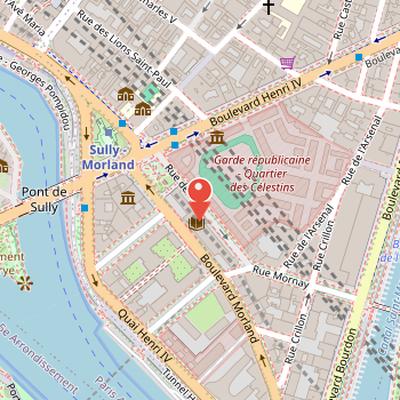
Bibliothèque de l’Arsenal is a division of the Bibliothèque nationale de France, located at 1 rue de Sully in Paris. It occupies the site of the former Arsenal of Paris, in the 4th arrondissement within the Arsenal district, opposite the Pavillon de l'Arsenal. The old arsenal was founded by the king in the 14th century, rebuilt by Sully, and enlarged in the 18th century by architect Germain Boffrand.
The site was originally established in 1512 with the agreement of the city of Paris to centralize powder and munition deposits. Over time, it was modernized and gradually lost its military function as it gained more luxurious residential spaces. The grand lodging built for Sully in 1600 was preserved, while later works transformed the Arsenal further under Boffrand’s plans. The library is associated with the historical residence of the grand master of French artillery and with the personal collection of Marquis de Paulmy d'Argenson, which included medieval manuscripts and prints.
Nearby Objects
-
 Hôtel Saint-Pol 300 m away
 -
 Hôtel de Lauzun 350 m away
 -
 Temple du Marais 400 m away
 -
 Arab World Institute 500 m away
 -
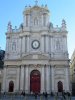 Église Saint-Paul-Saint-Louis 500 m away
Location and Historical Setting
The Bibliotheque de l'Arsenal is located at 1 rue de Sully in Paris, in the 4th arrondissement, within the Arsenal district. It is part of the Bibliotheque nationale de France and stands opposite the Pavillon de l'Arsenal. Its setting is tied to the history of the old arsenal of Paris, which was founded by the king in the 14th century. The site was later rebuilt by Sully and enlarged in the 18th century by architect Germain Boffrand. These successive phases give the library a historical position within an area shaped by long institutional use and later architectural development.
From Arsenal to Literary Residence
The Arsenal was first decided in 1512 as a place to centralize powder and munition deposits, with the agreement of the city of Paris. It was then modernized under unknown authority and developed further after the appointment of the duke of Sully as grand master of French artillery in 1599, when he settled in the grand lodging of the Arsenal. The site later gained added apartments for Marshal de la Meilleraye, increasing its luxury while its military role gradually diminished. It was also used as a foundry for the statues in the garden of Versailles.
Shortly before 1715, the Arsenal was transformed at the king's expense to create a new lodging for the duke of Maine. The grand lodging built in 1600 for Sully was preserved, but its large southern facade was concealed by a new building begun in 1715 from Germain Boffrand's plans and supervision. Only the main structure was completed before the duke of Maine died in 1736, and he rarely stayed there and never used the new lodging. The Arsenal then passed to the count of Eu, and part of the unfinished building was left without doors, windows, or interior decoration for the masons Destriches, father and son, who lived there at their own expense because their work remained unpaid.
Around 1745, architect Dauphin was allowed to reside there and decorate several salons with harmonious and elegant decor that still existed. Other rooms were assigned to the count of Eu's intendant Limanton, later succeeded in 1756 by Marquis de Paulmy d'Argenson. After the grand master of artillery charge was abolished the previous year, Paulmy d'Argenson became governor of the Arsenal and sword bailiff of French artillery. By 1765, he had progressively evicted the occupants and obtained use of all 141 rooms on the first floor and 31 rooms and cabinets on the second floor. In the Arsenal residence, he kept a rich personal collection of medieval manuscripts and prints, later acquired the collection of the Duke of La Valliere in 1786, and wanted scholars to have freedom to use his collection during his lifetime.
From Private Collection to National Library Department
In 1785, the Arsenal library was sold in its entirety to the Count of Artois. Under the administration of the Abbe de Vauxcelles, the collection became public and rivaled the royal library in both importance and volume. On the day of the Bastille, when people learned that the library belonged to the Count of Artois, they attempted to destroy it. To protect the building, the librarian ordered a Swiss guard to change into the King's household uniform, and when the guard opened the door in that uniform, the crowd withdrew.
Later decrees that condemned the property of those who had left France and served enemy armies made the Arsenal library national property. It then became the eighth national literary deposit in Paris. The collection received the archives of the Bastille as well as works from major Parisian abbeys, and it opened to the public on an unspecified date. Hubert-Pascal Ameilhon served as the first librarian for fourteen years.
The library was rediscovered by Charles Nodier in 1824, and he remained librarian until 1844. It gained notoriety as the headquarters of the Cenacle and expanded with legal deposit collections from 1841. In 1848, Adam Mickiewicz was replaced as administrator by Paul-Mathieu Laurent. By the end of the 19th century, under Edouard Thierry, its collections increasingly focused on literature and theater. Jose-Maria de Heredia served from 1901 to 1905, followed by Paul Cottin. The Arsenal library received the Rondel collection on performing arts and early cinema in 1925. It was attached to the Reunion des bibliotheques nationales in 1934, became a department of the National Library in 1977, and remained within the institution after the National Library became the Bibliotheque nationale de France in 1994.
Performing Arts Collections at the Arsenal
In 1976, a performing arts department was created at the Arsenal library because of the importance of the Rondel collection and other theatrical holdings. These collections remained at the Arsenal until 2004. In that year, the performing arts department was moved to the Richelieu site, marking the end of its long association with the Arsenal library.
Collections and acquisitions
Today, the Bibliotheque de l'Arsenal holds more than one million documents, including items dating from before 1880. Its holdings include a collection of unspecified items, a little more than an unspecified number of items and plans, more than an unspecified number of closed periodicals, and approximately an unspecified number of living periodicals. The library's acquisitions policy is focused on 19th century French literature, publications related to archives and existing collections, bibliophilia, the history of the book and bookbinding, and the history of the Arsenal and its occupants. This profile gives the library a clearly defined documentary character, combining historical holdings with targeted contemporary acquisitions.