Hôtel de Lauzun is a private mansion built between 1657 and 1658 by French architect Charles Chamois for the financier Charles Gruyn. The building was decorated by the painter Michel Dorigny, a student and son-in-law of Simon Vouet, who inherited Vouet’s workshop after his death in 1649. Dorigny’s works at the mansion include Le Triomphe de Cérès, La Toilette de Vénus, Diane et Endymion, and Le Triomphe de Flore.
The mansion changed hands several times over the following centuries. The duc de Lauzun bought and lived in it in 1682, followed by the marquis de Richelieu in 1685. Later owners included Pierre-François Ogier, Jean-François Ogier, René-Louis de Froulay, marquis de Tessé, and the Saulx-Tavannes grandchildren. In the 19th century, it was restored by the bibliophile and collector Jérôme Pichon, who rented some rooms to creators. Among its residents were writer Roger de Beauvoir, painter Joseph Ferdinand Boissard de Boisdenier, and Charles Baudelaire, who lived on the top floor from 1847 to 1851 and wrote L'Invitation au voyage there.
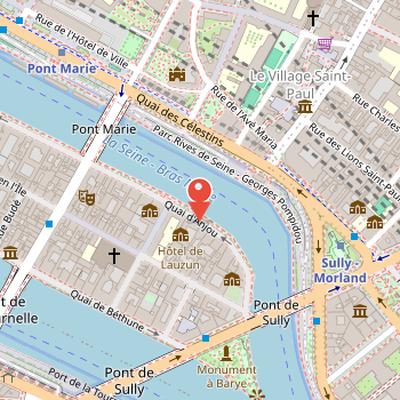
Nearby Objects
-
 Hôtel Saint-Pol 200 m away
 -
 Arab World Institute 350 m away
 -
 Bibliothèque de l’Arsenal 350 m away
 -
 Église Saint-Paul-Saint-Louis 400 m away
 -
 Maison européenne de la photographie 400 m away
Construction, Decoration, and Ownership
Hotel de Lauzun was built between 1657 and 1658 by the French architect Charles Chamois for the financier Charles Gruyn. Its decoration was carried out by the painter Michel Dorigny, who was a student and son-in-law of Simon Vouet and inherited Vouet's workshop after Vouet's death in 1649. Dorigny's works at the hotel include Le Triomphe de Ceres, La Toilette de Venus, Diane et Endymion, and Le Triomphe de Flore.
The property later changed hands several times. The duc de Lauzun bought and lived in Hotel de Lauzun in 1682, and the marquis de Richelieu bought it in 1685. In 1709, Richelieu sold it to Pierre-Francois Ogier, who was Grand Audiencier of France and receiver general of French clergy. The hotel then passed to Ogier's son, Jean-Francois Ogier, who sold it to Rene-Louis de Froulay, marquis de Tesse, in 1764. In 1769 it passed to the Saulx-Tavannes grandchildren of Rene-Louis de Froulay, and in 1779 they sold it to the marquis de Lavallee de Pimodan, who occupied it until the French Revolution.
Residents, Writers, and Commemorations
Histoire presents Hotel de Lauzun as a place strongly linked to literary and artistic life. Writer Roger de Beauvoir was both born there and later lived there. The building was restored by the bibliophile and collector Jerome Pichon, who also rented some rooms to creators. Among its best-known residents was Charles Baudelaire, who lived on the top floor from 1847 to 1851 in an apartment overlooking the courtyard. During this period, he received Madame Sabatier at the hotel and wrote the poem L'Invitation au voyage there. Théophile Gautier was a neighbor of Baudelaire at Hotel de Lauzun, and he is associated in the record with the Club des Haschischins and the experience of Paradis artificiels.
The hotel was also home to painter Joseph Ferdinand Boissard de Boisdenier, who hosted monthly meetings of the Club des Haschischins there. On the ground floor, brocanteur Arondel operated a business, and Baudelaire incurred heavy debts with him. The building's later public recognition included a commemorative plaque placed by Paris city hall on June 18, 1952, honoring Baudelaire at Hotel de Lauzun.
Later History and Interior Changes
Htel de Lauzun was classified as a historic monument in 1906. By 1900, it was already municipal property, and between 1900 and the date of classification it was owned and inhabited by the Pichon family. In the postwar years, the building was renovated and modified. A major interior change came in 1949, when a new honorary staircase was installed. This staircase is a pastiche of a 17th century classical staircase and evokes the staircase of the Chateau de Maisons. It was placed on the site of the former dining room, while preserving the original dining room decorations. Since October 2013, Htel de Lauzun has housed the Institut d'etudes avancees de Paris, a research institute that hosts international humanities and social sciences researchers in residence.
Architectural Features of Hotel de Lauzun
Hotel de Lauzun is located at 17, quai d'Anjou on the ile Saint-Louis in the 4th arrondissement of Paris. Its exterior facade is aligned with the other buildings on the street and includes a wrought iron balcony. Entrance gates were installed in 1910. The facade facing the quai is marked by a decorated lantern and an ornamented gutter representing a dolphin, while the western facade toward the courtyard has detailed doors. The interior courtyard is paved and framed by three facades and a blind wall decorated with arcades. The courtyard ensemble includes a southern facade, an eastern blind wall known as the mur renard, and a northern facade with a central vertical sundial. On this northern side, a cabinet is supported by two sculpted lions. The western facade of the courtyard includes a door. These elements give the building a distinct architectural character through a combination of aligned street frontage, courtyard composition, and ornamental detail.
The Courtyard Sundial
On the northern courtyard facade of the Hotel de Lauzun, between two windows, there is a vertical sundial that indicates both the hours and the calendar. The dial measures 3.20 meters in height and 1.60 meters in width, and it is executed in both engraved and painted forms. Its design includes four hour lines linking arcs of the solstices and the equator, together with four dotted half-hour lines. An equatorial dotted ascending line is marked with the symbols of Libra and Aries, while the solstice arcs represent Cancer and Capricorn. A true noon line also serves a calendar function, with twelve perpendicular marks corresponding to each month. The sundial formerly had a resting disk with a face surrounded by rays converging toward the peephole, but this disk was stored in the hotel reserves in 1970 and its current whereabouts are unknown. Above the dial, the tripod decorated with golden vegetal motifs is still present. Separate from the sundial, the 1910 gates were removed in the early 2000s during facade restoration, replaced by new wooden gates, and later sold in 2021 at Drouot.
The Hotel as a Film and Television Setting
The Hotel de Lauzun has repeatedly served as a filming location in cinema and television. In 1998, Roman Polanski used the hotel in La Neuvieme Porte, where its facade appeared as the building of the baroness Kessler's foundation. The hotel was also featured in Bruno Dumont's Hadewijch in 2009, when it represented the apartment of Celine's parents. In 2015, several sequences for the television program Secrets d'Histoire were filmed at the hotel; the episode was devoted to Anne-Marie-Louise d'Orleans under the title La Grande Mademoiselle : une rebelle sous Louis XIV and was broadcast on France 2. More recently, the hotel's state rooms were used in the 2023 film Les Trois Mousquetaires : D'Artagnan as the apartments of Queen Anne of Austria.