The Chapelle Expiatoire is located in Paris, Île-de-France, in the 8th arrondissement, in the quarter of La Madeleine. It stands in the center of the square Louis XVIII, at 29 rue Pasquier, on the site of the former cemetery of La Madeleine. Its exact position is linked to the burial place of the king’s body after his execution on Place de la Concorde on January 21, 1793.
The site formed part of a cemetery opened before the French Revolution and used as a discreet burial place during the Terror, including for several victims of the guillotine. After the cemetery was closed in 1794, the property passed to various owners. Louis Desclozeaux, a royalist magistrate, identified the burial site of the king and queen’s bodies. Following the restoration of the monarchy in 1814, Louis XVIII searched for the remains of Louis XVI and Marie-Antoinette, which were exhumed from the cemetery and transferred to the royal necropolis of Saint-Denis on January 21, 1815.
The Chapelle Expiatoire was constructed between 1816 and 1826 as part of a religious and commemorative ensemble dedicated to victims of the Revolution, including the royal couple. It has been classified as a historic monument since 1914.
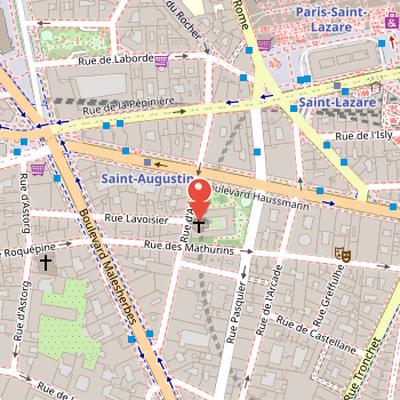
Nearby Objects
-
 Madeleine Cemetery 10 m away
 -
 One-Two-Two 250 m away
 -
 Théâtre de la Madeleine 350 m away
 -
 Saint-Augustin 400 m away
 -
 La Madeleine 450 m away
Chapelle Expiatoire in Paris
The Chapelle expiatoire is located in Paris, in the Ile-de-France region. It forms part of a religious and commemorative ensemble dedicated to the victims of the Revolution, including the royal couple. The structure was constructed between 1816 and 1826. It has been classified as a historic monument since 1914.
Location and Historical Setting
The Chapelle expiatoire is situated in the 8th arrondissement of Paris, in the quarter of La Madeleine. It stands in the center of the square Louis XVIII, at 29 rue Pasquier. The chapel was erected on the site of the former cemetery of La Madeleine. Its exact position is defined by the burial place of the king's body after execution on Place de la Concorde on January 21, 1793.
History and Commemoration
Before the French Revolution, the cemetery on this site was an active burial ground that still had many available burial spaces, unlike other Parisian cemeteries that were becoming overcrowded. The overcrowding of the cemetery des Innocents led to a ban on new burials in Paris in 1780, with bodies then ordered to be transferred to the catacombs. The cemetery was already used for special burials, including victims of the fireworks accident at the future Louis XVI's wedding in 1770. During the Terror, its location near place de la Revolution made it a practical and discreet burial site within Paris, and several guillotine victims, including Madame Rolland and Charlotte Corday, were placed in common graves there. It was closed by the Committee of Public Safety in 1794 and later sold to various owners.
One of those owners, the royalist magistrate Louis Desclozeaux, noted the burial site of the bodies of the king and queen. After the restoration of the monarchy in 1814, Louis XVIII searched for the remains of his brother Louis XVI and Marie-Antoinette, which were exhumed from the cemetery based on Desclozeaux's information. Their remains were transferred to the royal necropolis of Saint-Denis on January 21, 1815, the same day Louis XVIII laid the first stone of the current commemorative chapel. The chapel had been suggested by the ultra royalist duc de Doudeauville, aide de camp of the comte d'Artois, and was intended to honor the memory of the royal couple who had been guillotined, as well as the hundreds of Swiss Guards killed at the palace of the Tuileries.
The monument was commissioned to the architect Pierre Fontaine, with Louis-Hippolyte Lebas as inspector and Charles Percier excluded as collaborator. Funded by Louis XVIII with five million francs, the neoclassical project took 18 years to complete, beginning on May 30, 1816 and ending in 1834 under Louis Philippe I. It was originally presented as a calm oasis surrounded by an English park over the former Madeleine cemetery, linked by a cypress alley to rue de l'Arcade. The site was later restored during the Second Empire, the cypress alley was removed in 1862, and Haussmann's works replaced the original romantic garden with square Louis XVIII. Its erection also provoked political controversy between ultra-royalists and supporters of the Charter of 1814, and later calls for demolition were made, including by the Commune in 1871 and in repeated proposals during the Third Republic from 1880 to 1908.
Public Status, Damage, and Ongoing Research
The Chapelle expiatoire was not destroyed during regime changes, despite threats, and was later classified as a historical monument by a decision of the Minister of Fine Arts. It is managed by the Centre des monuments nationaux and remains open to the public, with only rare closures for war, restorations, or private ceremonies. Unlike other places of worship, it is State-owned through royal treasury funding, and it can also be privatized for weddings or events. The chapel continues to have a ceremonial role through an annual mass for the souls of Louis XVI and Marie-Antoinette, held on January 21 or on the preceding Sunday.
The building has also faced repeated damage and technical interventions. Construction of metro line 14 passed under the chapel in the late 1990s, and both the storm of the century in 1999 and Storm Klaus in 2009 damaged its roofs and square trees. In 2017, sealed and blind chambers were discovered behind the underground chapel walls. The historian Aymeric Peniguet de Stoutz questioned confusion between Madeleine Cemetery and a nearby cemetery, and in 2018 Philippe Belaval authorized Philippe Charlier to insert micro-cameras in the mortar joints. These investigations revealed cavities containing coffers and bones, and research on the cavities and remains is still ongoing.
Architectural layout and memorial design
The Chapelle expiatoire is designed in a neoclassical style that borrows from Antiquity, the Middle Ages, and the Renaissance. Its exterior appears as a closed enclosure entered through a pavilion that was formerly surrounded by an English garden. The entrance pavilion contains a vestibule and a straight staircase leading to a raised honor courtyard.
The courtyard functions as an inner garden, also called the honor courtyard or Campo Santo, and is made of sifted soil from the old cemetery. It is bordered by cenotaphs dedicated to the Swiss Guards killed on August 10, 1792, and these also mark the boundaries of the old cemetery. The cenotaph steles are decorated with a winged hourglass, a poppy, and cypress branches, symbols of time passing, eternal rest, and mourning. A rose-bordered alley, created for Marie-Antoinette at Trianon and planted with rose bushes of the variety created for her at Versailles, leads through the courtyard to the chapel.
At the lower level, two cloister galleries surround the courtyard at park level. The pavilion facade is a bare wall with a monumental door and a colossal sarcophagus topped by a pediment. The building facade bears a broad cartouche dedicated to the burial site of King Louis XVI and Marie-Antoinette. Inside, the tall entrance room is intentionally blind and dark, with two doors to lateral cloister galleries and a central staircase rising two meters, creating a strong contrast with the light arriving at the honor courtyard. Its walls are decorated with garlands, floral motifs, and the royal couple's monograms. At the rear, a tetrastyle portico with a Doric pediment gives access to the chapel, whose overall composition recalls the Queen's convent built by Richard Mique at Versailles.
Architecture and commemorative design
The Chapelle expiatoire was designed as a commemorative building with a plan centered on a Greek cross, and its form referenced martyria. Its architecture was strongly shaped by the exact location of the royal burial pit, which prevented the use of a longitudinal building and a Latin plan. The resulting composition created balance through a central dome and two half-domes around the cubic mass, while a peristyle softened that mass visually.
Inside, the building included three groin vaults with coffers, as well as a central dome with coffers and openings supported on pendentives. Natural zenithal lighting came only through the oculi in the vaults, which also illuminated the upper part of the interior. The decorative program was designed by Francois-Antoine Gerard and included four religious compositions: the Passion of Christ, the Eucharist, the Trinity, and the Tables of the Law. Above the entrance, a tympanum represented the translation of bones to Saint-Denis.
The side chapels contained two white marble sculpted groups showing sovereigns in ecstatic attitudes. One statue by Francois Joseph Bosio showed a sovereign with an angel pointing to the sky, and another by Jean-Pierre Cortot showed Marie-Antoinette supported by Religion. The sovereigns' testaments were reproduced on the pedestals. These statues were gifts from the duchess of Angouleme, the eldest surviving daughter of the sovereigns. Access to the chapel areas was provided by spiral staircases behind the sculpted groups.
A transverse corridor led to a small chapel with an antique-style black marble altar placed precisely where the body was exhumed. Ossuaries were sealed within and behind the walls to collect the remains of Revolution victims who had been guillotined. The building also included a white wood-paneled room for objects of worship, with a confessional covered in red velvet and a portrait of the duchess of Angouleme. From this room, access led to a gallery with nine arcade bays at park level, a configuration repeated on the south side.