Madeleine Cemetery was an 18th-century parish cemetery in the current VIII arrondissement of Paris, named in honor of Saint Mary Magdalene. In 1720, the parish of Sainte-Madeleine de la Ville-l'Évêque purchased a 45-by-19-metre plot for its third parish cemetery at the intersection of rue d'Anjou and Grand égout. The cemetery was used during the French Revolution for the burial of people executed by guillotine, and mass graves were dug and covered with quicklime. It also contained the remains of 133 victims of the fireworks accident at the Dauphin and Maria Antonietta's wedding in 1770, as well as Swiss Guards killed at the Tuileries on 10 August 1792. Closed by decree on 25 March 1794 for hygienic reasons, it was later sold and eventually acquired by Pierre-Louis-Olivier Desclozeaux, who marked royal graves with plantings. After Louis XVIII bought the site in 1815, the Chapelle Expatoire was built on part of the burial ground. The cemetery was dismantled in 1844 except for graves within the chapel.
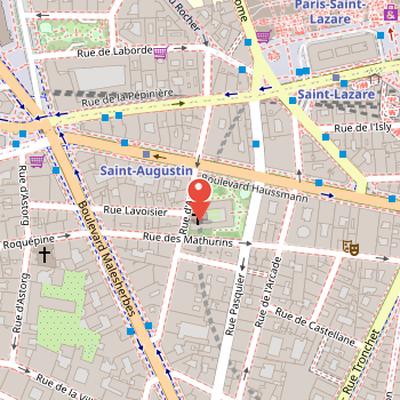
Nearby Objects
-
 Chapelle Expiatoire 10 m away
 -
 One-Two-Two 250 m away
 -
 Théâtre de la Madeleine 350 m away
 -
 Saint-Augustin 400 m away
 -
 La Madeleine 400 m away
History and Use
Madeleine Cemetery was the parish cemetery of what is now the VIII arrondissement of Paris during the 18th century. It was constructed and later demolished in the same century. During the French Revolution, it was used for the burial of people executed by guillotine. The cemetery was named in honor of Saint Mary Magdalene.
History of Madeleine Cemetery
In 1720, the parish of Sainte-Madeleine de la Ville-l'Evque bought a 45 by 19 m plot for its third parish cemetery. The site later became known as Madeleine Cemetery. It was closed on March 25, 1794, by decree of the French Parliament for hygienic reasons. Before and during its closure, the cemetery held several politically and historically notable burials, including 133 victims of the fireworks accident during the wedding of Dauphin and Maria Antonietta on May 30, 1770, and Swiss Guards massacred in the Tuileries on August 10, 1792. After the execution of the Hebertistes and the cemetery closure, the land was sold to a private stonemason. The decapitated victims were transferred to the Errancis Cemetery, and after that cemetery was closed, the remains were moved again to the Paris Catacombs. On June 3, 1802, the cemetery and its land were bought by Pierre-Louis-Olivier Desclozeaux, a royalist magistrate, who marked the royal graves with a hedge, two weeping willows, and cypress trees. Desclozeaux later sold the cemetery and house to King Louis XVIII of France on January 11, 1815.
Later History and Remains at Madeleine Cemetery
After the exhumations of January 18 and 19, 1815, Louis XVIII had the remains of his brother and sister-in-law moved to the Basilica of Saint-Denis. Marie Antoinette's remains were identified by a garter and a jawbone recognized by the poet Chateaubriand. Louis XVIII did not succeed in finding the remains of his sister Elisabeth in the Madeleine Cemetery and Errancis Cemetery area. He later built the Chapelle Expatoire on the graves of his brother and sister-in-law. The cemetery was completely dismantled in 1844, except for the graves in the Chapelle Expatoire. Its skeletal remains were transferred to the Ossuaire de l'Ouest and later moved again to the Paris Catacombs in the Montparnasse district. In 2020, an ossuary discovered in the lower chapel was reported to contain 500 remains, likely of people guillotined and buried at Madeleine.
Revolutionary Mass Graves
During the French Revolution, Madeleine Cemetery became associated with the disposal of decapitated corpses, which were thrown into mass graves on the site. To manage the large number of burials, mass graves were specially dug and covered with quicklime to accelerate decomposition. These details reflect the cemetery's use during a period of political violence and emergency burial practices.
Location of Madeleine Cemetery
Madeleine Cemetery was situated in Paris at the intersection of rue d'Anjou and Grand egout. The cemetery covered the present land of Square Louis XVI and was part of the area where the Chapelle Expiatoire now stands. It was also located near the church of La Madeleine. These details place the cemetery within a specific historic part of the city, linked to later landmarks and public spaces.