Moulin Rouge is a Parisian cabaret founded in 1889 by the Catalan Josep Oller and Charles Zidler. Located on boulevard de Clichy in the Pigalle district at the foot of the Montmartre hill, it is served by Blanche metro station. The venue became known for its French cancan show and for a form of entertainment that mixed dancing, laughter, and regularly changing humorous attractions.
According to the historical context of the site, Montmartre retained a village atmosphere within a growing Paris, while the Moulin Rouge was inaugurated at the former Bal de la Reine Blanche location. Oller and Zidler, who were businessmen familiar with public tastes, created a place where people from many backgrounds could mix, including employees, local residents, artists, bourgeois, businessmen, elegant women, and foreigners. The cabaret was nicknamed "Le Premier Palais des Femmes" and quickly achieved success. Its hall architecture was described as revolutionary because it allowed rapid changes of decor and mixed audiences. The Moulin Rouge is now one of the two largest cabarets in France alongside the Royal Palace, and its style and name have been imitated by other cabarets worldwide.
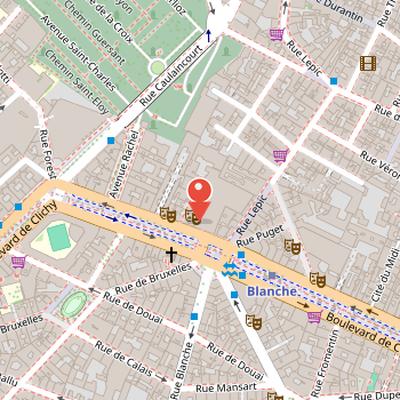
Nearby Objects
-
 Le Chat Noir 150 m away
 -
 Théâtre du Grand-Guignol 300 m away
 -
 Musée de la Vie romantique 350 m away
 -
 Monument to Maréchal Moncey 350 m away
 -
 Place de Clichy 350 m away
Location and Cultural Influence
The Moulin Rouge is a Parisian cabaret founded in 1889 by the Catalan Josep Oller and Charles Zidler, who already owned the Olympia. It is located on the boulevard de Clichy in the Pigalle district, at the foot of the Montmartre hill, and is served by the Blanche metro station. The venue is known for its French cancan show. Its style and name have been imitated and borrowed by other cabarets worldwide, giving it a wider cultural influence beyond its Paris setting.
The Moulin Rouge in Montmartre
The Moulin Rouge was inaugurated at the foot of Montmartre hill on the site of the former Bal de la Reine Blanche. It was created by Joseph Oller and directed by Charles Zidler, both businessmen described as knowing public tastes well. The venue opened in a district where Montmartre still kept a village atmosphere, even as Paris became larger and more impersonal. Histoire notes that the hill had earlier mills, including one at 12 rue Lepic, used for grinding grain, corn, plaster, and stone. In this context, the Moulin Rouge combined the imagery of the mill with a modern entertainment venue.
The establishment was designed by Adolphe Willette and conceived as a venue with a large red-painted mill, lit at night and visible from the Grands boulevards and rue Blanche. Unlike other Montmartre mills, it served mainly as the venue sign. Its shape and color made it one of the recognizable symbols of Paris, and it was the first electrified building in the city. The facade displayed the words Bal, divertissements, varietes, underscoring its function as a place for dance and entertainment.
Histoire describes the Moulin Rouge as having revolutionary hall architecture, which allowed decor to be changed quickly and audiences to mix freely. This mixed public included employees, local residents, artists, bourgeois, businessmen, elegant women, and foreigners. Oller and Zidler even nicknamed it Le Premier Palais des Femmes. The cabaret quickly achieved great success and is now presented as one of the two largest cabarets in France, alongside the Royal Palace.
Its program featured festive champagne evenings with dancing, laughter, and regularly changing humorous attractions. Among these attractions was the Peto Mane. The Moulin Rouge was also associated with the rise of the French Cancan, a new dance inspired by the Quadrille. It became increasingly popular and was performed at a fast rhythm by dancers wearing revealing costumes with petticoats and split knickers. Famous performers linked to the venue included La Goulue, Jane Avril, Cha-U-Kao, Mome Fromage, Grille d Egout, Nini Patte-en-l'Air, Demi-Siphon, Germaine Pichot, and Yvette Guilbert.
The Moulin Rouge was a favorite place for artists, especially Henri de Toulouse-Lautrec. His posters and paintings quickly gave the cabaret international fame. Toulouse-Lautrec also celebrated his 25th birthday there and was present in the hall. More broadly, Montmartre at the end of the 19th century was described as having two sides: one devoted to celebrations and another to artists seeking quality light and affordable rent. Both shared values of pleasure and beauty, and the Moulin Rouge became one of the most visible expressions of that world.
Performance, Scandal, and Public Appeal
According to Histoire, women had a primary role in the cabaret, and Oller and Zidler wanted to create a cabaret in which female bodies, which were rarely fully revealed in late 19th century society except in sculpture and painting, could be presented on stage. At the Moulin Rouge, men and their imagination and fantasies were also central to its appeal. La Goulue and other dancers performed wild rhythms with partly revealed bodies, while male performers such as Valentin le Desossse were also stars. La Goulue became the permanent headliner and a symbol of both the cancan and the Moulin Rouge, admired for her audacity and energy and noted as the highest paid artist in Paris. Henri de Toulouse-Lautrec admired her and made her his favorite model, and she was also the first Toulouse-Lautrec poster subject for the Moulin Rouge in 1891.
The early years of the venue featured extravagant circus-inspired shows and attractions such as Petomane, along with daily concert balls. Humor was an essential part of the atmosphere, with uproarious laughter reportedly causing audience convulsions. Foottit and Chocolat performed there from 1889 to 1910 as a popular comedic duo in the roles of clown blanc and Auguste noir. The program also included the show Circassiens et Circassiennes on May 14, 1890. The Moulin Rouge attracted high-profile attention as well: the Prince of Wales reserved a table to watch the quadrille on October 22, 1890, and La Goulue recognized him and answered with a provocative gesture. Public sensation continued with the 1893 Quat'z'Arts ball, which scandalized Paris with a nude Cleopatra and similarly nude young women.
From Ball Hall to Theater Concert
The Moulin Rouge closed its doors for the funeral of its director and co-creator Charles Zidler, and Yvette Guilbert paid homage to him. After its renovation by Edouard-Jean Niermans, it reopened with its first aperitif concert, which gathered the elegant elite for dinner and spectacle. Its last ball was held there before the venue transformed into a theater concert. By then, the Moulin Rouge had become a temple of operetta until the First World War. It hosted shows such as Voluptata, La Feuille de Vigne, Le Reve d'Egypte, and Tais-toi tu m'affoles. Le Reve d'Egypte became especially notable when Colette exchanged a kiss on stage with the duchess of Morny, and the play was later banned for being judged scandalous. In 1900, foreigners from five continents, drawn by the Exposition universelle, flocked to the Moulin Rouge, helping make Paris the capital of pleasures and of the p'tites dames de Paris. Its influence also spread beyond the city, as many places created venues called Moulins rouges and Montmartre in imitation of Parisian models.
Reconstruction and Postwar Revival
The Moulin Rouge was destroyed by fire, and reconstruction work began in 1921 under the architect Adolphe Thiers. After the war, Francis Salabert took charge of the cabaret and entrusted Jacques-Charles with reviving its colors. The venue then experienced new growth, with performers such as Gina Palerme, Mistinguett, Jeanne Aubert, and Maurice Chevalier presenting American revues with the Hoffmann Girls. In 1923, the composer and conductor Raphae l Beretta offered to restore the Moulin Rouge music hall in a large building. Histoire also described the facade as having a round part decorated with oval dormer windows. Earlier, Histoire recorded the first appearance of Mistinguett at the Moulin-Rouge in La Revue de la Femme, and noted her later success with Max Dearly in La Valse chaloupee. It also reported the attendance of an old lady-in-waiting of Empress Eugenie at a performance of Revue amoureuse, where she shouted Vive l'Imperatrice! during the reconstituted ceremony of the return of troops from Italy.
A 1927 Show Incident
Histoire reported that a 1927 show incident involved girls in tight outfits emerging from giant cakes. The cake layer was covered in custard and was slippery, which caused repeated slips and falls during the performance. The girls were also wearing high-heeled shoes, and they had been ordered not to remove them during the show. According to the report, these conditions made the performance a catastrophe.
Changing Uses and Artistic Identity
In the 1920s, the Moulin Rouge was shaped by a group of artists and managers who helped define its public image. Histoire Gesmar became a decorator at age 20, and his drawings and models remained permanently associated with the image of the Moulin Rouge. Pierre Foucret became director and appointed Jacques Charles as artistic director, while Mistinguett was named codirector with Earl Leslie and director of the costume workshop. Together, Histoire Jacques-Charles and Mistinguett created the shows La Revue Mistinguett in 1925, Ca, c'est Paris in 1926, and Paris qui tourne in 1928. Mistinguett also created many songs at the Moulin Rouge, including Valencia, Ca, c'est Paris, Il m'a vue nue, and On m'suit. She retired from the stage and left the Moulin Rouge in 1929.
During the following years, the theater changed function several times. It became one of the largest cinema halls in Europe, with music-hall artists serving as opening acts. The revue Lew Leslie's Black Birds performed there between June and an unspecified month. In 1937, the old ballroom was converted into a modern night club, and both the Cotton Club from New York and Ray Ventura and his collegians performed that year. From 1940 to 1945, the venue operated as a dancing club named Robinson Moulin-Rouge. Before the liberation of Paris in 1944, Edith Piaf and Yves Montand performed on its stage.
After 1944, Georges France, known as Jo France, acquired the Moulin Rouge and commissioned Henri Mahe, together with architects Bernard de La Tour d'Auvergne and Marion Tournon-Branly, to renovate it. After this renovation, dancing evenings, attractions, and French cancan returned. In 1953, two entrance panels titled Hommage a Lautrec and Priere aux artistes, with portraits of Pielal and Edmond Heuze, were placed at the entrance. The Bal des Petits Lits blancs, organized by novelist Guy des Cars and attended by President Vincent Auriol, also took place there, and Bing Crosby performed for the first time on a European stage during that event.
Revue, Expansion, and Gala Events
Between 1951 and 1960, the Moulin Rouge hosted a series of famous artists, including Luis Mariano, Charles Trenet, Charles Aznavour, Line Renaud, Bourvil, Fernand Raynaud, and Lena Horne. Its stage repertoire also included the French Cancan choreographed by Ruggero Angeletti in 1955. In 1957, Doris Haug founded the troupe Doriss Girls at the Moulin Rouge, and the group later grew to 100 members, with 40 performers on stage.
During this period, the venue also changed its format by creating a new kitchen space in order to offer international dinner-shows with a gastronomic menu and worldwide famous revues. Early in 1960, it presented the Revue japonaise, performed entirely by Japanese artists and introducing kabuki to Montmartre. In 1962, Jacki Clerico was appointed director, and under his leadership the hall was expanded and a giant aquarium was installed, along with the first aquatic ballet. That same year, the Cancan revue designed by Doris Haug and Ruggero Angeletti was launched, followed by the premiere of Frou-Frou in 1963. After 1963, Clerico chose revue titles beginning with the letter F.
The Moulin Rouge also became a setting for major gala events and official occasions. The Bal des Petits Lits blancs attracted thousands of stars worldwide, including Josephine Baker, who sang J'ai deux amours. In 1983, it hosted a prestigious British official event in France, presided over by Princess Anne with Prince Edward as guest of honor. The venue later held an exceptional performance in London in spring 1989 before the Prince and Princess of Wales, and the Centenary gala in 1989 brought together artists including Charles Aznavour, Lauren Bacall, Ray Charles, Tony Curtis, Ella Fitzgerald, Gipsy Kings, Margaux Hemingway, Barbara Hendricks, Dorothy Lamour, Jerry Lewis, Jane Russell, Charles Trenet, and Esther Williams. Later gala performances included a Cartier event in 1994 with a private concert by Elton John and a Lancome gala in 1995 with Juliette Binoche, Charles Aznavour, and Jessye Norman. The Centenary Revue Formidable ended on April 30, 1999, and the revue Feterie premiered on December 17, 1999. One of the venue's numbers using snakes was permanently ended to comply with the law against animal cruelty.
Wing Collapse and Aftermath
At 1:45 in the morning, the famous wings of the Moulin Rouge collapsed. In the fall, the letters MOU were carried away. Jean-Victor Clerico, the venue's director general, said the incident was due to a technical problem, despite bi-monthly maintenance. The building was announced as remaining open for the evening after the incident, for a planned audience of 1,700 spectators.
Televised Recordings at Moulin Rouge
Moulin Rouge was used as a filming location for several recorded television shows. The filmography includes On a tout essaye, On n'est pas couche, On n'a pas tout dit, and On n'demande qu'a en rire, which were recorded at the venue until 2014. It also includes the TV show Panique dans l'oreillette, presented by Frederic Lopez for France 2, as well as La nuit nous appartient by Mustapha El Atrassi for Comedie ! and NRJ12. These recordings show the venue's role in television production and public entertainment.
Cultural Presence and Cabaret Profile
Le Moulin Rouge is a recurring landmark in songs about Paris. It was sung about by Andre Claveau, Percy Faith, Juliette Greco, and Les Compagnons de la chanson, and it is also mentioned in the 2001 single by Christina Aguilera, Lil' Kim, Mya, and Pink used as the soundtrack for the film Moulin Rouge. The cabaret is the central subject of Moulin Rouge! The Musical, directed by Baz Luhrmann with a libretto by John Logan. The Moulin Rouge troupe, the Parisian cabaret of French cancan, holds six world records, including the highest number of leg lifts. The venue is also one of the largest champagne clients worldwide, with around 900,000 bottles per year between 2009 and 2014 and 1,000,000 bottles in 2015.