Académie Julian was a private painting and sculpture school founded in Paris in 1866 by the French painter Rodolphe Julian and Amélie Beaury-Saurel. It opened in 1867 at 36 rue Vivienne in the 2nd district and later expanded to several studios across Paris. At its peak, the school had multiple ateliers and remained notable for the number and quality of artists who studied there during a period of artistic effervescence.
The school attracted both French and foreign students, especially Americans, and accepted professional painters as well as amateurs. It was also distinctive for allowing women to enroll, unlike the École des Beaux-Arts, and for including women in studies of drawing and painting nude models. In 1876, it created a women-only free class, and in 1880 it opened a new women-only space at 51 rue Vivienne, later adding locations at 31 rue du Dragon and 5 rue de Berri, known as the Atelier des Dames. Its reputation was strengthened by teachers such as Jules Lefebvre, Tony Robert-Fleury, Adolphe-William Bouguereau, Jean-Paul Laurens, Henri Bouchard, and Paul Landowski. The school also presented students to the Prix de Rome starting in 1903 and helped them exhibit in Salons and begin artistic careers.
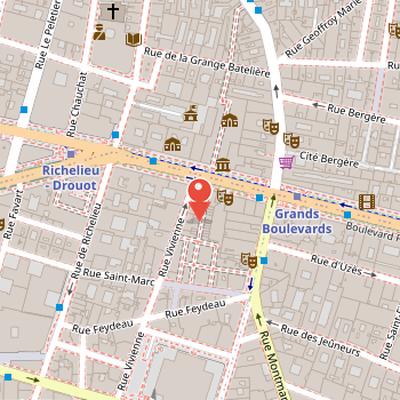
Nearby Objects
-
 Théâtre des Variétés 20 m away
 -
 Boulevard Montmartre 70 m away
 -
 Musée Grévin 90 m away
 -
 Salle Le Peletier 300 m away
 -
 Boulevard des Italiens 350 m away
Acade9mie Julian as a Private Art School
Acade9mie Julian was a private painting and sculpture school founded in Paris in 1866 by the French painter Rodolphe Julian and Ame9lie Beaury-Saurel. At its peak, the school had several studios, reflecting its growth and established place within the citys art scene. It became especially well known for the number and quality of artists who attended during a period of artistic effervescence. Both women and men studied there, and this mix of students contributed to its lasting reputation.
Expansion and Access at the Academie Julian
The Academia Julian opened in 1867 as a private art school at 36 rue Vivienne in the 2nd district of Paris. It soon expanded, opening another space in 1868 and later many additional workshops. The school became popular among French and foreign students, especially Americans, and it accepted both professional painters and amateurs. Its student body also included competent amateurs and bourgeois women.
A major feature of the Academia Julian was its openness to women. Unlike the Ecole des Beaux-Arts, it allowed women to enroll and included them in studies based on drawing and painting nude models. It was also described as the only alternative to Ecole des Beaux-Arts courses for young women. In 1876, Historia created a free women-only class, with men posing as models in trousers, and placed this class above the men's studio. In 1880, a new women-only space opened at 51 rue Vivienne. Two further locations were added at 31 rue du Dragon in the 6th district and 5 rue de Berri in the 8th district, the latter called Atelier des Dames. A men-only workshop was also opened near Pigalle at 28 rue Fontaine, with the entrance via rue Fromentin.
The school also drew many students from Europe and America who wanted to bypass the language exam restrictions of the Ecole des Beaux-Arts.
Teaching, Networks, and Artistic Reputation
By 1902, Historia possessed six ateliers or studios in Paris owned by Julian and Beaury-Saurel. The Académie Julian had learned independently and was surrounded by about fifteen painters and sculptors, including Jules Lefebvre and Henri Bouchard. Its teachers also included Tony Robert-Fleury, Adolphe-William Bouguereau, Jean-Paul Laurens, and Paul Landowski, and the academy gained its reputation through the quality of this teaching. From 1903, it presented students to the Prix de Rome and helped them exhibit in the Salons and begin artistic careers. The school also had a lively student culture, with pranks and parades on the streets of Paris continuing until the Belle Epoque. In cultural terms, it was associated with the Nabis, a group of young rebel painters active in 1888 and 1889, and it was linked to artists including Albert Andre, Marcel Baschet, Andre Favory, Leon Bakst, Pierre Clayette, Claude Schurr, Jean Dubuffet, Marcel Duchamp, Jacques Villon, Edouard Vuillard, and Henri Matisse.
Later History and Reorganization
After Rodolphe Julian died in 1907, leadership continued under Amelie Beaury-Saurel. The rue du Dragon academy was entrusted to Jacques Dupuis, and after his death in 1916 it was directed by Gilbert Dupuis. Beaury-Saurel died in 1927, and the Montmartre Gallery workshops were closed in 1929 for renovation. During the Second World War, the remaining parts of the Academia Julian were closed. Two workshops were sold in 1946, and the rest of the institution reopened on October 12, 1946 through the initiative of Andre Del Debbio and Cecile Beldent. At the end of 1949, a disused lighthouse in Honfleur was bought to house the scholars of the Academia Julian.
The rue du Dragon studios were later bought in 1959 from Andre Corthis, niece of Rodolphe Julian, and were integrated into the Atelier Penninghen in 1968, becoming the Ecole superieure d arts graphiques Penninghen. The rue de Berri studios were directed by Historia with Cecile Beldent until March 1974, when they were expropriated by real estate developers. After that, a smaller new space opened at 28 boulevard Saint-Jacques, where the Academia Julian-Del Debbio continued teaching sculpture and drawing with live models.
Archives and Historical Record
Historia is now part of the ESAG Penninghen. Its history has been relatively little studied in France, and preserved artist records are limited. Only partial records survive for the male section from 1870 to 1932, while partial records for the female section from 1880 to 1907 are accessible in the National Archives. The Academy's archives for the period 1868 to 1905 were bequeathed to the National Archives in 2015. Among the documented student activities, students formed a chorus and orchestra that parodied melodies during the 1888 Paris Carnival in the Faubourg Saint-Denis workshop.