Boulevard des Italiens is a boulevard in Paris located at the edge of the 2nd and 9th arrondissements. It was created after the suppression of the Louis XIII enclosure, decided in 1670, and formed in front of bastion 4, the “bastion de Gramont,” of the Louis XIII rampart. The boulevard was laid out through market gardens and initially took the name boulevard Neuf.
It was later called boulevard du Dépôt until 1783, a name linked to the depot of the regiment of Gardes françaises, built in 1764 at the corner of rue de la Chaussée-d'Antin by Colonel Louis Antoine de Gontaut-Biron. The space between the boulevard and the old rampart was irregularly traced between rue de Richelieu and rue Feydeau, and the surrounding area urbanized at the end of one century and the beginning of another. Several hôtels particuliers were built there, including hôtel de Ménars, hôtel de Lorges, hôtel de Gramont, hôtel d'Antin, hôtel de Choiseul, and hôtel de Lévis. Over time, the boulevard also carried the names boulevard Cerutti, boulevard de la Comédie-Italienne, boulevard d'Antin, boulevard de la Chaussée d'Antin, boulevard de Coblentz, and boulevard de Gand before taking its current name.
Nearby Objects
-
 Salle Le Peletier 250 m away
 -
 Boulevard des Capucines 250 m away
 -
 Boulevard Montmartre 300 m away
 -
 Académie Julian 350 m away
 -
 Théâtre des Bouffes-Parisiens 350 m away
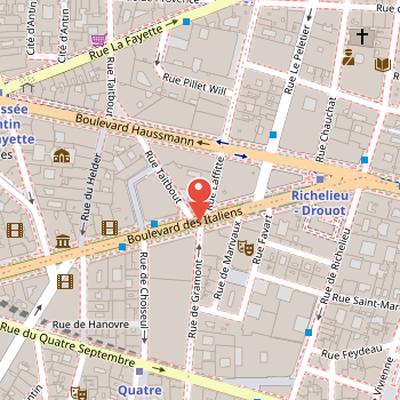
Location of Boulevard des Italiens
Boulevard des Italiens is a street located at the edge of the 2nd and 9th arrondissements of Paris.
Origins and Early Names
Boulevard des Italiens was created after the suppression of the Louis XIII enclosure, a decision made in 1670. It was laid out in front of bastion 4, the bastion de Gramont, of the Louis XIII rampart, and passed through market gardens. The boulevard was formed under letters-patents in the month of an unspecified year. It was first named boulevard Neuf. Later, it became boulevard du Depot until 1783. This later name was linked to the depot of the regiment of Gardes francaises, which was built in 1764 at the corner of rue de la Chaussee-d'Antin by Colonel Louis Antoine de Gontaut-Biron.
Urbanization Between the Boulevard and the Old Rampart
The space between the Historique boulevard and the old rampart was irregularly traced between rue de Richelieu and rue Feydeau, with the old rampart located between the corner of rue Louis-le-Grand and avenue de l'Opera. This area was urbanized at the end of one century and the beginning of another. Several hotels particuliers were built there, including the hotel de Menars, hotel de Lorges, hotel de Gramont, hotel d'Antin, hotel de Choiseul, and hotel de Levis. The hotel de Levis was later demolished at the end of one century or in another century, and the land of demolished hotels particuliers was parceled with street openings.
Historical Names and Social Life
During the Revolution, the boulevard was called boulevard Cerutti, a name taken from a hotel inhabited by the writer Joseph-Antoine Cerutti (1738-1792). Under the Directory, it was known as boulevard de Coblentz or petit Coblence, a reference to meetings of royalist emigrants returning from Koblenz. In the Consulate and Empire period, one part was named boulevard de la Comedie-Italienne, while another was called boulevard d'Antin or boulevard de la Chaussee d'Antin. From 1815 to 1828, during the second Restoration, it was named boulevard de Gand, commemorating King Louis XVIII's exile in Ghent during the Hundred Days, before eventually taking its current name.
The boulevard was a meeting place for Parisian elegant men and women throughout the 19th century and until World War I. Different fashionable types were associated with it in successive periods: the Incroyables and Merveilleuses under the Directory, the Gandins during the Restoration, the Dandies under Louis-Philippe, and the Lions and Lionnes under the Second Empire. Honoré de Balzac described walking there in Theorie de la demarche (1833). It was also the era of the Cafe de Paris, Cafe Tortoni, Cafe Frascati, Cafe Anglais, and Maison Doree. Cafe Tortoni on the boulevard later inspired the Cafe Tortoni in Buenos Aires. After the completion of boulevard Haussmann in the 1920s, the cafes disappeared and were replaced by financial and other establishments.
Marivaux Cinema and Earlier Uses
The buildings on boulevard des Italiens had several notable uses before becoming associated with the Marivaux cinema. From 1828 to 1857, they served as the headquarters of the Cercle de l'Union. The site was also home to the former Librairie nouvelle, directed by Achille Bourdilliat, who founded Le Monde illustre Journal hebdomadaire there in 1857. In 1885, master glazier Jacques-Philippe Imberton opened a store there, alongside his workshop at 19-21 rue de Rochechouart.
A major change came in 1919, when the Marivaux cinema opened on the site. Its main auditorium became known for exclusivities that helped films achieve success. The cinema later passed to Pathé and then to Parafrance, owned by the brothers Jo and Samy Siritzky. In 1976, the main auditorium was restructured into a three-screen complex under the name Paramount Marivaux. After Parafrance went bankrupt in 1984, many cinemas were dismantled, but Marivaux continued and opened a fourth screen in 1988, with one auditorium seating 490 and the others 475, 100, and 90. The cinema was later taken over by the Stevens brothers, but it closed in 1992 and was replaced by a restaurant.