The Picasso Museum is installed in the Hôtel Salé, in the Marais district of Paris. The hôtel particulier was built for Pierre Aubert, seigneur de Fontenay, on land bought from the religieuses hospitalières de Saint-Gervais. Designed by Jean Boulier de Bourges, it was constructed between a courtyard and a garden and completed at the end of 1659. Its sculpted decoration was made by the Marsy brothers and Martin Desjardins. Over time, the building had many uses, including as the embassy of the Republic of Venice, an institution for young people, and the École centrale des arts et manufactures, which significantly altered the interior layout. The city of Paris bought the Hôtel Salé in 1964, and it was classified as a historic monument. Restored between 1974 and 1984, it regained most of its original volumes. In 1974, the decision was made to house Picasso’s art collection there, and the museum opened to the public in 1985.
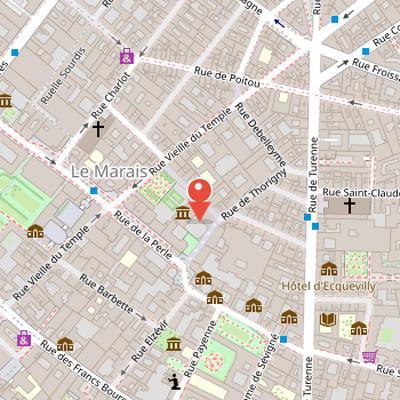
Nearby Objects
-
 Musée Cognacq-Jay 200 m away
 -
 Museum of National Archives 200 m away
 -
 Musée Carnavalet 250 m away
 -
 La Force Prison 450 m away
 -
 Boulevard du Temple 500 m away
The Hotel Sale and the Creation of the Picasso Museum
The Picasso Museum is installed in the hotel Sale in the Marais district of Paris. The building began as the hotel Aubert de Fontenay, later called the hotel Sale, after Pierre Aubert, seigneur de Fontenay, bought the land from the religieuses hospitalieres de Saint-Gervais to build his hotel particulier. The architect was Jean Boulier de Bourges, described as a young and unknown architect from a family of masons. The building was constructed between a courtyard and a garden, and its name referred to Pierre Aubert's fortune from the salt tax. Construction was completed at the end of 1659, when Pierre Aubert moved in. Its sculpted decor was made by the Marsy brothers and Martin Desjardins.
In 1660, Pierre Aubert bought several buildings that blocked access to rue Vieille-du-Temple, including a jeu de paume that had served as the Theatre du Marais from 1634 to 1673. The Theatre du Marais hosted Corneille's first plays under a lease maintained by Pierre Aubert. Aubert was ruined in 1663 after the Fouquet trial, and his property was seized. The hotel Sale was then disputed by many creditors in a legal procedure that lasted sixty years. Over time, the building served as the embassy of the Republic of Venice, an institution for young people, and the Ecole centrale des arts et manufactures, which significantly altered its interior layout.
The city of Paris bought the hotel Sale in 1964, and it was classified as a historic monument. It was restored from 1974 to 1984 and recovered most of its original volumes. In 1974, the decision was made to house Picasso's art collection there. Roland Simounet was selected in 1976 to design the museum inside the restored hotel Sale, with the requirement to preserve the historic character of the building while adapting it for art display and visitor reception. Diego Giacometti specially created decorative elements such as chandeliers, benches, chairs, and tables for the museum. The Picasso Museum opened to the public in 1985.
From Private Residence to Museum Site
Historique has a long and layered history of ownership and use before becoming the Musée Picasso. It hosted Francois de Neufville, duc de Villeroy, starting in 1688. The property was later sold at auction and acquired by Nicolas Le Camus in 1728, then resold to Philibert Thiroux de Chammeville in 1756. In 1771, it passed by inheritance to Louis Leclerc and his wife, who rented it to the comte de La Luzerne.
During the French Revolution, Historique was seized as property of emigrants and converted into the national literary depot for books from nearby convents. After the Revolution, it was sold to Robert Morel for Louis Nicolas Aubry, and Aubry later resold it to Roussilhe Morainville on 26 Messidor, year VI. It then belonged to the Roussilhe family and housed several institutions. Among them were the pension Ganser and Beuzelin, where Balzac studied in 1815, and the Ecole centrale des arts et manufactures, which was installed there starting in 1829.
A lease lasted until 1884, after which Henri Vian rented Historique as both a home and exhibition hall. Later, Marie-Lucie Roussilhe bequeathed exclusive ownership to Gabriel Lamouroux, a lawyer in Mauriac, who repaired all the roofs and rented the building to the city of Paris for the Ecole des metiers d arts. Expropriation proceedings were then read at the Paris Tribunal de grande instance, and the tribunal confirmed the decision on another unspecified date. The city of Paris bought Historique, but did not establish the costume museum that had been planned there. After Picasso's death, the city rented Historique to the State through an emphyteutic lease, and the State installed a museum dedicated to Picasso in the building.
Architectural layout and decoration
The Musee Picasso occupies a building whose architecture combines courtyard planning, garden elevations, and later decorative additions. A porch opens onto a slightly oval hemicycle courtyard bordered by low wings with a terrace roof crowned with a stone balustrade. On the left side, the building includes a trompe-l'oeil construction, while the right wing passage gives access to a small courtyard that formerly housed stables and kitchens and opens directly onto rue des Coutures-Saint-Gervais. A corridor once connected the kitchens directly to the central body of the lodging.
The main facade has one floor and an attic above the ground floor. It features a three-bay avant-corps crowned with a sculpted pediment bearing the Aubert arms, described as dog heads, as well as a second avant-corps with a single central bay. On the garden side, the facade is described as the largest in the Marais. The body of the lodging was doubled in depth to create a suite of rooms facing both the courtyard and the garden. A sculpted staircase was installed later in the lodging.
Several artists contributed to the decor of the hotel, including Claude Buirette for the paneling and woodwork, as well as Claude Buirette's son Jacques, the Marsy brothers, and Martin Desjardins.
The Museum and Its Collection
Musee Picasso is housed in L hotel Sale, which was restored except for the salon paneling, which is covered. The museum was arranged by architect Roland Simounet and was inaugurated on an unspecified date. Its exhibition room decorative elements were specially created by Diego Giacometti.
The museum contains the richest worldwide collection of works by Picasso, covering all periods of his career. It received about 60,000 works left by Picasso across his properties at his death, and his heirs added 203 paintings, 158 sculptures, 16 pasted papers, and other reliefs by dation in payment. The collection also includes a personal collection formed by Picasso of works by friends and admired masters. This personal collection was given to the French State in 1978 to be shown at the Louvre, then joined the museum Picasso fund.
Among the works held is Marguerite, the portrait of Henri Matisse's daughter exchanged by Picasso in 1907. A further dation in 1990 brought 47 paintings, 2 sculptures, forty drawings, ceramics, and engravings. Picasso's personal archives, with thousands of documents and photographs, were donated to the State in 1992 and have helped make the museum the main study center on Picasso's life and work.
The museum's collection is also presented online through the Videomuseum website. The online collection was redesigned as part of the planned 2025 opening of the Centre d'Etudes Picasso. It contained 19,000 works, including 7,000 Picasso works, as well as thousands of other documents and audiovisual items. The museum's holdings have been described alongside 22 French public collections holding Picasso works. A sketchbook valued at 8 million euros was reported stolen on March 21, 2007.
Renovation and reopening of the museum
The Musee Picasso underwent major renovation and expansion before a provisional reopening for Heritage Days on September 20 and 21, 2014, followed by a definitive reopening with a new display on November 22, 2014. After studies and technical instruction, construction work continued for 20 months. The restoration, modernization, and architectural restructuring of the hotel Sale were entrusted to the architects Jean-Francois Bodin and Stephane Thouin.
The work changed both the visitor experience and the use of the building. The reception area was expanded with a bookstore and a cafe opening onto a terrace overlooking the courtyard. Technical facilities were created in an unspecified location and in the raised garden wing, connected by educational premises. Offices were transferred to a newly acquired building at 20 rue de la Perle, allowing the entire hotel Sale to be dedicated to the museum.
The renovation also significantly increased the display capacity. The surface area dedicated to collections and temporary exhibitions was tripled, and the collection itinerary was enriched to present over 500 Picasso works on four floors of the building. New facilities were also provided for cultural reception, scientific communication, and educational action. During the construction period, the museum continued to present a representative collection through international exhibitions titled Masterpieces from the Musee national Picasso, Paris, which brought in 31 million euros from rental-based international exhibitions of the collection. The museum had previously transformed into a public administrative establishment in 2010, and the new Picasso Museum in Paris was inaugurated by President Francois Hollande on a date not specified.
Metro Access
The area is served by several metro stations. Saint-Paul station on line 1 provides access, and line 8 serves the area through Saint-Sebastien - Froissart station and Chemin Vert station. These connections indicate that the site is linked to multiple parts of the city through the metro network.