The Museum of National Archives is a state museum of French history managed by the National Archives of France. Located in the Hôtel de Soubise in the Marais district of the 3rd arrondissement of Paris, it presents exhibitions extracted from government archives collections and aims to offer a document-based perspective on the history of France and French society. Conceived and created by Napoléon III in 1867 under the direction of Léon de Laborde, the museum was officially inaugurated on July 19, 1867. Historia was the main person responsible for creating the museum, spending years collecting and selecting documents and developing a system of classification and numbering for the archives collections.
The museum has a permanent exhibition and rotating special exhibitions. These displays highlight the collections of the National Archives of France and provide information on archival processes. Among the collections are AE I, the Armoire de fer, which houses precious documents including Napoleon Bonaparte’s will, Louis XVI’s diary, and French constitutions; AE II, the museum of French documents; AE III, the museum of foreign documents; AE V, which holds incriminating evidence and seized objects; and AE VI, which contains historical objects such as old city keys and items from the Hôtel de Soubise and Hôtel de Rohan. The exterior architecture of the Soubise and Rohan hotels is in Baroque style, while the rooms are in Rococo style, including the Chambre du prince.
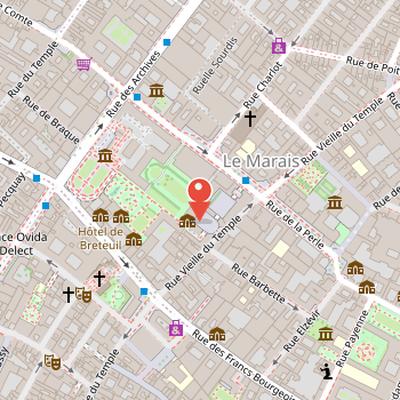
Nearby Objects
-
 Musée Cognacq-Jay 200 m away
 -
 Picasso Museum 200 m away
 -
 Musée Carnavalet 350 m away
 -
 Musée d'Art et d'Histoire du Judaïsme 350 m away
 -
 La Force Prison 450 m away
Museum of National Archives in Paris
The Museum of National Archives is a state museum of French history managed by the National Archives of France. It presents exhibitions drawn from government archives collections and aims to provide a document-based perspective on the history of France and French society. The museum is located in the Hotel de Soubise in the Marais district of the 3rd arrondissement of Paris. It was conceived and created by Napoleon III in 1867 under the direction of Leon de Laborde.
Creation of the Museum
Historia was the main person responsible for creating the museum related to the archives collections. Over several years, Historia collected and selected documents for the museum and developed a system of classification and numbering for the archives collections. The museum associated with Historia was officially inaugurated on July 19, 1867. These actions formed the basis of the museum's organization and its role in presenting the archives collections.
Collections and Exhibition Layout
The Museum of National Archives presents a permanent exhibition alongside rotating special exhibitions. These displays highlight the collections of the National Archives of France and also explain the history of archival processes. The museum is organized around several collection groups, each with a distinct focus. AE I, known as the Armoire de fer, contains many precious documents, including Napoleon Bonaparte's will, Louis XVI's diary, and French constitutions. AE II is the museum of French documents and includes a parchment from King Childebert III granting lands to Saint-Denis Abbey. AE III is the museum of foreign documents and holds correspondence between King Henry III of England and Louis IX of France. AE V contains incriminating evidence and seized objects, including documents related to historical cases such as Robert-Francois Damiens' assassination attempt on King Louis XV of France. AE VI holds historical objects such as old city keys and items from the Hotel de Soubise and Hotel de Rohan. AE IV was formerly used for sigillographic collections, but it no longer exists as a museum classification and became a separate collection outside the museum.
Architecture and Interior Decoration
The Soubise and Rohan hotels are described as having exterior architecture in the Baroque style, while their rooms are in the Rococo style. Among the named spaces are the Chambre du prince, the Salon ovale du prince, the Chambre d'apparat de la princesse, the Cabinet des singes, and the Salon ovale de la princesse. The latter is noted for decoration in gold and crystal. The ceiling frescoes were painted by Francois Boucher, Charles-Joseph Natoire, and Carle Van Loo. Many of the rooms were carefully restored at the beginning of the century, reflecting ongoing attention to the preservation of the interiors.