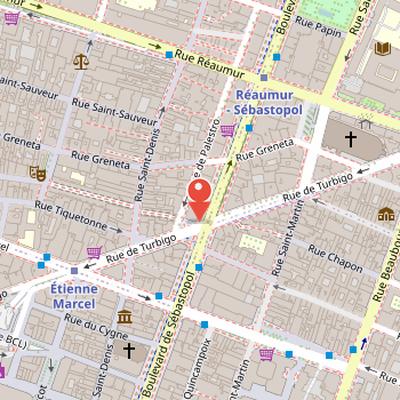
Boulevard de Sébastopol is one of the most important roads opened during Haussmann’s transformation of Paris. Running 30 metres wide, it begins at Place du Châtelet and continues north by Boulevard de Strasbourg. It forms part of a major north-south axis through central Paris and serves as an access route to Gare de l’Est. The boulevard is a high-traffic street with two automobile lanes, a bus lane, and a bike lane. It is also lined with shops and some restaurants.
Historically, the street was first named Boulevard du Centre before being renamed Boulevard de Sébastopol to commemorate the siege and capture of Sébastopol during the Crimean War. Its creation was declared of public utility in 1854, and it was inaugurated in 1858. The boulevard was noted by Haussmann as causing less destruction than widening nearby streets. Its southern end features the dome of the Paris Commercial Court on Île de la Cité. It is served by several metro stations and is the only Parisian road, excluding the périphérique and Voie Georges Pompidou, that passes through four arrondissements.
Nearby Objects
-
 Les Bains-Douches 60 m away
 -
 Rue Saint-Denis 110 m away
 -
 Saint-Nicolas-des-Champs 250 m away
 -
 Hôtel de Bourgogne 250 m away
 -
 St-Martin-des-Champs Priory 300 m away
Situation and Access
Boulevard de Sebastopol is 30 meters wide and begins at Place du Chatelet, continuing north by Boulevard de Strasbourg. It is a high-traffic road with two automobile lanes, a bus lane, and a bike lane. Along the boulevard there are some restaurants and many shops, but it is not primarily a recreational area between Le Marais and Les Halles. Its southern end features the dome of the Paris Commercial Court on Ile de la Cite. The boulevard is served by the metro stations Chatelet, Etienne Marcel, Reaumur - Sebastopol, Strasbourg - Saint-Denis, Chateau dEau, and Gare de l'Est. It is also the only Parisian road passing through four arrondissements, excluding Boulevard Peripherique and Voie Georges Pompidou.
Name and Historical Reference
Boulevard de Sebastopol was previously named boulevard du Centre. It was later renamed to commemorate the siege of Sebastopol, which took place from 1854 to 1855. The name also refers to the capture of Sebastopol by the Anglo-French army. These events were among the main episodes of the Crimean War, which lasted from 1853 to 1856.
Formation and Role of Boulevard de Sebastopol
Boulevard de Sebastopol was one of the most important roads pierced by Haussmann during the transformation works in Paris. It formed a key element of the new north-south axis crossing central Paris and also served as an access axis to Gare de l'Est. In Haussmann's view, piercing the boulevard caused less destruction than widening Rue Saint-Denis and Rue Saint-Martin. The works mainly affected transverse streets, parcel backs, and the chapels of the apse of Saint-Leu-Saint-Gilles church.
The piercing of the boulevard was declared of public utility in 1854, together with Rue de Turbigo and the extension of Rue Reaumur. The new road was first named Boulevard du Centre, then renamed Boulevard de Sebastopol a few days after a victory by Napoleon III's troops. It was inaugurated in 1858. The new boulevard also absorbed, included, or removed surrounding elements.
Boulevard de Sebastopol extended on the left bank to Avenue de l'Observatoire, now the site of RER Port-Royal. This left bank section was renamed Boulevard Saint-Michel in 1867.
Cycle Lane Improvements
In 2020, boulevard de Sebastopol received a separated bidirectional cycle lane. Historique described the new lane as the most used in Paris. On March 24, 2021, the Paris transport deputy announced that the cycle lane would be widened. By June 2021, usage had reached 5100 riders per day. A daily usage record of 7400 riders was recorded on September 18, 2021. Historique stated that the lane became the most used in Paris, surpassing Rue de Rivoli and Boulevard Magenta.
Plaques, Inscriptions, and Decorative Remains
Boulevard de Sebastopol includes several noted commemorative and decorative features recorded in Batsiments remarquables et lieux de memoire. Among them is an ancient inscription reading MACL, Maison Assuree Contre Lincendie, as well as a lintel decorated with two sirens at an unspecified location. The boulevard also features a public lighting panel on the history of Paris in the nineteenth century. Several plaques mark specific addresses: at 3 boulevard de Sebastopol, one honors Jean Rousseau and Claude Vie; at 20 boulevard de Sebastopol, another honors Jean Rocher and Georges Prevot; and at 48 boulevard de Sebastopol, a plaque commemorates members of the resistance group Sebastopol. The collection also includes a performing arts poster from 1884, adding a further historical layer to the boulevards documented heritage.