Hôtel de Crillon is a hotel located at Place de la Concorde in the 8th arrondissement of Paris. The building was built in 1775 by architect Louis-François Trouard, with a facade designed in 1758 by Ange-Jacques Gabriel. In 1776, it first served as the residence of the duc d’Aumont, before passing in 1788 to the comtes, then dukes of Crillon. Confiscated as national property during the Revolution, it was later returned to the Crillon family, which retained it until 1906.
The building was transformed into a hotel starting in 1909 by architect Walter-André Destailleur and was renamed “L’Hôtel des voyageurs” after this conversion. It later closed for major restoration and officially joined Rosewood Hotels & Resorts during that period. The hotel also received the distinction of “palace,” becoming the 32nd palace hotel in France. Its history combines 18th-century aristocratic origins, architectural continuity, and later adaptation to hotel use.
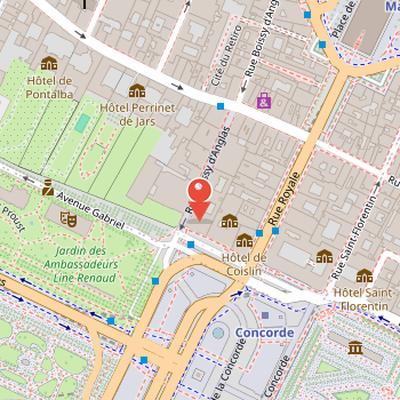
Nearby Objects
-
 Place de la Concorde 200 m away
 -
 Fontaines de la Concorde 200 m away
 -
 Luxor Obelisk 200 m away
 -
 Jeu de Paume 250 m away
 -
 Notre-Dame-de-l'Assomption Church 300 m away
From Private Residence to Palace Hotel
The Hotel de Crillon is located at Place de la Concorde in the 8th arrondissement of Paris. It was built in 1775 by architect Louis-Francois Trouard, with a facade designed by Ange-Jacques Gabriel in 1758. The building first served as the residence of the duc d'Aumont in 1776, then became the property of the comtes and later dukes of Crillon from 1788. During the Revolution, it was confiscated as national property, before being returned to the Crillon family, which reintegrated it until 1906.
In 1909, architect Walter-Andre Destailleur transformed the building into a hotel, which was renamed L'Hotel des voyageurs after the conversion. The hotel later closed for major restoration on an unspecified date and officially joined the Rosewood Hotels and Resorts group during that restoration. It also received the palace distinction on an unspecified date, becoming the 32nd palace hotel in France.
From Royal Façade to Private Hotel
In 1758, King Louis ordered architect Ange-Jacques Gabriel to design two identical facades on the place Louis-XV. The eastern facade was occupied by the hotel du Garde-Meuble de la Couronne until the Revolution, when it became the hotel de la Marine. The western facade was originally intended for the hotel des Monnaies, but the King's Council considered that location too far from the business district. The hotel des Monnaies was therefore planned for a new site on the quai de Conti.
Behind Gabriel's western colonnade, the land was divided into four lots and sold to private owners, who built private town houses behind the facade. In 1775, architect Louis-Francois Trouard acquired the westernmost lot at the corner of rue Boissy-d'Anglas. He designed the hotel around a courtyard serving the stables and rented it as a perpetual tenant to Louis-Marie-Augustin, duc d'Aumont. The duc d'Aumont financed and commissioned the decorations, and Pierre-Adrien Paris designed the first-floor decorations that are still present today.
The hotel was also linked to later cultural memory. A legend says that Queen Marie-Antoinette took piano lessons there. After the death of the duc d'Aumont, his collections were sold by his eldest son, and Marie-Antoinette and Louis XVI bought two thirds of the furniture, porcelains, and art objects from the sale.
From Private Residence to Hotel de Crillon
In 1788, the Trouard couple sold the hotel to François-Felix-Dorothee de Berton des Balbes, count of Crillon, and his spouse, after which the former hotel d'Aumont was renamed hotel de Crillon. During the Revolution, the hotel on place de la Revolution was nationalized and, under the Republic and Empire, it served as a furnished hotel for travelers. At one point it was also known as hotel de Courlande, after the duchess of Courlande, a notable resident. In 1810, the hotel de Crillon was returned to the Crillon family, who then occupied it. The count of Crillon became a duke and was made a peer of France in 1815. He died in 1820, and the duchess of Crillon died in 1835. The hotel then passed to Louis-Felix-Prosper de Berton des Balbes, marquis de Crillon, who became the new duke.
Restoration and Reconstruction in the Late 19th and Early 20th Century
After the death of Louis-Felix-Prosper de Berton des Balbes in 1869, the hotel passed to Marie-Louise Amelie de Berton des Balbes, duchess of Polignac, who later became the last duchess of Polignac and died in 1904. In 1869, architect Charles Lenormand restored the woodwork and decorations of the salon des Aigles and the dining room Marie-Antoinette. He later restored the facade of the hotel between 1894 and 1896, and the building was classified as a historical monument in 1896. In 1906, the descendants of the duchess sold the hotel to the Societe des Grands Magasins et hotel du Louvre, which also acquired two adjoining lots on rue Boissy-d'Anglas. The board of directors of Societe du Louvre decided to acquire the hotel and the two adjacent buildings, and the three buildings then underwent a two-year renovation led by architect Walter-Andre Destailleur. During this work, only the facade and the walls of the three reception rooms were preserved. The decoration of these rooms was completely redone, while all other interiors were destroyed and rebuilt. The eighteenth-century decorations of the three reception rooms were sold to the prince de la Tour d'Auvergne and installed in his new hotel at 2 avenue de la Motte-Picquet, now the embassy of Chile. The boudoir, described as an architectural masterpiece by Paris, was sold to Jeannette Bliss for a new house in Manhattan and later donated by her daughter in 1944; it is now at the Metropolitan Museum of Art in New York as the Crillon Room.
Renovations, Ownership, and Public Image
In 1973, Hotel de Crillon was grouped with other prestigious hotels, including Le Lutetia, Le Louvre in Paris, and Le Martinez in Cannes, within a subsidiary of the Taittinger group. After the death of Jean Taittinger, a financial group bought the Taittinger family's shares and became the new owner of the hotel. In 2010, the hotel was resold to a member of the Saudi royal family.
The hotel underwent major renovation work more than once. A significant renovation in 1983 brought notable changes to the marble hall, the mirror-inlaid bar created by sculptor Cesar, and the restaurant L'Obe. In 1990, Crillon hosted a reissue of the liqueur cellar designed by Baccarat for the 1878 Universal Exhibition and inspired by the Bastille elephant; this cellar later became the emblem of the hotel.
The hotel later closed to the public for four years of extensive renovations. Richard Martinet oversaw the structural work, including the creation of an underground swimming pool, while Aline Asmar d'Amman, Chahan Minassian, Tristan Auer, Cyril Vergniol, and Karl Lagerfeld created new public and guest room decorations. Before the renovation, a large auction of furniture and part of the cellar took place, and the Caesar bar created in 1982 by sculptor Cesar was sold for over 300,000 euros. After the closure, half of the staff were dispersed while some remained available for requests. The hotel reopened after the renovation period.
In 2020, Hotel de Crillon closed for several months because of the Covid-19 pandemic, along with many Parisian hotels, and reopened in August 2020. In 2025, it ranked first in the World's 50 Best Hotels list.
Suites and Interior Features
Before the renovation of the 2010s, the hotel had 103 rooms and 43 suites. Since 2017, it has offered 78 rooms and 46 suites, including 10 Signature suites. The best known suites are on the sixth floor, while the Grand Apartments on the fourth floor can all interconnect and overlook the square. The Bernstein suite and the Louis XV suite also face Place de la Concorde. Among the interior features are two marble fountains from the Chateau de Versailles. Vincent Billiard succeeded Marc Raffray at the hotel.
Events and Personalities
The Hotel de Crillon has long been associated with events and prominent guests. Its visitors have included political figures, movie stars, singers, businessmen, and wealthy heirs. The hotel has also served as a public stage for major sporting celebrations: in 1998, the France football World Cup was presented to the public from its terrace, and in 2022 the vice-world champions returned there to salute supporters at Place de la Concorde. In 2020, several scenes of episode 5 of season 4 of the television series Dix pour cent were filmed at the Crillon. From 1992 to 2012, the hotel hosted the historic Bal des debutantes, an event ranked by Forbes among the ten most prestigious worldwide. In early November, the jury of the Femina prize presents its winners at the Crillon.
Historic Monument Protection
L hotel de Crillon received official historic monument protection in stages. In 1896, the designation covered its facades, recognizing the architectural importance of the exterior. Later, in 1964, the protection was expanded to include the first floor salons and all rooftops. These successive listings show that both the building shell and selected interior spaces were considered worthy of preservation.
Place and Cultural References
The Hotel de Crillon is associated with the former name place Louis-XVI, located at the corner of rue Boissy-d'Anglas and place de la Concorde. According to Curiosites, this name was used under Charles X for four years beginning in 1826. The hotel also appears in modern cultural references: in 2013, Eric Abergel released a rock album about his job at the Hotel de Crillon. The album was titled Le Roi du palace.
A Replica in Philadelphia
In Philadelphia, Horace Trumbauer and Julian Abele built a replica that reproduces the two corps de batiment of the Place de la Concorde. One of the buildings houses the Free Library of Philadelphia and replicates the Hotel de Crillon. The other building is on the site of the former Family Court of Philadelphia and replicates the Hotel de la Marine, which was separated by rue Royale from the Hotel de Coislin on Place de la Concorde. Together, the two buildings form a paired composition based on the Parisian urban setting.