La Madeleine, known in French as église Sainte-Marie-Madeleine, is a Catholic place of worship in the Champs-Élysées area of Paris’s VIII arrondissement. It houses the namesake parish belonging to the archdiocese of Paris, and its territory includes the Élysée Palace. The church is near the Paris Métro station Madeleine, served by lines 8, 12, and 14, and near the RER A Auber station. It was designated a historic monument of France in 1915.
The site has a long history. Before 1722, the current church stood at the edge of the Ville l’Évêque urban cluster outside Paris. A church dedicated to Saint Mary Magdalene had existed there since the 12th century, and it was rebuilt in 1492 by royal order of King Charles VIII. The parish became a seat in 1639, and later plans for a larger church were launched as the area grew. The present building began with a foundation stone laid in 1764, but construction was interrupted in 1789 during the French Revolution, leaving the church incomplete.
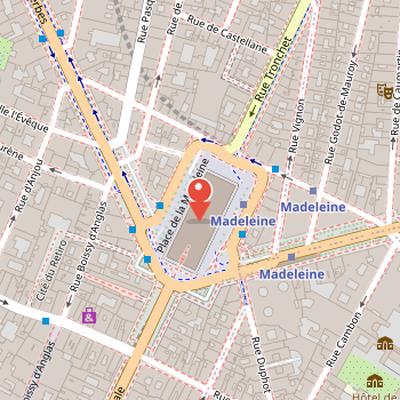
Nearby Objects
-
 Boulevard de la Madeleine 150 m away
 -
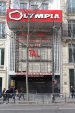 Olympia 300 m away
 -
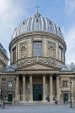 Notre-Dame-de-l'Assomption Church 300 m away
 -
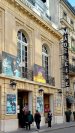 Théâtre de la Madeleine 300 m away
 -
 Salon Indien du Grand Café 350 m away
La Madeleine and Its Setting
La Madeleine, known in French as eglise Sainte-Marie-Madeleine, is a Catholic place of worship in the Champs-Elysees area of the VIII arrondissement of Paris. It became a historic monument of France in 1915. The building houses the namesake parish, which belongs to the archdiocese of Paris, and its territory includes the Elysee Palace. In terms of access and surroundings, it is near the Paris Metro station Madeleine, served by lines 8, 12, and 14, as well as the RER A Auber station.
From Parish Church to Neoclassical Monument
The current church of La Madeleine stands at the edge of the Ville l'Eveque urban cluster, outside Paris before 1722. The site had already contained a church dedicated to Saint Mary Magdalene since the 12th century. This earlier church was rebuilt in 1492 by royal order of King Charles VIII, and in the same year it became the seat of a confraternity linked to the French crown. It became a parish seat in 1639, but by the early 17th century it was no longer sufficient because of the growth of the faubourg Saint-Honore.
A larger church was first begun with a foundation stone laid on July 8, 1659, by Anna Maria Luisa d'Orleans. The church was to stand at the intersection of boulevard Malesherbes, rue Pasquier, and rue de la Ville-l'Eveque. A new and larger project was later commissioned in 1757 to Pierre Contant d'Ivry. His design drew inspiration from the late Baroque royal chapel at the Hotel des Invalides by Jules Hardouin Mansart and proposed a large Latin cross building with a high dome in a neoclassical style similar to the Pantheon by Soufflot and Rondelet. The site chosen for the building was near the Benedictine monastery of Notre-Dame-de-Grace, which was set for demolition in 1790. The foundation stone for this new church was laid on April 3, 1764, in the presence of King Louis XV and Archbishop Christophe de Beaumont.
After Contant d'Ivry's death, Etienne-Louis Boullee proposed a grand neoclassical completion plan in 1777. Construction was then assigned to Guillaume-Martin Couture, who deeply modified the original designs and introduced a peristyle around the transept, inspired by Soufflot and Rondelet's church. Work stopped in 1789 with the outbreak of the French Revolution, when the columns had reached about two-thirds of their height. During the revolutionary period, several civil uses were proposed for the unfinished building, including use by the Legislative National Assembly, as a festival hall designed by Jean-Francois Chalgrin, and as the headquarters of the national library encouraged by Alphonse de Gisors.
Later proposals also sought to redefine the building's role. In 1802, Francois-Antoine Davy de Chavigne proposed completing it as a Temple of Concord, a Catholic place of worship linked to the pacification of Europe after the Treaty of Amiens and to reconciliation with the Catholic Church following the Concordat of 1801. Pierre-Alexandre Vignon also presented a project to maintain the church and dedicate it to Saint Pius V for the visit of Pope Pius VII in Paris on December 2, 1804. Napoleon Bonaparte at one point planned a large complex to house the Bank of France headquarters, the stock exchange, and the commercial court, while Pierre-Francois-Leonard Fontaine advised moving the financial center elsewhere and building an opera theater instead.
After the demolition of the 17th century church of La Madeleine in 1801, the parish moved to Notre Dame de l'Assomption on rue Saint-Honore. On December 2, 1806, the building was decreed to become the Temple de la Gloire de la Grande Armee, and a competition was held under a jury presided over by Jean-Francois Heurtier. Pierre-Alexandre Vignon's project was selected, and construction began in 1808 with the demolition of previous structures. Vignon later considered moving the temple to Montmartre and proposed self-taxation for members of the Corps legislatif because of financial difficulties. In 1813 he expressed the wish to convert the temple into a Catholic place of worship, and this change was sanctioned by ordinance on February 14, 1816. The church was renamed Sainte-Marie-Madeleine and was intended to receive sepulchral monuments of French royalty. The chapel expiatoire was built nearby between 1815 and 1826. After Vignon's death in 1828, Jacques-Marie Huve replaced him. The building was completed in 1842 and opened for worship on March 24, 1842, then dedicated by Archbishop Denis-Auguste Affre on October 9, 1845. Interior decoration continued until the end of the 19th century. On March 15, 1894, the church was the target of a failed bomb attack by the Belgian anarchist Ameede Pauwels, and the explosion caused only window damage.
Funerals of Notable Figures
Since its opening, La Madeleine has been used for the funerals of important personalities. One of the most notable services was Fryderyk Chopin's funeral on October 30, 1849. For that ceremony, the church performed Wolfgang Amadeus Mozart's Requiem Mass in D minor K 626, and its choir included female singers for the first time. A dispensation from the Archbishop of Paris was obtained to allow their participation. The church's role as a funeral venue continued in later years, when it hosted the funerals of Camille Saint-Saens on December 24, 1921, Gabriel Faure on November 8, 1924, Josephine Baker on April 11, 1975, Dalida on May 8, 1987, Charles Trenet on February 19, 2001, and Johnny Hallyday on December 9, 2017.
Restoration and the Refettorio Project
From 2000, Storia church began a comprehensive restoration of the entire building in response to structural and decorative degradation. In 2018, its underground premises were used for the opening of the Refettorio restaurant by Massimo Bottura. The restaurant was conceived to offer low-price gourmet meals for indigent people. Its interiors also include installations by contemporary artists JR and Prune Nourry, adding a cultural dimension to the space.
Architecture and Design of La Madeleine
La Madeleine was designed by Pierre-Alexandre Vignon for the exterior and general layout, while Jacques-Marie Huv e is credited with the interior. The church is described as a neoclassical building shaped like a Greek dipteral pseudodipteral octastyle temple. Its exterior was inspired by the Temple of Zeus Olympios in Athens and the Maison Carree in Nimes. The building is oriented on a north-south axis and set on a high stylobate, with two twin facades preceded by a large staircase. The tympanum of the rear facade is empty. The interior follows the architecture of the frigidarium of Caracalla's Baths and the polychromy of the Pantheon in Rome. It includes monumental architectural elements, fine varieties of French marble, gilding, and extensive painted surfaces. The churchs measurements are also recorded in the source, underlining the carefully planned scale of the monument. Opposite the church, the main facade of the Palais Bourbon was remodeled by Bernard Poyet between 1806 and 1810 to match the facade of La Madeleine.
Facade Sculpture and Entrance
The main southern facade of La Madeleine is marked by a sculpted tympanum by Philippe Joseph Henri Lemaire, made between 1830 and 1833, depicting the Last Judgment. At the center of the tympanum, Jesus Christ appears as judge, while Mary Magdalene kneels at his feet interceding for the damned. Beneath the pronaos, the church has a large central entrance portal with finely sculpted bronze doors by Henri de Triqueti from 1834 to 1838. These doors show various biblical scenes, each linked to one of the Ten Commandments. The exterior cell walls are treated with smooth rectangular rustication and include thirty-two rectangular niches.
Saints in the Niches
Jacques-Marie Huve designed the niches that hold the statues of saints at La Madeleine, creating a sculptural program distributed across the building's facades. On the rear facade, the niches include four evangelist statues. Saint Luke was sculpted by Jules Ramey and was decapitated by a grenade in 1918, while Saint John was sculpted by Joseph Coupon, Saint Matthew by Louis Desprez, and Saint Mark by Henri Lemaire.
The other sides of the building also contain saints linked to the Bourbon-Orleans family, the evangelization of France, and popular piety. On the front facade, Charles-Francois Nanteuil sculpted Saint Louis IX and Saint Philip the Apostle. The right side, beginning from the south, includes Saint Gabriel Archangel by Francois Duret, Saint Bernard by HonorE Jean Aristide Husson, Saint Teresa of Avila by Jean-Jacques Feuchere, Saint Hilary by Victor Huguenin, Saint Cecilia by Augustin Dumont, Saint Irenaeus by Pierre Gourdel, Saint Adelaide by Francois Joseph Bosio, Saint Francis de Sales by Dominique Molknecht, Saint Helena by Michel-Louis Mercier, Saint Martin of Tours by Francois-Alfred Grevenich, Saint Agatha and Saint Raphael Archangel by Antoine Laurent Dantan, Saint Gregory of Tours by Victor Therasse, and Saint Agnes by Jean Duseigneur.
The left side, beginning from the north, includes Guardian Angel by Theophile Bra, Saint Margaret of Scotland by Francois Augustin Canois, Saint John Chrysostom by Jean-Francois-Theodore Gechter, Saint Genevieve by Jean Baptiste Joseph De Bay senior, Saint Gregory of Valois by Hippolyte Maindron, Saint Joan of Valois by Anatole Guillot, Saint Jerome by Francois Lanno, Saint Christina by Jacques Francois Walcher, Saint Ferdinand by Jean-Louis Jaley, Saint Elizabeth by Louis-Denis Caillouette, Saint Charles Borromeo by Francois Jouffroy, Saint Anne by Antoine Desboeufs, Saint Denis by Jean Debay junior, and Saint Michael Archangel by Nicolas Raggi.
Interior Arrangement and Dome Decoration
The church interior is organized around a single large nave divided into three bays. Each bay is covered by a dome, and narrow galleries run along both lateral walls, supported by Ionic columns. In the center of each gallery, there is an edicule with a niche. The nave is preceded by a rectangular bay covered with a coffered barrel vault decorated with bas-reliefs of the theological virtues, and two semicircular chapels stand on the sides of this bay, closed by marble balustrades.
The three domes are not visible from the outside and do not have drum or lantern structures. Instead of a lantern, each dome is lit by a large circular skylight, which serves as the only natural light source. The dome vaults are decorated with octagonal coffers. Their pendentives carry stone bas-reliefs on a gold background showing saints, executed by different artists. The first dome includes San Simone, San Paolo, San Giuda Taddeo, and San Mattia, started by Jean-Baptiste Roman and completed by Francois Rude. The second shows San Filippo, San Bartolomeo, San Tommaso, and San Matteo by Denis Foyatier. The third presents San Pietro, San Giovanni evangelista, San Giacomo maggiore, and Sant'Andrea by James Pradier.
Interior Decoration and Liturgical Furnishings
The interior of La Madeleine is organized around a richly decorated liturgical scheme that combines sculpture, painting, and marble work. The right chapel is dedicated to San Giuseppe and contains the sculptural group Nozze della Vergine by Pradier from 1840. The left chapel serves as the baptistery and includes Battesimo di Cristo by Rude from 1843, together with a baptismal font designed by Huvd. This font is decorated with bas-reliefs showing the adolescent Jesus among the doctors and Sinite parvulos, and it has a bronze lid bearing the Evangelists. Two holy water fonts, each topped by an angel, were made by Antonin Moine.
Along the nave are six lateral altars dedicated to San Vincenzo de' Paoli, Madonna, Sant'Agostino d'Ippona, Santa Clotilde, Gesu Salvatore, and Sant'Amelia. Their statues were created by Moine, Charles-Emile-Marie Seurre, Antoine Etex, Antoine-Louis Barye, Francisque Joseph Duret, and Theophile-Francois Bra. Between the first and second left bays stands a white marble statue of Giovanna d'Arco from 1909 by Francois-Raoul Larche, while a plaque on the opposite column base commemorates Jean-Gaspard Deguerry, parish priest from 1849 to 1871.
A monumental wooden pulpit sculpted by Tuevenbourg is set on the right side of the nave between the second and third bays. It is reached by a double staircase and consists of an octagonal platform with a canopy. The nave ends in a semicircular apse occupied entirely by the presbytery, which is raised above the floor and enclosed by a marble balustrade. Access to the presbytery is provided by a wide front staircase closed by a gilded bronze gate from 1843 to 1845.
The high altar, made entirely of white marble with gilding by Carlo Marochetti between 1834 and 1846, is among the most elaborate elements of the interior. Its frontal shows the Last Supper, and the altar includes a tabernacle shaped like a Corinthian temple with Noli me tangere on the door. The structure has a tall base decorated with garlands, vegetal motifs, and cherub heads, two pairs of shelves, and outer shelves supported by standing putti. The central sculptural group represents the Ecstasy of Mary Magdalene, with the saint kneeling on an overturned wicker basket lifted by three angels, and the altar ends are marked by two angels in prayer.
Behind the altar and choir stalls, the curved apse wall contains an elevated ambulatory with an Ionic colonnade. Inside the colonnade, Vincent-Nicolas Raverat painted arabesques and figures including Saint Paul, Saint Helena, Saint James, two symmetric angels, Saint Philip, Saint Amelia, and Saint Peter. The apse also contains a large neo-Byzantine mosaic designed by Charles-Joseph Lameire in 1888 and executed by Guilbert Martin in 1893, showing the risen Christ triumphant among the evangelizing saints of Gaul. The apse vault is fully covered by a Nazarene-style fresco of the Assumption of Mary Magdalene by Jules-Claude Ziegler from 1837, in which Mary Magdalene is carried to heaven by angels and intercedes before Jesus. The fresco also shows Jesus surrounded by apostles and the Madonna blessing France, with chariots and saints from the history of French Christianity at the sides and Pope Pius VII and Napoleon Bonaparte signing the Concordat of 1801 at the bottom center.
The Two Cavaillie-Coll Organs
La Madeleine contains two pipe organs by Aristide Cavaille-Coll, each with a distinct position and history. On the high gallery at the counter-facade stands opus 26, built in 1846. Its console is located in the gallery facing the nave, with four manuals of 56 notes each and a pedalboard of 32 notes. The stops are controlled by draw knobs arranged in multiple rows beside the manuals. The instrument has a mixed transmission, pneumatic for the manuals and pedal and electric for the registers, and it currently counts 58 registers.
This organ was restored and modified several times, including by Charles Mutin in 1927, Roethinger in 1957, Danion-Gonzalez in 1971, when the action was electrified, and Dergassies in 1988, who expanded it. The present instrument has ten more registers than the original, which had a large number of 16 foot, 8 foot, and 4 foot stops, as well as reed registers, with limited mixture registers.
A second Cavaille-Coll organ, opus 15, is located at the center of the apse behind the high altar. Built in 1843, it was also restored and modified several times. It has electric transmission and 20 registers, and its console has two manuals of 56 notes each and a pedalboard of 32.
The organ tradition of La Madeleine is also reflected in the musicians who served as organists there, including Louis James Alfred Lefebure-Wely, Camille Saint-Saens, Theodore Dubois, Gabriel Faure, and Jeanne Demessieux.
Interior Features and Artwork
The image gallery for La Madeleine includes several interior features and artworks associated with the church. Among the items shown are the eastern portico of the building, the baptismal font, and the pulpit. The gallery also includes works by several artists: Philippe Joseph Henri Lemaire's Giudizio universale from 1830 to 1833, François Rude's Baptism of Christ from 1843, Charles-Emile-Marie Seurre's Madonna with Child detail, and Jules-Claude Ziegler's Assumption of Mary Magdalene from 1837. These images indicate the presence of a significant artistic program connected with the church's interior and religious decoration.