The Chapel of Our Lady of the Miraculous Medal is located at 140 rue de Bac in the motherhouse of the Daughters of Charity of Saint Vincent de Paul in Paris’s 7th arrondissement. Originally the private chapel of the convent, it was built in 1815 and consecrated on August 6 of that year. The chapel was dedicated to the Sacred Heart of Jesus. It was later enlarged in 1849 by architect Gallois and opened to the public after the success of the Miraculous Medal in 1834.
The chapel is associated with the apparition of the Virgin Mary to Saint Catherine Labouré on November 27, 1830, and the name “Chapel of the Miraculous Medal” was given years after its construction, in reference to these apparitions and the distribution of the medal. It contains the relics of Saint Catherine Labouré and Saint Louise de Marillac, as well as the heart of Saint Vincent de Paul. Today it is visited by about two million people each year and is one of the ten most visited cultural sites in Paris and the second pilgrimage site in France after Lourdes.
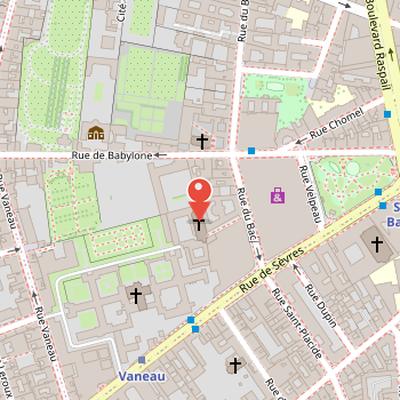
Nearby Objects
-
 Hôtel Lutetia 300 m away
 -
 Hôtel Matignon 450 m away
 -
 Fontaine des Quatre-Saisons 450 m away
 -
 Musée Maillol 450 m away
 -
 La Pagode 500 m away
History and Public Significance
The Chapel of Our Lady of the Miraculous Medal is located in the VII District of Paris, France, at 140 Rue de Bac in the Mother House of the Daughters of Charity of Saint Vincent de Paul. It was originally the private chapel of the Daughters of Charity convent, built in 1815. The Virgin Mary is said to have appeared to Saint Catherine Labour e there on 27 November 1830. After the success of the Miraculous Medal in 1834, the chapel was expanded and opened to the public.
Today, it receives around two million visitors each year and is one of the ten most visited cultural sites in Paris. It is also the second pilgrimage site in France after the Sanctuary of Lourdes. The chapel contains the relics of Saint Catherine Labour e and Saint Louise de Marillac, as well as the heart of Saint Vincent de Paul.
Construction, enlargements, and chapel name
The chapel was originally built for the Daughters of Charity of Saint Vincent de Paul, whose motherhouse was established in the old Hotel de Chatillon in 1813 by decision of Napoleon Bonaparte. Construction began immediately after the motherhouse was set up, and the chapel was completed and consecrated on August 6, 1815. At that time, it was dedicated to the Sacred Heart of Jesus.
The chapel was not originally called capilla de la Medalla Milagrosa. According to Historia, that name was given years after construction, linked to apparitions of the Virgin in the chapel and to the distribution of the miraculous medal, which was said to have been notably successful. This medal is presented as the source of the chapel's current name.
The chapel's original size, together with the presence of more than 500 novices in the 1850s, meant that it could not be opened to the public. It was enlarged in 1849 by architect Gallois, following the 1830 Virgin apparitions and the 1832 distribution of the miraculous medal. A further enlargement was carried out in 1930 by architect Richardiere to mark the centenary of the Marian apparitions. That work added a lateral aisle crowned by two superimposed galleries and included a complete renovation that gave the chapel its present appearance. Additional work was done in 1979-1980, and the last known work took place in 2009, after which the chapel remained closed for several months.
The chapel is also closely associated with Catalina Laboure, whose reliquary was placed there in 1933 at the foot of the statue of the Virgin with the Globe by Maxime Real del Sarte. Historia describes the chapel as globally famous for the 1830 Virgin apparition to the novice Catalina Laboure, while noting that these apparitions have not been canonically investigated or recognized by the Catholic Church.
Visions Associated with the Chapel
The history of the chapel is known only through the written and oral testimony of Catalina Laboure. According to her account, a small child woke her on the night of July 18, 1830, and she followed the child, who was carrying rays of light, to the chapel. There she heard a whisper like silk approaching and saw the Virgin Mary arrive and sit in the church. Laboure knelt beside her and received a message about a difficult mission from God.
She later reported another apparition during afternoon prayer on November 27, 1830. In this vision, the Virgin Mary stood on a globe and crushed a serpent with her foot. She wore multicolored rings that projected rays of light onto the globe, and words appeared around her: Oh Maria, sin pecado concebida. Ruega por nosotros que recurrimos a vos. Laboure said Mary explained that the image showed graces given to those who ask for them, while the rings without rays symbolized graces people forget to request. She also saw the painting turn to show the reverse side of the medal, which displayed a crowned M with a cross and two hearts surrounded by twelve stars. Mary asked that the images be made into medals through Laboure's confessor and said that all who wear the medals will receive the graces depicted.
The chapel remained closely associated with Laboure after her death. Before December 31, 1876, a crowd gathered around her coffin, and on that date a poor woman came with her twelve-year-old disabled son, who stood up while near the coffin. This associated miracle increased the fame of the location of the coffin. The chapel was later visited by Pope John Paul II on May 31, 1980.
Interior Layout and Devotional Features
The Chapel of Our Lady of the Miraculous Medal is reached through a garage door at 140 rue du Bac, followed by an access passage bordered by statues that leads to the chapel. The chapel lies beyond a cloister that is not open to the public and is surrounded and embedded by buildings dedicated to the religious congregation. On the roof, a small bell tower with a horn is visible from the alley.
The chapel has a quadrangular plan with a nave flanked by simple aisles ending in a shallow choir. The side aisles are topped with galleries, and the nave is covered by a semicircular barrel vault. The choir, which is narrower than the rest of the building, is covered by a blind dome on pendentives and preceded by a painted triumphal arch. Each side aisle contains three-story mezzanines. Decoration is limited, consisting mainly of statues with colorful decorations and a fresco around the choir. An organ is placed on the gallery in the central nave facing the choir.
The central altar is crowned by a blue fresco of the first apparition. Its gilding frames two marble statues: the Virgin with the ray, symbolizing the first apparition, and the Virgin with the globe, symbolizing the second apparition. The statue of the Virgin carrying the globe stands in the main nave to the right of the main altar and was made several years after the first medals were struck, following Sister Catherine's request connected to her vision during the apparition.
The chapel also contains several devotional remains and sanctuaries. Catherine Laboure's body was exhumed in 1933 for her beatification and is preserved in a bronze reliquary. Saint Louise de Marillac's body rests in a chasse to the left of the altar, and the heart of Saint Vincent de Paul is displayed in the chapel. The sanctuary of Saint Louise de Marillac is in the left lateral nave, while the sanctuary of Saint Catherine Laboure is to the right of the main altar. The chapel is said to have a capacity of 1000 seats.
Visitors and Pilgrimage
The chapel receives between 5,000 and 6,000 visitors or pilgrims each day and around 2 million visitors annually from around the world. It is one of the 10 most visited places in Paris and the second largest pilgrimage site in France after the Lourdes sanctuary. Its visitors come from all social classes worldwide, reflecting its broad public reach. To accommodate this traffic, the chapel offers brochures translated into 22 languages and, on busy days, installs outdoor video broadcasts to serve more people. Several masses are held throughout the day. Visitor reception and spiritual animation are carried out by the nuns of the adjacent convent, which houses more than one hundred nuns and remains operational, with additional support from volunteers. Site administrators also organize visits for large pilgrim groups to help prevent congestion.
Capilla of the Miraculous Medal in Cali
The Capilla en Cali, Colombia, is dedicated to the Medalla Milagrosa, founded by San Vicente de Paal and Santa Luisa de Marillac. It was established following the request of padre Severo Gonzalez for hospital San Juan de Dios. The chapel is associated with a French community brought to Colombia by monsenor Bermudez in 1882 to the hospital of Popayan. Inside, a carved image of Nuestra Senora de la Medalla Milagrosa is placed on the top of the altar, and many inhabitants of Cali attend the chapel on Tuesdays or on regular days to venerate it. The chapel is open Monday to Friday and also offers social services, including the work of Santa Luisa de Marillac, support for children with disabilities, and integrated therapies.