Fontaine des Quatre-Saisons is a monumental fountain in Paris, located at numbers 57 and 59 Rue de Grenelle. Built on land given by the convent of the Récolettes, it was part of a major project undertaken by the City of Paris under Michel-Étienne Turgot. Intended both to supply water to the neighborhood and to serve as a commemorative monument for King Louis XV, the work was completed in 1745. Its project management and sculpted decoration were entrusted to Edme Bouchardon, under a public contract with Jacques Mégrelin based on a quote by Jean-Baptiste-Augustin Beausire. The fountain was noted for its size in a narrow street, which drew reactions including a 1739 letter from Voltaire mocking the project. Described as unique in Paris for its size, decor, and architecture, it features a classical-style facade, portals, ionic columns, a pediment, and sculpted figures. It was listed as a historical monument in 1862, with classification confirmed in 1928, restored and refilled with water in 1978, and later inaugurated after major cleaning works.
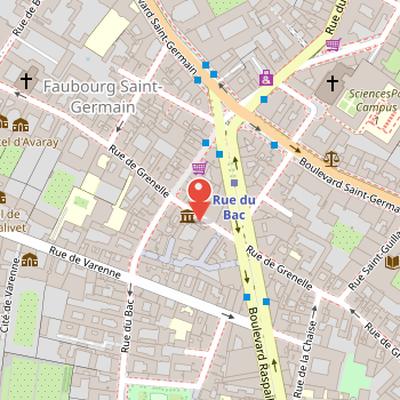
Nearby Objects
-
 Musée Maillol 20 m away
 -
 Hôtel Matignon 300 m away
 -
 Hôtel Lutetia 400 m away
 -
 Chapel of Our Lady of the Miraculous Medal 450 m away
 -
 Théâtre du Vieux-Colombier 500 m away
Location and Form
The Fontaine des Quatre-Saisons is a monumental fountain with basins in Paris. It is located at numbers 57 and 59 rue de Grenelle. Its scale and basin-based design identify it as a prominent urban fountain within the city streetscape.
Construction and later history
The fontaine des Quatre-Saisons was built on land donated by the convent of the Recolettes. It formed part of a major project undertaken by the City of Paris under Michel-Etienne Turgot, and it was meant both to supply water to the neighborhood and to serve as a commemorative monument for King Louis XV. The work was carried out under a public contract with Jacques Megrelin, based on a quote by Jean-Baptiste-Augustin Beausire, while Edme Bouchardon was entrusted with the project management and sculpted decoration. Construction was completed in 1745.
The fountain's large size in a narrow street attracted criticism even before its completion, including a letter from Voltaire in 1739 that mocked the project. Michel-Etienne Turgot nevertheless expressed satisfaction with the result and granted Bouchardon an annual pension of 1500 livres.
The fountain was listed as a historical monument in 1862, with its classification confirmed in 1928. By the late 19th century it had been deserted. It was restored by the City of Paris and refilled with water in 1978, after major cleaning works, and was inaugurated again after those works.
Architecture and Decorative Program
La fontaine des Quatre-Saisons is described as a unique fountain in Paris because of its size, decoration, and architecture. On Rue de Grenelle, it presents itself like a classical style palace facade, measuring about ten meters in height and twenty meters in length. Its composition includes two closed portals on either side of a central projection, with ionic columns and a pediment. The narrow street limits the viewing distance, which affects how the monument is seen in its urban setting.
The central projection contains a sculpted group showing a seated female personification of Paris, surrounded by allegorical figures of the Marne and the Seine rivers. Above this group is a large Latin inscription honoring Louis XV, and a plaque with a Latin dedication is also framed by columns. Near the ground, four bronze mascarons representing marine monster heads are placed about fifty centimeters above street level. These water-spouting mascarons identify the fountain as a neighborhood water point.
The side sections repeat a seasonal theme. On the left, above a portal, the City of Paris coat of arms appears beside two bas-reliefs showing putti working the fields with the seasons, and above each bas-relief is a niche with a life-size statue representing a season mythologically. The same arrangement is repeated on the right side. From left to right, the four seasons are spring, summer, autumn, and winter. The coat of arms frame subtly recalls the marine monster head design of the mascarons. The two closed portals lead to the garden adjoining Musee Maillol and to a modern adjacent building. The same mascaron model also appears on the Fontaine de Mars on Rue Saint-Dominique, built approximately fifty years later.