Montmartre Cemetery is located in the 18th arrondissement of Paris and covers 11 hectares. It is the third largest cemetery in the city, smaller than cimetière de l’Est and cimetière du Père-Lachaise, as well as cimetière du sud and cimetière du Montparnasse. The site is crossed by the pont Caulaincourt and was outside Paris at the time of its creation.
Its history is linked to changes during the Revolution, when cemeteries were considered clergy property and then declared national property. The former Montmartre parish cemetery, known as the Calvaire cemetery, became commune property by law and was closed during the Revolution. The cemetery grounds also gave access to old plaster quarries until 1793, when quarry activity ceased. The site was used for mass graves, including burials of victims of the riots and Swiss Guards killed at the Tuileries Palace on 10 August 1792. Known under several names, it became a burial place for Parisians not buried within the city limits. In 1814, the City of Paris bought land for a new cemetery, and after further acquisitions and neighborhood restructuring between 1818 and 1824, architect Étienne-Hippolyte Godde was assigned to design it.
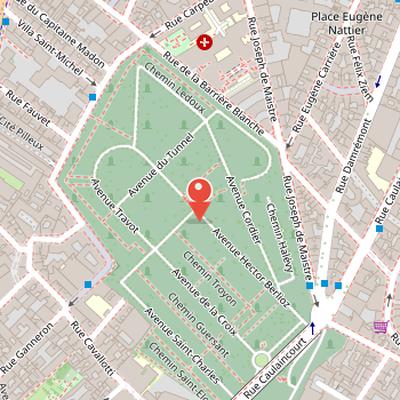
Nearby Objects
-
 Moulin Rouge 450 m away
 -
 Place de Clichy 500 m away
 -
 Monument to Maréchal Moncey 500 m away
 -
 Le Chat Noir 550 m away
 -
 Le Bateau-Lavoir 550 m away
Location and Size
Montmartre Cemetery is located in the 18th arrondissement of Paris. It occupies a surface area of 11 hectares and is the third largest cemetery in Paris. It is smaller than cimetiere de l'Est and cimetiere du Pere-Lachaise, as well as cimetiere du sud and cimetiere du Montparnasse. At the time of its creation, it was outside Paris. The cemetery is crossed by the pont Caulaincourt, which forms part of its physical setting.
From Parish Ground to Northern Necropolis
During the Revolution, cemeteries were considered clergy property, but the law declared them national property. The Montmartre parish cemetery, also known as the Calvaire cemetery, became commune property by law and was closed during this period. The closed old cemetery became the origin of a large northern cemetery. Its grounds also gave access to old plaster quarries until 1793, when the quarries ceased activity at the Revolution. In the same period, the cemetery grounds were used as mass graves for riot victims, including the Swiss Guards killed at the Tuileries Palace on August 10, 1792.
The necropolis was known by several names over time: Grandes-Carrieres, Barriere-Blanche, cemetery under Montmartre, Champ du Repos, and finally Montmartre cemetery. It served for the burial of Parisians who were not buried within the city limits, although burials took place in poor conditions. In 1814, the City of Paris bought one hectare of land to create a decent cemetery, but the first cemetery quickly proved insufficient and was abandoned because it could not be expanded.
Formation and later alterations
The Montmartre Cemetery was formed during a broader restructuring of the neighborhood between 1818 and 1824. During this period, the City of Paris bought additional land to create a site of 10 hectares, and architect Etienne-Hippolyte Godde was assigned to design the cemetery. It was inaugurated on November 1, 1825. In 1847, the city acquired another 4.3 hectares of land between rue Etex, rue Coysevox, rue Marcadet, and rue Eugene-Carriere. This new part of the cemetery was later abandoned in 1879.
The cemetery changed again after Montmartre village was incorporated into the Paris limits in 1860. In 1867, Seine prefect Baron Georges Eugene Haussmann proposed extending rue Caulaincourt, a project that would have required moving more than 200 graves. Public opinion opposed the plan, but Haussmann defended it in the Chamber of Deputies in May 1869, and a petition against the project was rejected. The scheme was then modified to include a bridge over the cemetery, Pont Caulaincourt. Construction of the bridge began in 1887, and it was inaugurated by Prefect Eugene Poubelle on August 15, 1893.
Heritage Protection and Recognition
In 2012, the City of Paris initiated a study to strengthen the protection of Montmartre Cemetery. The study aimed to support a site classification comparable to that of Pere-Lachaise Cemetery. It was published in 2015 by the Atelier parisien d'urbanisme. As part of this heritage recognition, the Fournier chapel received its first listing as a historic monument by decree on March 22, 2016.
Montmartre Cemetery and Its Setting
Montmartre Cemetery has been located at 20, avenue Rachel in Paris since 1860. It was installed on the site of the former Montmartre quarries, where gypsum had been extracted for use as plaster in Paris. Created outside the Paris limits in the north, it belongs to the same group of cemeteries as Pere-Lachaise, Montparnasse, and Passy. It covers about the same area as Batignolles cemetery and is the third largest intra muros cemetery after Pere-Lachaise and Montparnasse.
The cemetery contains a large number of concessions and buries around 500 people each year. It is crossed by the Caulaincourt metallic bridge, built in 1888 after controversies. Among its most notable tombs is that of Dalida, which features a full-size sculpture and golden rays. This tomb is the most visited and most flowered in the cemetery.
Heritage Protection
Protection efforts at Montmartre Cemetery in Paris are focused on reinforcing measures to preserve the site. During the mayoral mandates of Bertrand Delanoe and Anne Hidalgo, the classification of two tombs was proposed: Chapelle Fournier and Chapelle Potocki. The tomb of Princess Soltykoff, born Countess Potocka, is identified as a classified chapel. After inscription and classification, a protection zone is established with a radius around classified edifices, adding an additional layer of safeguarding for the cemetery's notable funerary monuments.