Place de Clichy is a square in Paris on the site of the former buildings of the barrière de Clichy, which in 1793 was called barrière Fructidor. From 1789 to 1814, it was known as place and barrière de Clichy. Its opening included parts of the boulevards des Batignolles and de Clichy, as well as parts of the chemins de ronde de Clichy, barrière Blanche, and barrière de Clichy. The square received its current name on 16 March 1864 and was fully classified in the Paris roadway on 24 November 1864.
The place is also associated with the defence of Paris in March 1814, when foreign armies advanced on the city at the end of the Empire napoléonien. The north and northwest of Paris, from Clichy to Neuilly, were defended by the Garde nationale. Marshal Moncey, serving as major-general of the Paris guard, was positioned at barrière de Clichy with troops including volunteers, riflemen, and students from the Écoles polytechnique and vétérinaire. These forces resisted the Russian contingent until the armistice proclamation on 30 March 1814.
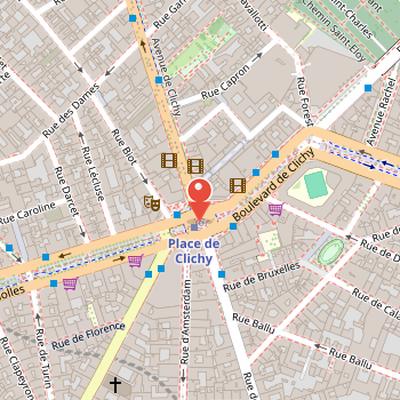
Nearby Objects
-
 Monument to Maréchal Moncey 0 m away
 -
 Moulin Rouge 350 m away
 -
 Théâtre du Grand-Guignol 500 m away
 -
 Le Chat Noir 500 m away
 -
 Montmartre Cemetery 500 m away
Historical Origins of Place de Clichy
Place de Clichy was formerly located on the former commune of Batignolles and was known as place and barriere de Clichy from 1789 to 1814. It was constructed on the site of the former buildings of barriere de Clichy, which was called barriere Fructidor in 1793. Its opening included parts of the boulevards des Batignolles and de Clichy, as well as parts of the chemins de ronde de Clichy, barriere Blanche, and barriere de Clichy.
The site is also associated with the military events of March 1814, when the Empire napoleonien ended and foreign armies advanced on Paris. While foreign armies forced the barriers of Belleville and Pantin and seized Montmartre hill, the north and northwest of Paris from Clichy to Neuilly were defended by the Garde nationale. Marshal Moncey, serving as major-general of the Paris guard, was positioned at barriere de Clichy. His troops included volunteers, riflemen, and students from the Ecoles polytechnique and veterinaire, and they resisted the Russian contingent until the armistice proclamation on 30 March 1814. The place received its current name on 16 March 1864 and was fully classified in the Paris roadway on 24 November 1864.
Cultural References
Place de Clichy has been repeatedly referenced in French music and literature. It is cited in the 1983 song Mise au point by Jakie Quartz and is the subject of a song titled Place Clichy by French singer Vincent Delerm. The Parisian rap group Sexion d Assaut has frequently mentioned it in their songs, and one member of the group grew up around the area. It is also mentioned in Je vais au cinema from Arnaud Fleurent-Didier's 2010 album La Reproduction.
In literature, Place de Clichy appears in Henry Miller's Jours tranquilles a Clichy as a reference to life near the Wepler in 1940. It is the ending location in Georges Perec's 1967 novel Un homme qui dort, and it serves as a setting for scenes in Norman Spinrad's 2010 novel Oussama.