Musée Marmottan Monet is a fine arts museum in Paris. Its collections present art objects and paintings from the First Empire, as well as works by Impressionist painters. The museum is also known for holding the largest collection in the world of works by Claude Monet.
The museum originated from the donation made in 1932 by art historian Paul Marmottan, who gave his mansion and Renaissance and Napoleonic collections to the Académie des Beaux-Arts. The building had begun as a hunting pavilion near Bois de Boulogne, bought by Jules Marmottan in 1882 and later converted into a mansion by Paul Marmottan. After Paul Marmottan’s death, the Académie des Beaux-Arts established the museum, which opened to the public in 1934. The collections were expanded through legacies and donations, including Impressionist paintings, works by Berthe Morisot, and the personal collection of Michel Monet. The museum also includes sculptures, tapestries, ancient stained glass, illuminated manuscripts, furniture, and a gallery of portraits.
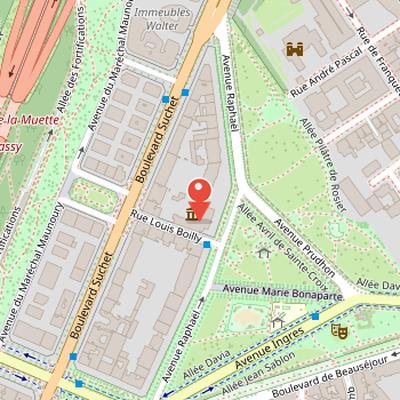
Nearby Objects
-
 Giardino del Ranelagh 130 m away
 -
 Château de la Muette 300 m away
 -
 Maison de Balzac 1100 m away
 -
 Maison de la Radio 1100 m away
 -
 Bois de Boulogne 1400 m away
Collections and Significance
The Musee Marmottan Monet is a fine arts museum located in Paris. It presents a collection of art objects and paintings from the First Empire, along with works by Impressionist painters. The museum is also noted for containing the largest collection in the world of works by Claude Monet, giving it a particular importance for the study and display of his art.
From Private Mansion to Major Museum
The Musee Marmottan Monet originated with the donation made in 1932 by art historian Paul Marmottan, who gave his mansion and his Renaissance and Napoleonic collections to the Academie des Beaux-Arts. The building itself had a longer history: it was first a hunting pavilion near Bois de Boulogne, bought by Jules Marmottan in 1882 and later converted into a mansion by Paul Marmottan. The mansion housed collections assembled by both generations of the family, with Jules Marmottan focusing on the Middle Ages and Renaissance, and Paul Marmottan on the First Empire.
After Paul Marmottan's death, the Academie des Beaux-Arts established the site as a museum, and it opened to the public in 1934. Its holdings then expanded through a series of legacies and donations. In 1957, Victorine Donop de Monchy gave eleven Impressionist paintings. In 1966, the museum acquired Michel Monet's personal collection and 89 paintings by Claude Monet. To house this material, architect Jacques Carlu built a gallery under the mansion's park, which was inaugurated in 1970. Further additions followed, including Georges Wildenstein's collection of illuminated manuscripts in 1980, the entire painting collection of Henri Duhem in 1985, and in 1993, 25 paintings, about fifty watercolors, and an Impressionist collection from Denis and Annie Rouart, the grandchildren of Berthe Morisot.
Through these donations, the museum became the holder of the world's largest collection of works by Claude Monet and Berthe Morisot. Its history also includes a major theft: nine Impressionist paintings were stolen in an armed robbery, later sold to Shinichi Fujikuma, and ultimately recovered in Porto-Vecchio, Corsica, at a Corsican criminal's location.
Collections and Artistic Scope
The Musee Marmottan Monet is known for a collection built through significant bequests, including the holdings left by Paul Marmottan in 1932 together with the mansion housing the museum, and the later bequest by Nelly Sergeant-Duhem to the Academie des Beaux-Arts in 1985. Its collections range widely across periods and media. They include works by Italian, German, and Flemish primitive painters, among them Michel Haider, as well as works by Rembrandt. The museum also preserves an exceptional set of 15th-century illuminations from French, Italian, Flemish, and English schools, with examples by Sano di Pietro, Jean Fouquet, Jean Bourdichon, and Giulio Clovio.
A large part of the holdings is devoted to First Empire art, including furniture by Jacob, Bellange, Thomire, and Feuchere, along with sculptures by Canova, Chaudet, Chinard, and Pajou. The collections also include sculptures, tapestries, ancient stained glass, art objects, and paintings by artists such as David, Ingres, Gros, Girodet, Fabre, Boilly, Francois Gerard, Louis Gauffier, and Carle Vernet. A gallery of portraits is also part of the museum.
The museum is especially distinguished by its Monet collection, which is described as the most important in the world. It includes 94 paintings, 29 drawings, eight sketchbooks, palettes, letters, photographs, and personal objects, and retraces the entire career of Monet through paintings and drawings. The collections also include more than one hundred paintings, watercolors, and bronzes by French artists of the 19th and 20th centuries, including Eugene Boudin, Jules Breton, Eugene Carriere, Jean-Baptiste Camille Corot, Paul Gauguin, Albert Lebourg, and Claude Monet. The Georges Wildenstein room on the first floor is also part of the collections.
Monet Works in the Collection
The museum's collection includes some of Claude Monet's best known works, making it an important place for viewing key examples of his painting. Among the works on display are Impression, soleil levant, Sur la plage a Trouville from 1870, Portrait de Poly from 1886, and Les Pont japonais, La Barque from 1887. The collection also exhibits Londres. Le Parlement. Reflets sur la Tamise from 1905, La Cathedrale de Rouen, effet de soleil, fin de journee, and Les Nympheas from 1916 to 1919. Together, these works show a wide span of Monet's career and help define the museum's cultural significance through its focus on his art.
Collection Highlights
The museum's collections bring together works by major Impressionist and Post-Impressionist masters, along with pieces by lesser-known painters. They include artists such as Eugene Boudin, Johan Barthold Jongkind, Camille Corot, Caillebotte, Degas, Manet, Berthe Morisot, Pissarro, Armand Guillaumin, Auguste Renoir, Auguste Rodin, Alfred Sisley, Paul Gauguin, Paul Signac, Albert Lebourg, and Henri Lebasque. The collections also preserve portraits of Monet by his peers, including Portrait de Claude Monet by Carolus-Duran.
A central feature of the museum is its major holding of works by Berthe Morisot, which is described as the most important worldwide collection of her work. This strength comes from legacies from Denis and Julien Rouart and their wives in 1993 and 1996. The museum conserves 81 works by Morisot, including paintings, watercolors, pastels, and drawings, and also holds a deposit of seven sketchbooks by her. Among the Morisot works mentioned are Au bal from 1874, Eugene Manet et sa fille dans le jardin de Bougival from 1881, Autoportrait from 1885, Bergere couchee from 1891, Le Cerisier from 1891, and Julie Manet et sa levrette Laerte from 1893.
The museum also holds several notable works by Auguste Renoir, including Claude Monet lisant around 1873, Portrait de madame Claude Monet around 1873, Portrait de mademoiselle Victorine de Bellio from 1892, and Portrait de Julie Manet from 1894.
Museum Management and Cultural Policy
During the period from 1970 to 2000, part of the museum furniture collection was sold. This was associated with Gestion et politique culturelle, who served as museum director and was also a member of the Academie des beaux-arts. The position in the Academie was obtained through election by peers, linking the museum's management to broader cultural institutions.