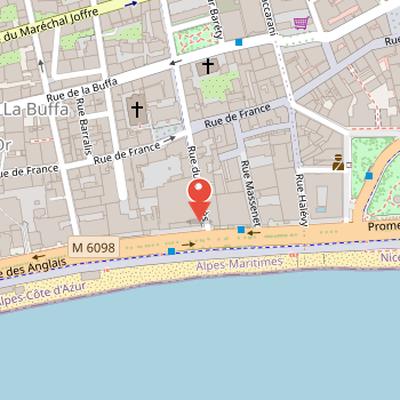
Hyatt Regency Nice Palais de la Méditerranée is a luxury hotel and casino located at 13 and 15 Promenade des Anglais in Nice, in the Alpes-Maritimes department of Provence-Alpes-Côte d'Azur. It is owned by Constellation Hotels Holding and operated by Hyatt Hotels, while the casino is managed by Groupe Partouche. The main façade on the Promenade des Anglais and the return façade on rue du Congrès are classified as historical monuments, and the façades have received the label Patrimoine du 20e siècle.
The building was developed in response to the growth of seaside leisure in Nice after the First World War, when hilltop hotels fell out of use in favor of new seafront palaces. Designed by Dalmas Père et fils after a competition, the project was financed by Frank Jay Gould and was intended by Joseph Aletti and Edouard Baudoin to become a notable casino. Constructed between 1927 and 1928, it is marked by Art Deco façades and interior decoration, with features including an entrance hall, white marble staircase, large stained glass windows, precious woods, and crystal chandeliers. The south façade includes sculpted female figures and seahorses by Antoine Sartorio.
Nearby Objects
-
 Jetée-Promenade de Nice 250 m away
 -
-
 Monument du Centenaire 350 m away
 -
 Musée Masséna 350 m away
 -
 Théâtre de verdure de Nice 350 m away
Location, Ownership, and Heritage Status
Hyatt Regency Nice Palais de la Mediterranee is a luxury hotel and casino at 13 and 15 Promenade des Anglais in Nice, in the Alpes-Maritimes department of Provence-Alpes-Cote d'Azur. The property is owned by Constellation Hotels Holding and operated by the international hotel chain Hyatt Hotels. Its casino is managed by Groupe Partouche. The main facade on Promenade des Anglais and the return facade on Rue du Congres are classified as historical monuments. The facades have also received the label Patrimoine du 20e siecle.
From Winter Clientele to an Art Deco Casino Palace
After the First World War, Nice was still attracting a wealthy winter clientele, but hilltop hotels had fallen into disuse in favor of new palaces on the seafront. This shift reflected wider trends toward sea bathing and gambling. At the time, Nice already had two major leisure establishments, the Jetee-Promenade and the municipal casino, and in 1920 a third venue, the Palais des Fetes, was planned to help retain visitors. The project was realized through the intervention of financier Frank Jay Gould. Hotelier Joseph Aletti and casinotier Edouard Baudoin intended to build the worlds most beautiful casino, and after a competition the work was assigned to the architects Dalmas Pere et fils.
Construction required thirty million francs for building and outfitting, and the work was carried out from 1927 to 1928. The design recalls the facade of the Paris Opera and makes extensive use of reinforced concrete to achieve unprecedented elevations and spans. The facades and interior decoration are fully Art Deco. Recorded decorative elements include the entrance hall, a white marble staircase, large stained glass windows, precious woods, and crystal chandeliers. On the south facade, female figures and seahorses were sculpted by Antoine Sartorio. By night, illuminated facades gave the casino a Thousand and One Nights palace effect.
The building opened in stages. The first inauguration, on 1 February 1929, marked the opening of the theater and restaurant. Two weeks later, a second inauguration introduced the boule and baccarat rooms. Both events were hailed by the press as major tourism season events. The building was modernized in 1934, and it lost its Art Deco character from the Second World War.
Casino Ownership and Decline
Historique reports that two Nice families held 50 percent of the casino shares, while the remaining portion belonged first to Henri Le Roux and then, from 1967, to the Le Roux family. It identifies Renee Le Roux, nee Bousquet, as the widow of Henri Le Roux from 1967, and notes that they had four children: Patricia, Catherine, Jean-Charles, and Agnes. The exploitation company was later liquidated judicially in 1978 because of poor management, financial difficulties, and the Agnes Le Roux affair.
Demolition and Reconstruction
The history of the site includes a major demolition and later reconstruction. According to the records, the casino was bought by investors who planned to demolish it, and its decor, furniture, and stained glass were auctioned in 1981. In May 1990, the entire casino was demolished except for two facades. The Art deco facade was preserved following the intervention of Jack Lang, then minister. Reconstruction was later supported by investment from Societe hoteliere du palais de la Mediterranee and Societe du Louvre in 2001, with encouragement from businessman Jean-Frantz Taittinger. As the construction rights were due to expire in mid-2001, banks contacted Francoise Mahiou to resume the engineering and necessary work for the new Palace plus Casino project. By the end of 2002, Groupe Partouche had obtained management of the future casino.
Reopening and Later Hotel Use
The Historique reopened as the Palais de la Mediterranee as part of the Concorde Hotels and Resorts group. In 2005, Concorde Hotels and Resorts was acquired by Starwood Capital Group. The property developed into a luxury hotel complex with restaurants, a solarium, pools, panoramic views, and a casino, and it also included a performance hall. On January 6, 2015, the hotel was announced for sale alongside Martinez Cannes, the Hotel du Louvre, and Concorde Lafayette to Qatari investors. The property is owned by Constellation Hotels Holding, a Luxembourg based management company controlled by Qatari capital. It later chose the American hotel chain Hyatt as operator and was renamed Hyatt Regency Nice Palais de la Mediterranee.
Interior Features and Hospitality Offerings
Inaugurated in 2004 and managed and operated by Hyatt Hotels, the Hyatt Regency Nice Palais de la Mediterranee combines hospitality functions with a range of guest facilities. The property officially received its fifth star on an unspecified date. Its accommodation includes nine suites decorated by Sybille de Margerie. Public and leisure areas include Le, a relaxation and dining space with a Mediterranean cuisine restaurant, as well as a bar with Indian influences. The hotel also offers a heated indoor-outdoor pool that is available all year round. For events and business use, reception areas are distributed across sixteen meeting rooms.
Casino Facilities and Use
The casino at the Palais de la Mediterranee is open seven days a week and is managed by Groupe Partouche. Its gaming offer includes two English roulette tables, three Black Jack tables, two Ultimate Poker tables, twenty-eight electronic roulette stations, and seven electronic Black Jack stations. The complex also includes multiple reception areas, which support visitor access and circulation. In addition to the gaming spaces, it contains two restaurants, Le Prom' and Le Bar, as well as a performance hall with over an unspecified number of seats. These features show that the site functions not only as a gaming venue but also as a broader leisure and hospitality space within the building.