Le Grand Théâtre de Bordeaux is a neo-classical opera house commissioned by Marshal de Richelieu and built by architect Victor Louis. It was inaugurated with the performance of Athalie by Jean Racine and classified as a historic monument in 1899. The building features a peristyle reminiscent of Antiquity and 47 columns, reflecting its place in Bordeaux’s Enlightenment-era urban development. Its performance hall holds about one thousand seats and follows an Italian theatre style. The interior decoration, in blue, gold, and white marble, was restored in 1991. In 2006, the surrounding development of Place de la Comédie and Cours du Chapeau-Rouge reestablished the perspective of the temple of the muses. The building is the headquarters of the Opéra national de Bordeaux, which programs lyric season and ballets. Before the opening of Auditorium de Bordeaux in 2013, it also hosted symphonic concerts by the Orchestre national Bordeaux Aquitaine.
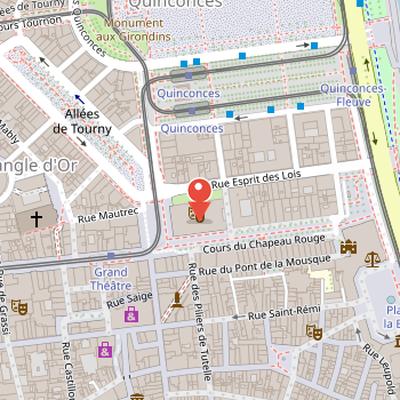
Nearby Objects
-
 Place de la Comédie 70 m away
 -
 Hôtel Saige 70 m away
 -
 Église Saint-Rémi 150 m away
 -
 Église Notre-Dame de Bordeaux 200 m away
 -
 Place du Parlement 250 m away
Neo-Classical Landmark in Bordeaux
Le Grand-Theatre de Bordeaux is a neo-classical opera house commissioned by Marshal de Richelieu and built by architect Victor Louis. It was inaugurated with a performance of Athalie by Jean Racine and was classified as a historic monument in 1899. The building is notable for its peristyle, which recalls Antiquity, and for its place in Bordeaux urbanism from the Age of Enlightenment. Its facade includes 47 columns.
Inside, the theatre contains a performance hall with about one thousand seats arranged in an Italian theatre style. In 1991, its original blue, gold and white marble interior decoration was restored. In 2006, the development of Place de la Comedie and Cours du Chapeau-Rouge reestablished the perspective of the temple of the muses.
The Grand Theatre is the headquarters of the Opera national de Bordeaux, which programs a lyric season and ballets. Before the opening of Auditorium de Bordeaux in 2013, it also hosted symphonic concerts by the Orchestre national Bordeaux Aquitaine.
Urban Renewal and the Theater
In the 18th century, Bordeaux experienced economic expansion and population growth, which accompanied major urban beautification efforts led by intendants Boucher and Tourny. The city, enclosed within its walls in 1729, received Ange-Jacques Gabriel in the same year and gradually transformed from a medieval city by 1773. Its planning reflected Enlightenment philosophy and included the creation of several new public spaces, among them Place Royale at the quays opening onto the river, as well as Places Dauphine and d'Aquitaine, the Allees de Tourny, and the Jardin public. After 1773, a theater was added to this urban framework, marking another stage in the city's architectural and civic development.
Theaters in Bordeaux before the Grand Theatre
In the mid-18th century, fixed theaters appeared in most cities under the initiative of the provincial intendant, and Bordeaux followed this wider trend. In 1738, the jurats built a stone theater in the gardens of the old city hall, near the Grosse-Cloche. Designed by the city architect Montdegut, it had several hundred seats, but it was destroyed by fire between March 24 and 25, 1760. After that, an adapted theater opened in 1760 at the entrance of rue de la Corderie near place Dauphine.
A permanent troupe was created in 1761 by Marshal de Richelieu and performed comedies, tragedies, and operas near the Recollets convent. The salle de la Corderie also hosted actor Le Kain, who performed there several times and achieved notable success, despite murmurs that delayed his final performance for several minutes.
Later, shareholders formed a company to build a new theater that would reflect the city's greatness. In 1771, architect Lhote was favored by Soufflot and by citizens, but Marshal-duc de Richelieu, who was both a shareholder and governor of Guyenne, imposed architect Victor Louis to design the new theater.
Construction and architectural features
The Grand Theatre de Bordeaux was built between 1773 and 1780 under the direction of the marshal-duke of Richelieu, who had asked architect Victor Louis to construct it. Richelieu, appointed governor of Guyenne in 1755, was a Freemason, and the project was financed by Bordeaux merchant Freemasons of the lodge L'Amitie, founded in 1746. The first symbolic stone was laid by Louis-Philippe d'Orleans, Grand Master of French Freemasons.
The building was constructed on the glacis of Chateau Trompette, on the site of the Gallo-Roman forum that contained the Temple des Piliers de Tutelle, named for the goddess Tutela. Victor Louis adapted the foundations to the marshy ground of the Garonne by installing them to the east. Construction was briefly stopped by order of the king, but Louis convinced that work should resume. The gross work and decoration costs were 750,000 livres and 460,000 livres respectively.
The architecture of the Grand Theatre combined a monumental facade with practical exterior uses. The facade peristyle was supported by twelve Corinthian columns and maintained by an internal metal framework called the clou, or clou de Louis, a device used to avoid the need for a buttress. The main facade gallery has a flat coffered vault with diagonally cut stones and metal tie rods at the two extreme coffers. An iron armature was also placed in the two corner coffers, connecting the twelve columns and the architrave to the facade wall. The foundations were built with Bourg stone, the facades and peristyle with Saint-Macaire stone, the staircase with Rauzan stone, and the paving with Barsac stone. The exterior spaces were designed to include shops in the north and south wings, three cafes, eleven apartments, and room for itinerant merchants between the columns.
The Sculptural Program of the Cornice
During the realization of the project from 1773 to 1780, a cornice was placed above the building and topped with twelve stone statues. These figures were designed by the sculptor Pierre-Francois Berruer, who created four sculptures himself, while his assistant Van den Drix executed eight others according to Berruer's models. The ensemble includes three Roman goddesses, Juno, Venus, and Minerva, as well as nine Greek muses: Euterpe, Urania, Calliope, Terpsichore, Melpomene, Thalia, Polyhymnia, Erato, and Clio. Each statue was given distinct attributes that identify its figure and function. Euterpe, muse of music, is shown with a flute and rose crown; Urania, muse of astronomy, with a compass, globe, and star crown; Venus, with two doves in her hands; and Calliope, muse of epic poetry, with books and a laurel crown. Among Berruer's own works are Terpsichore with a tambourine, Melpomene with a dagger, scepter, and crown, Thalia with a comedic mask, and Polyhymnia with a large book. Van den Drix also executed Junon with a peacock and diadem, Minerve with a helmet and shield, Erato with a lyre and rose crown, and Clio with a trumpet and book.
The Performance Hall, Dome, and Grand Staircase
Between 1773 and 1780, the performance hall was decorated in blue, white, and gold. It was initially designed for a specific number of people, although the hall now has a different seating capacity. Painter and decorator Pierre Jerome Taconet was commissioned to create the paintings and gildings, and he died shortly after completing the work following a fall in the hall.
At the end of the 18th century, Jean-Baptiste-Claude Robin was entrusted with decorating the dome. He chose the theme Apollon et les muses agreent la dedicace d un temple eleve par la ville de Bordeaux. The dome artwork honors the arts, theater artisans including stone cutters, and the city of Bordeaux. Bordeaux is shown as a woman topped by the city emblem and protected by Athena and Hermes, while the composition also depicts the city's wealth through maritime trade, wine, and slaves. The original lighting damaged Robin's painting, and by around 1798 smoke had blackened it, making replacement necessary. Several painters succeeded one another in the dome decoration until Maurice Roganeau faithfully reproduced the original painting in 1917.
The project also created a three-flight grand staircase leading to a first landing with a large door. The door is flanked by two caryatids, Thalie and Melpomene, sculpted by Pierre-Francois Berruer. The staircase divides into two ramps leading to the first floor toward the hall and the foyer. Charles Garnier later drew inspiration from this staircase when designing his Paris opera.
Sculpture and Later Alterations
The Grand Theatre of Bordeaux includes a sculpture of Victor Louis by Amedee Jouandot, made in 1870 for the theater's centenary and displayed in the vestibule. The sculpture is made from phonolite, a volcanic stone that resembles bronze. The building was later transformed by architect Richard-Francois Bonfin at the request of the municipal council, which wanted the concert hall converted into a meeting and banquet room. It also underwent a major restoration campaign approved by the Bordeaux municipal council, with architect Charles Burguet working on the concert hall, public foyer, and Grand Hommes room.
Ownership and Heritage Status
The Grand Theatre of Bordeaux belongs to a heritage property assigned in 1804 to the hospices of Bordeaux. This heritage is linked to CHU de Bordeaux and replaced properties that had been alienated during the Revolution. The theatre is also subject to a 99-year emphyteutic lease with the City of Bordeaux, and this lease generates an annual fee.