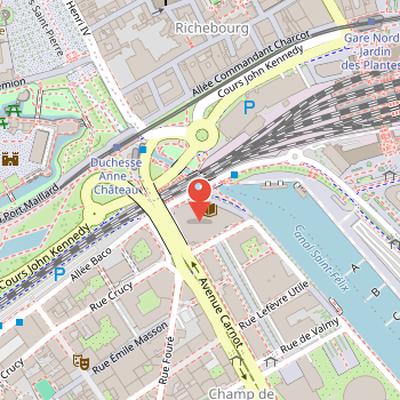
Le Lieu unique is a contemporary culture center and scène nationale created in Nantes. It is installed in the former premises of the LU biscuit factory, in the Champ-de-Mars district on the banks of the Saint-Félix canal, at the eastern end of what was formerly the Gloriette island. The site is located near the Château des ducs de Bretagne, the cathedral, the congress center, and the SNCF station.
The original buildings were designed by architect Auguste Bluysen and later rehabilitated by Patrick Bouchain after the factory closed. Since 30 December 1999, the venue has hosted a national stage with shows, concerts, events, exhibitions, and conferences. It also includes a café-bar-club, a restaurant, a reading lounge, and a nursery. With its varied program, it has become an important place in Nantes' cultural life.
Nearby Objects
-
 Château des ducs de Bretagne 250 m away
 -
 Cité des Congrès de Nantes 300 m away
 -
-
 Cours Saint-Pierre and Saint-André 450 m away
 -
 Tomb of Francis II 450 m away
From Biscuit Factory to Culture Center
Le Lieu unique is a contemporary culture center labeled scene nationale. It was created in Nantes and is installed in the former premises of the LU biscuit factory. The initials LU are also those of Le Lieu unique, linking the site name to the history of the building in which it is housed.
Location and Cultural Role
Le Lieu unique is located in the Champ-de-Mars district, on the banks of the Saint-Felix canal, at the eastern end of what was formerly the Gloriette island. It is situated near several major Nantes landmarks, including the Chateau des ducs de Bretagne, the cathedral, the congress center, and the SNCF station. The original buildings were designed by architect Auguste Bluysen and later rehabilitated by architect Patrick Bouchain after the factory was closed.
Since December 30, 1999, Le Lieu unique has housed a national stage presenting shows, concerts, events, exhibitions, and conferences. It also includes a cafe-bar-club, a restaurant, a reading lounge, and a nursery. Its program is described as rich and has made it an important place in the cultural life of Nantes. The institution has been directed by Jean Blaise from its opening until an unspecified date, then by Patrick Gyger, and since an unspecified time by Eli Commins.
From Biscuit Factory to Cultural Site
Le Lieu unique is located in the preserved remains of the former biscuit factory built in Nantes in 1895 by Louis Lefevre-Utile and his biscuiterie Lefevre-Utile (LU). The historic building was constructed in concrete and metal, and two corner towers were added in 1909. Designed by Auguste Bluysen in an Art Nouveau style, the towers were intended to create a perspective along cours Saint-Pierre and Saint-Andre and to correspond to the towers of the chateau des ducs de Bretagne.
The factory continued to operate until 1986, when production and 450 employees moved to La Haie-Fouassiere. After that, the Nantes site was abandoned and most of its buildings were gradually demolished, with the exception of the annex on quai Ferdinand-Favre. The towers were damaged but not destroyed by bombings in Nantes in 1943, later decapitated in major works in 1972, and the west tower was completely demolished in the 1980s for a hotel.
The abandoned site began to be used by artists, including the Royal de Luxe company, from 1989. The annex was purchased by the city of Nantes in 1995 and preserved as a cultural and living space under the direction of Jean Blaise. In 1998, rehabilitation of the former factory began under architect Patrick Bouchain, with tower restoration by Jean-Marie Lepinay. The northern part of the site, between avenue Carnot, quai Ferdinand-Favre, and rue de la Biscuiterie, was declared a protected site and preserved, while the southern biscuiterie LU buildings were demolished for real estate development around cours du Champ-de-Mars, where Nantes Metropole's headquarters now stand.
The 2000 Transformation and Grenier du Siacle
Historique became Le Lieu unique in 2000, when it was inaugurated on January 1 as a place of life and utopia. That same year, from January 1 to December 31, 2000, it hosted an artistic time capsule experiment called Grenier du Siecle. Any person could deposit a personal object representing their existence. The objects were then listed, packaged, and installed in a translucent double wall created by artist Patrick Raynaud. This structure was placed in a wall of the LU factory attic. The testimony preserved in the time capsule is scheduled to be revealed on January 1, 2100, at 5 p.m.
Cultural Programming and Festivals
Le Lieu unique is used for a wide range of artistic and cultural fields, including plastic arts, theater, dance, circus, music, literature, philosophy, architecture, and digital cultures. Its programming includes performances, exhibitions, and residencies of visual artists at Historique. Over the years, the venue has also hosted several festivals. These include Le livre et l art from 2000 to 2007, Festival I.D.E.A.L. from 2003 to 2008, and Assis ! Debout ! Couche ! from 2013 to 2015. Since 2016, it has hosted Question(s) d Ethique. Historique has presented Les Rencontres de Sophie since 2000, Les Geopolitiques de Nantes since 2013, Atlantide les mots du monde a Nantes - Festival des litteratures since 2013, and Festival Variations, musiques pour pianos et claviers since 2017.
Exhibitions at Le Lieu unique and Historique
Le Lieu unique and Historique hosted a sequence of exhibitions that show a continued focus on contemporary art, design, technology, and visual culture. In 2003, Le Lieu unique presented L Art biotech. The programme then includes Simone et Lucien Kroll - Une architecture habitee at Le Lieu unique in 2013, followed by Theatres en Utopie in 2014 and Pierre Giner - Ultima in 2015. In 2016, Le Lieu unique presented Leviathan et ses Fantomes - Verena Paravel et Lucien Castaing-Taylor, and in 2017 it hosted Megastructures and Komorebi - Une exposition d art brut japonais. Later presentations included Tomorrows, fictions pour l avenir mediterraneen in 2019, Sens Fiction in 2021, L oeil du cyclone - Taiwan, creation contemporain in 2022, and Un monde a guerir in 2023.
Historique also presented a parallel series of exhibitions across the same period. These included La Belle peinture est derriere nous in 2013, Ryoji Ikeda - Supersymmetry in 2014, Tout ce qui se fait sous le soleil: collection du FMAC de Geneve in 2015, Guy Brunet realisateur: Le studio Paravision and Le vide et la lumiere - Evelina Domnitch et Dmitry Gelfand in 2016, H. R. Giger, seul avec la Nuit in 2017, Mangasia - Merveilles de la bande dessinee d Asie in 2018, Richard Mosse - Incoming in 2019, Felicie d Estienne d Orves - Soleils martiens in 2021, and Jacques Perconte - Maree Metal in 2023. Taken together, these exhibitions indicate an ongoing curatorial activity at both venues over two decades.
A Venue for Contemporary Performance
Le Lieu unique has served as a host venue for a wide range of contemporary performance, music, and dance presentations across the 2010s and early 2020s. The recorded program includes theatre, choreography, concerts, and mixed-discipline works, showing the venue's role as an active cultural platform rather than a single-purpose space.
Among the productions hosted were Christian Rizzo's D'apres une histoire vraie in 2014, Maguy Marin's BIT in 2015, Julien Gosselin's Les Particules elementaires in 2014, and Robert Lepage's 887 in 2015. Other theatre and performance works included Phia Menard's Belle d'hier in 2015, Christiane Jatahy's Julia in 2015, Thomas Ostermeier's La Mouette in 2016, Tiago Rodrigues's Bovary in 2017, and Cyril Teste's La Mouette in 2022. The venue also hosted the work of directors and companies such as Ene-Liis Semper and Tiit Ojasoo with N0 99 in 2014, Amir Reza Koohestani with Hearing in 2017, and Emma Dante with Misericordia in 2023.
Dance and physical theatre were also prominent in the program. Le Lieu unique presented DV8 Physical Theatre's John in 2015, Les Ballets C de la B - Alain Platel's Nicht schlafen in 2017, Robyn Orlin's And So You See... in 2017, Boris Charmatz's Manger in 2018, Olivia Grandville's A l'Ouest in 2018, Ruth Childs's 4 pieces de Lucinda Childs in 2019, and Giselle Vienne's Crowd in 2019. The venue also hosted Martine Pisani's Sans in 2018, Claude Regy's Reve et Folie in 2018, and Loic Touze's Cabaret brouillon in 2023.
Music performances and concerts formed another major part of the venue's history. These included Arvo Part by the Choeur Philharmonique de Chambre d'Estonie in 2014, Kronos Quartet in 2015, Kraftwerk 3D in 2015, Mulatu Astatke in 2016, Tindersticks' Minute bodies in 2017, Michel Legrand in 2017, Einsturzende Neubauten in 2017, Nils Frahm in 2018, Kaija Saariaho and Camilla Hoitenga in 2018, Ryuichi Sakamoto in 2018, Cecile McLorin Salvant in 2019, Philip Glass in 2019, Terry Riley and Gyan Riley in 2019, Dead Can Dance in 2019, Kae Tempest in 2022, and Abdullah Ibrahim in 2023. This sequence of events indicates a sustained program of internationally varied artists and ensembles over more than a decade.
Architecture and Later Uses of Le Lieu unique
Le Lieu unique is set within a block bordered by quai Ferdinand-Favre to the east, quai Malakoff to the north, avenue Carnot and pont de la Rotonde to the west, and rue de la Biscuiterie to the south. Its main entrances are on quai Ferdinand-Favre and quai Malakoff. The west facade facing avenue Carnot is blind, while the south side facing rue de la Biscuiterie includes a service entrance and incorporates the Grenier du Siecle.
The quai Ferdinand-Favre side is pedestrianized and forms a terrace with plane trees overlooking canal Saint-Felix. The tower, restored to its original state by architect Jean-Marie Lepinay at the end of the 1990s, rises 38 meters and is topped by a lantern identical to the one on the 1900 Universal Exhibition pavilion LU, as well as a metal spire. Its dome has six windows shaped like inverted chains, topped with sculpted eagles, and the body is decorated with a Fame angel holding a trumpet, surrounded by six zodiac signs. A staircase of 130 steps leads to a panoramic city view, and the tower reopened to the public in 2022 after several years of work.
The building also housed a 650 square meter hammam until the end of 2024. This space combined the industrial past of the building with riad-inspired zelliges and offered vapor rooms at different temperatures, treatment and relaxation spaces, and free entry with rituals, massages, and waxing. Developed by Zein, a brand of high-end wellness locations, the project was funded solely by Zein with a budget of 850,000 euros. The hammam closed abruptly after eighteen years of operation, and its future use remains undecided, although it is expected to stay dedicated to wellness in Nantes.
Facade and Interior Spaces
Photos des espaces show the public entrance facade of Le Lieu unique, including its facade near the Pont de la Rotonde in Nantes. The images also show Atelier 1, a room used for shows, conferences, performances, or exhibitions. Together, these views indicate that the site includes both a visible public frontage and functional interior spaces for cultural activities.