Villa Arson is a public administrative institution of the Ministry of Culture in Nice. Established in 1972 on Saint-Barthélemy hill, north of the city, it occupies a two-hectare domain with wide views over Nice. The site brings together a national school of art, a contemporary art center, an artists’ residence, and a specialized media library. Its missions focus on artistic training, support for creation, and the dissemination of contemporary art. In 2020, it became a component with legal personality of the University Côte d’Azur.
The site takes its name from Pierre-Joseph Arson, a wealthy merchant from Avignon, who acquired the Italian-style villa in 1812. The original estate covered six hectares and was progressively transformed by the Arson family into an ornamental garden. Its landscape included terraces, statues, balustrades, baroque fountains, rock gardens, and a cypress avenue, combining endemic and exotic plants. The property later passed through several uses before becoming an art school site in the 20th century.
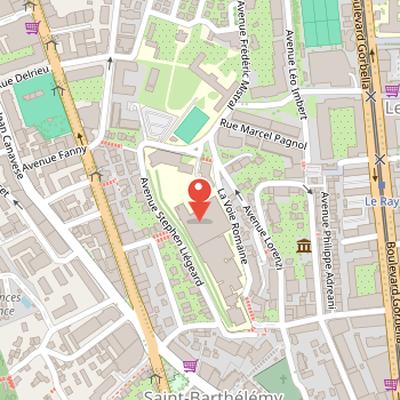
Nearby Objects
-
 Sainte Jeanne d'Arc Church 1100 m away
 -
 Château Valrose 1200 m away
 -
 Arènes de Cimiez 1800 m away
 -
 Musée Matisse 1900 m away
 -
 Musée Marc-Chagall 1900 m away
Institution and Site
Villa Arson is a public administrative institution of the Ministry of Culture in Nice. It is located on the Saint-Barthlemy hill north of the city, within a two-hectare domain that offers a vast panorama of Nice. Inaugurated in 1972, it brings together several functions in one place: a national school of art, a contemporary art center, an artists' residence, and a specialized media library. Its missions are artistic training, support for creation, and the dissemination of contemporary art. The institution is supervised by the Ministry of Culture and became a component with legal personality of the University Cote d'Azur in 2020.
From Italian Villa to Art School
Villa Arson was named after Pierre-Joseph Arson, a wealthy merchant from Avignon, who acquired the Italian style villa in 1812 from consul Peyre de la Coste. The original estate covered six hectares, and the Arson family continually expanded and improved it, converting agricultural land into an Italian-style ornamental garden. Its southern slope was arranged with terraces, statues, balustrades, and baroque fountains, while the rock gardens combined endemic plants such as pines, oaks, carobs, and olive trees with exotic species including palms, aloes, and cacti. Pierre-Joseph Arson also planted a large cypress avenue on the western flank of the property.
After Pierre-Joseph Arson's death in 1851, Gonzague Arson became head of the property. In the early 20th century, a British hotelier converted the villa into the Grand Hotel Saint Barthelemy. After World War I, it became a medical facility named Clinique de Cyrnos. In 1964, the city of Nice transferred the domain to the State in order to establish an international art school, a project desired by Minister of Cultural Affairs Andre Malraux. The Ecole nationale des arts decoratifs de Nice moved there in 1972 from rue Tondutti de l'Escarene, and architect Michel Marot redesigned the new school space. In 1984, the school was renamed Ecole pilote internationale d'art et de recherche (EPIAR) and linked to the contemporary art center. It became a public administrative institution under the Ministry of Culture and Communication in 2003. Beginning in 2005, the Ministry launched renovation and enhancement programs, including the public reopening of the site and its terraces.
Architectural Composition of Villa Arson
Villa Arson occupies almost the entire 2.7-hectare plot, with the project mainly developed in the southern part along a central street axis. The site buildings incorporate the former ochre villa from Genoa into their construction. Access is provided by a large monumental hall that connects the buildings, the old villa, the art center, and the media library. The plan is organized around a dual central circulation axis, combining upper rooftop terraces with lower school workshops.
The workshops located under the slab are designed to receive natural light through pyramid skylights and lateral lanterns. The interior walls are made of concrete and also rely on natural lighting. A large entrance hall light fixture once formed part of the interior, although it has since disappeared. On the outside, the wall coverings are made of pebbles taken from the Var riverbed. Overall, the design is described as a singular modernist style with a Mediterranean character.
Garden Heritage and Contemporary Layout
Villa Arson retains traces of its original garden, which was arranged in three successive Italian-style terraces facing south. In the early 20th century, part of the garden was dismantled for the installation of a hotel, but some elements from the Arson family period still survive, including alignments of maritime pine and cypress trees. The site was protected as a heritage and remarkable site of Nice in 1943.
The contemporary buildings now occupy much of the former pleasure garden area. Michel Marot arranged the main buildings on three levels along the southern slope in order to respect the original topography. Open-air patios help preserve green spaces and trees within the site buildings, while rooftop terraces with planted beds restore a garden aspect suspended above the site.
At the entrance, the contemporary garden Le Bosco was created with paved circles set on a large lawn. Its trees come from different continents, reflecting the international artistic vocation of the site, and selected foliage plants echo the raw materials of the buildings. Villa Arson also presents several in situ artworks through public exhibitions and commissions, linking the architectural setting to its cultural function.
Art Center and School at Villa Arson
Villa Arson is part of a network of 57 art centers supported by the Ministry of Culture. The project for an art center at Villa Arson was submitted by Henri Maccheroni to the Ministry of Culture, with support from Michel Butor and Max Gallo. It was created in 1984, replacing the Centre artistique de rencontres internationales (CARI), and for ten years its direction was led by Christian Bernard.
The institution supports artists through research, project realization, visibility, documentation, and the dissemination of creations. Its main activity is the organization and implementation of exhibition programs. These exhibitions often feature one or more artists early in their careers or artists who are rarely seen in France. It can present several monographic exhibitions at the same time, or large collective exhibitions, across the total surface of Villa Arson. Unlike museums or FRACs, it does not maintain a permanent collection. It also acts as a producer, providing technical and financial assistance, and it regularly publishes catalogs to promote artists and preserve the memory of contemporary creation.
Villa Arson also includes the National School of Decorative Arts, transformed into a contemporary art school in the mid-1980s. This ENSA is one of seven national schools under the Ministry of Culture and has about 200 students. It offers a five-year single-department Art curriculum leading to two state diplomas. Students can continue their curriculum near the art center alongside artists in residence or invited to exhibit. The school organizes teaching and workshops in five poles, recruits students through an annual competition and equivalences, and organizes studio visits each year at the beginning of March in an open house format.
The Media Library at Villa Arson
Villa Arson includes a media library that serves as the resource center of the entire site. It is open to all, but it mainly welcomes researchers and art students. The collection comprises about 10,000 references and includes a patrimonial collection. This heritage fund dates mostly from the 19th century and corresponds to the former decorative arts school. The media library also holds many model directories used in architecture and decorative arts, as well as books on art history.
Collections and Artist Residencies
Villa Arson's installations have been developed through a 30-year effort to build a documentary resource center specialized in contemporary creation. The collection policy is based on acquisitions and exchanges between institutions, and the site also receives deposits of books from many artists invited or exhibited at Villa Arson. In addition, the public has access to 65 current periodicals covering major research and creation trends.
The residence program hosts six artists each year, either by invitation or through a project linked to Villa Arson's artistic program. Each resident receives a grant, on-site accommodation, a studio, and access to all school workshops. Residents are also expected to take an active role in school life by working with students or organizing meetings and conferences. The residency lasts between three and four months at most.