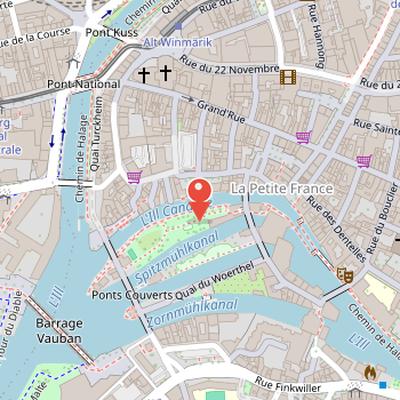
Petite France is the southwestern part of the Grande Île of Strasbourg, forming a central and characteristic island of the city’s historic center. It is bounded by Quai de la Bruche, Rue du Bain-aux-Plantes, Place Benjamin-Zix, Rue des Dentelles, Rue du Pont-Saint-Martin, Pont Saint-Thomas, the Mühlen-Fußgängerbrücke, the canal of the Zorn-Mühle, and the Gedeckten Brücken. The area is intersected by canals of the Ill river and contains old half-timbered houses from the 16th and 17th centuries with tall pointed roofs. It is one of the largest tourist hotspots of the Europastadt and, together with the entire old town, belongs to the UNESCO World Heritage. Historically, the district emerged as an urban unit in the 20th century, although its origins date back to the 16th century. It was associated with tanneries and other earlier residents, and the oldest houses still preserve ventilated attics used for drying hides as evidence of this past.
Nearby Objects
-
 Old Saint Peter's Church 200 m away
 -
 Saint Thomas Church 350 m away
 -
 Le Cosmos 450 m away
 -
 Église Saint-Louis de Strasbourg 450 m away
 -
 Place Kléber 450 m away
Petite France in the Historic Center
Petite France is the southwestern part of the Grande Ile of StraBburg in Elsass. It forms the central and characteristic island of StraBburg's historic center and is bounded by Quai de la Bruche, Rue du Bain-aux-Plantes, Place Benjamin-Zix, and Rue des Dentelles to the north; by Rue du Pont-Saint-Martin, Pont Saint-Thomas, and the Muhlen-FuBgangerbrucke to the east; by the canal of the Zorn-Muhle to the south; and by the Gedeckten Brucken to the west. The area is intersected by canals of the Ill river. Petite France contains old half-timbered houses from the 16th and 17th centuries with tall pointed roofs. It is one of the largest tourist hotspots of the Europastadt and, together with the entire old town, belongs to the UNESCO World Heritage.
History and Character of Petite France
Petite France emerged as an urban unit in the 20th century, although its origins date back to the 16th century. It is not a historic city quarter in the strict sense, but a picturesque district with half-timbered houses on the Ill river. The area was intersected by four water canals since ancient times. Until about 1830, three of these canals were named after the respective mills, while the fourth served navigation on the Ill river.
The district's older names show how it was formerly divided into separate units. Until the 19th century, the three parts were called Am Pflanzbad, der Muhlenplan, and bei den Gedeckten Brucken. Muhlenplan is now known in French as Rue des Moulins and is sometimes called Muhlenviertel. Geschichte also notes that Mühlenplan was inhabited by millers. The name Petite France originally referred to the dam separating Spitzmuhlen Canal from the shipping canal, and in the 20th century the designation expanded to include Ponts couverts, Muhlen-Viertel, and Rue du Bain-aux-Plantes with many tanneries.
The district was long associated with tanneries, including white and red tanners, and the related odors made it unpopular. Poor fishermen, executioners, and prostitutes also lived there. Many houses were built in half-timbered construction for financial reasons, and the oldest houses still preserve ventilated attics used for drying hides as evidence of the tannery past. Part of the district was called the tanners district. The Tanneurs-Graben canal was filled in by 1840, which separated Rue du Bain-aux-Plantes from the Saint-Thomas district and made the creation of Place Benjamin-Zix possible. Petite France has been listed as a UNESCO World Heritage Site since 1988.
Origin of the Name Petite France
The origin of the name Petite France is traced to the Alsatian name of a hospice, Blatterh us. The hospice was originally founded in the Finkwiller district and was relocated in 1687 to a new building at Rue des Moulins No. 6 on Quai de la Petite-France. It operated there for almost 300 years until 1789 in the then German-speaking university city of Strasbourg. Until 1789, all of Alsace was a customs foreign country, with a customs border to France but not to the Holy Roman Empire. French street names were introduced only from 1810 onward, and a passport requirement existed only from 1887 to 1889 during a diplomatic crisis caused by General Georges Ernest Boulanger.
From Hospice to District Name
Petite France began as a hospice founded in 1503 by Gaspard Hofmeister, a citizen of the city. It was intended for Landsknechte of the French king Karl VIII who had contracted syphilis during the Italian wars, and the disease was said to have been introduced to the region by their return from the siege of Naples. Because syphilis appeared suddenly in Europe at the end of the 15th century and required extensive care for isolated patients, the hospice served an important medical function. The place was expanded in 1506 and again in 1522 before it was relocated in 1687. In popular usage it was called Zum Franzosel, since syphilis was regarded as the French disease, and in the 18th century it was known as Hospiz der Unheilbaren. In 1795 the building was called La Petite France, and this name was later extended to the entire district.
Streets, Bridges, and Visitor Experience
Petite France is popular for its many cafes, restaurants, and hotels in the district. It also contains numerous bridges and narrow alleys that invite strolling. Visitors can experience the area by taking a boat tour, adding another way to explore Petite France.