Saint Thomas Church, or Thomaskirche in German, is located in the Saint-Thomas area of Strasbourg, near the Petite France district in the historic center. It is one of the city’s most important churches for cultural history and architecture. Nicknamed the cathedral of Protestantism in Alsace, it is also the only example of a hall church in Alsace and the only Protestant church to have retained canons in the region. The church has been classified as a historic monument since 1862.
A place of worship dedicated to the apostle Thomas has existed on the site for a long time. The location is also associated with Saint Florent, bishop of Strasbourg, who died in 693, and with bishop Adeloch, who planned a rebuilding around 820. The church was damaged by fire in 1007 and destroyed by lightning in 1144. Reconstruction began in 1196 with a fortress-shaped building and a large tower porch, combining Romanesque and early Gothic elements. Work continued until 1521, when the Saints-Evangelists chapel was completed in late Gothic style. In 1524, the church became Lutheran and held the first vernacular-language service in Strasbourg.
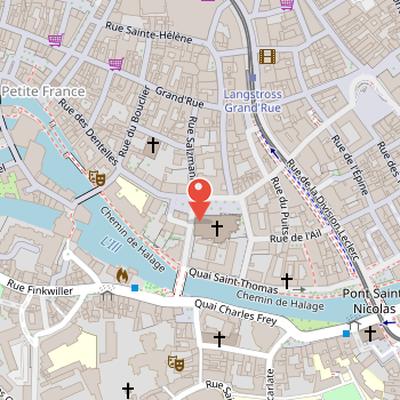
Nearby Objects
-
 Église Saint-Louis de Strasbourg 160 m away
 -
 Saint-Nicolas Church 250 m away
 -
 Statue of Johannes Gutenberg 300 m away
 -
 Place Gutenberg 300 m away
 -
 Le Cosmos 300 m away
Saint Thomas Church in Strasbourg
Saint Thomas Church, or Thomaskirche in German, is located at Place Saint-Thomas in Strasbourg, in the historic center near the Petite France district. It is regarded as one of the most important churches in Strasbourg for cultural history and architecture. The church is nicknamed the cathedral of Protestantism in Alsace, reflecting its significance in the region's religious heritage. Architecturally, it is the only example of a hall church in Alsace. It is also the only Protestant church in Alsace to have retained canons. Since 1862, Saint Thomas Church has been classified as a historic monument.
History and religious use
A place of worship dedicated to the apostle Thomas has existed on the present site since an unspecified period. The location is also associated with the burial of Saint Florent, bishop of Strasbourg, who died in 693. Around 820, bishop Adeloch planned to rebuild a church there together with a neighboring school. Parish assets acquired or bequeathed were managed by a chapter charged with increasing them, which shows the institutional role of the site in local religious life.
The church suffered repeated destruction. In 1007, Saint-Thomas church, the school, Notre-Dame cathedral, and one-third of Strasbourg's homes were destroyed by fire. In 1144, lightning destroyed the church entirely. Reconstruction began in 1196 with a fortress-shaped building and a large tower porch, starting from the facade. The eastern transept is Romanesque in style, while the tower combines Romanesque forms with primitive Gothic windows. This mixed architectural language was common in the Holy Roman Empire, as seen for example in Sainte-Marie church of Lubek. Building work later resumed and was completed in 1521 with the Saints-Evangelists chapel on the south aisle, built in late Gothic style, which has been preserved to the present day. Around 1130, religious members also commissioned a Romanesque sarcophagus sculpture in honor of bishop Adeloch.
The Reformation quickly changed the church's function. After Luther's preaching in 1517 spread to Alsace, Saint-Thomas held the first vernacular-language service in 1524, with Holy Communion distributed under both species. In the same year, the church was assigned to Lutheran worship and kept that status after Alsace's annexation by France. From 1529 onward, the chapter of canons led Strasbourg Protestantism. Martin Bucer, pastor at Sainte-Aurelie and Saint-Thomas, was an influential reformer in Strasbourg and sought to unite different Protestant factions through extensive travels in Europe.
Under changing political rule, the church remained a key Protestant site. After Alsace was integrated into the kingdom of France in 1648 by the treaties of Westphalia, signed by canon Marc Otto of the Saint-Thomas chapter, Saint-Thomas Church became the main Protestant church in Strasbourg after 1681, the same year Notre-Dame Cathedral was returned to Catholic worship.
Liturgical Renewal and Later Adaptation
Saint Thomas Church played a decisive role in liturgical renewal at the end of the 19th century. From 1888, during the period of annexation, Friedrich Spitta experimented with new forms of religious service at the church. The Akademischer Kirchenchor was created there, and Julius Smend began preaching regularly in 1893. Between 1894 and 1899, the Gesangbuch fur Elsass-Lothringen was developed at Saint Thomas Church. Albert Schweitzer, who studied in Paris and Berlin and was talented as an organist, also had a close connection to the church environment: he prepared simultaneous doctorates in philosophy on Kant and theology, later became a theology faculty teacher, vicar at Saint-Nicolas, and director of the Protestant seminary near Saint-Thomas. In 1906, he designed the choir organ.
After the Second World War, Saint Thomas Church underwent various modifications. In 1987, it was restored and transformed for multipurpose use. The southern nave was freed to serve as exhibition space, new seating arrangements allowed concerts to be held, and lighting enhancements highlighted the Gothic architecture. The parish had between nine hundred and one thousand members, compared with three thousand at the beginning of the 20th century. Today, two Lutheran services are celebrated each Sunday, one in German and one in French. The Chapter of Saint-Thomas is responsible for the Foyer Jean Sturm and the Protestant Seminary in the adjacent baroque building.
The Organs of Saint Thomas Church
The interior furnishings of Saint Thomas Church include an organ made by Johann Andreas Silberman in 1741. It received praise from Wolfgang Amadeus Mozart when he was in Strasbourg in 1778, and it later underwent several interventions: by Wetzel in 1836, by Dalstein-Haerpfer in 1908, by Schwenkedel in 1927 and 1943, and by Muhleisen in 1955. The church's organ section is classified as a monument historique. In 1964, the Association des Amis de l Orgue Silbermann de Saint-Thomas was created, and Albert Schweitzer was made an honorary member of this organ association. Schweitzer opposed the renovation project for the Silbermann organ, while the parish wished to transform it into a romantic symphonic organ; the transformation project was completed in 1927. A second organ was also installed to improve the accompaniment of the parish choir. This buffet organ with pneumatic action was built by Fritz Haerpfer in 1906, and the buffet organ was constructed by Haerpfer-Dalstein based on Albert Schweitzer's plans.
Interior Monuments and Historic Furnishings
The interior of Saint Thomas Church in Strasbourg brings together funerary monuments and liturgical furnishings from several centuries. Among the oldest preserved elements are funerary monuments erected between 1130 and 1850, including the Renaissance funerary plaque of Nicolas Roeder de Tiersberg, dated 1510, the Roman sarcophagus of Bishop Adeloch, and the mausoleum of Marshal de Saxe, built at the end of the 18th century. The church also contains a Gothic late mural depicting Archangel Saint Michael, attributed to the Alsatian painter Jost Haller. Discovered during restoration work in 1885, the mural commemorates a chapel dedicated to Saint Michael erected in 1290. It is considered one of the largest Gothic murals in France, alongside the mural of Saint Christopher at Wissembourg.
The church preserves important stained glass and facade decoration associated with its rose window. The rose, which features the apparition to Saint Thomas, is attributed to a probable fabrication around 1250 and is described as having an octolobed oculus, sixteen large medallions in two circles, and sixteen interstice panels. After a storm with hurricane-strength winds, the stained glass was replaced with clear glass in 1822, except for the central part, which was painted in colored transparent glass. Half of the panel of the incredulity of Saint Thomas was restored, especially the apostle and the lower part of Christ, while the vegetal motifs of the surrounding panels were recolored by Pereyra in 1842 and later partially modified in restorations in 1871, 1873, and 1906. The church also conserves other modern panels made for this rose at the Protestant seminary. The rose window has been classified as a historic monument since 1862.
Other interior features include the upper part of the large windows along the building, noted for their architectural and vegetal motifs, while the representations of saints below the windows were destroyed during Protestant iconoclasm. The walled choir windows were reopened in 1985, and new stained glass windows designed and installed by Gerard Lardeur were commissioned to emphasize the imposing mausoleum of Marshal de Saxe. The nave contains three brass chandeliers made in the first half of the 18th century, and the baptismal fonts, probably dating from the end of the 13th century, were moved from outside the church to a new base near the altar around 1975. From the French Revolution until 2009, the church had only two bells, including a bourdon cast in 1783 by Matthieu Edel and weighing 3.6 tons; in 2009, four additional bells were cast by the A. Bachert foundry in Karlsruhe, creating one of the largest Protestant bell peals in France.