Église Saint-Louis de Strasbourg is a Catholic church located on rue Saint-Louis in the quartier du Finkwiller. It is sometimes called Église Saint-Louis en ville, a name used to distinguish it from the Catholic church of the Robertsau. The building is described as having a baroque style, and its church combines neobaroque and neoclassical features.
The site has a layered history. It was once part of a Carmelite convent site that was secularized in 1528 and converted into a residential building with a tallow store. A first church dedicated to Saint Louis was built there in 1687, during the reign of Louis XIV, and took the name Saint-Louis-des-Français in honor of the Roi Soleil. Until the Revolution, the parish was administered by the Congrégation de Notre-Sauveur under the name Maison Saint-Louis. The site was also a pilgrimage place to Notre-Dame des Douleurs. After being sold in 1790, it became a tobacco store following a fire in 1805, then was rebuilt between 1825 and 1827 with a very plain appearance.
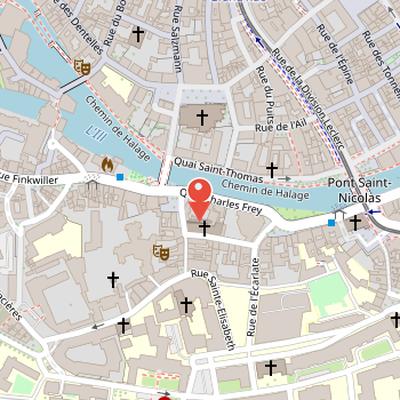
Nearby Objects
-
 Saint Thomas Church 160 m away
 -
 Saint-Nicolas Church 200 m away
 -
 Wine cellar of the Hôpital civil 250 m away
 -
 Statue of Johannes Gutenberg 400 m away
 -
 Place Gutenberg 400 m away
Location and Identity
Eglise Saint-Louis de Strasbourg is located on rue Saint-Louis in the quartier du Finkwiller. It is built in a baroque style and is assigned to the Catholic cult. The church is sometimes called Eglise Saint-Louis en ville, a name used to distinguish it from the Catholic church of the Robertsau.
History and Interior Features
The site of the church was originally part of a Carmelite convent, secularized in 1528 and turned into a residential building with a tallow store. A first church dedicated to Saint Louis was built there in 1687, during the reign of Louis XIV, and the parish adopted the name Saint-Louis-des-Francais in honor of the Roi Soleil. Until the Revolution, the parish was administered by the Congregation of Notre-Sauveur under the name Maison Saint-Louis, and the church also served as a pilgrimage site to Notre-Dame des Douleurs.
The property was sold in 1790 during the French Revolution. After a fire in 1805, it became a tobacco store before being rebuilt between 1825 and 1827 in a very plain form. The present church is in neobaroque and neoclassical style.
Its interior contains several notable works and fittings. The retable includes three statues dating from 1893, representing Saint Augustin, Sainte Therese d'Avila, and Saint Louis. The nave has a pulpit carved by Theophile Klem, which received an award at the 1895 Strasbourg industrial and artisanal exhibition. The church also contains oil paintings by Martin Feuerstein showing episodes from the life of Saint Louis, stained glass windows made by the Ott brothers in the 1930s, and a choir renovated between June and October 2015.
The Organ and Interior Features
The church organ dates from 1896 and replaced an earlier instrument by Jean-Conrad Sauer. It was built by Charles and Edgard Wetzel in a neobaroque case by Paul Klein, and the case is classified as a historic monument. The instrument is based on a Cavaille-Coll organ and has 25 stops with Machine-Barker. It has been minimally modified over time. Several pipes were stolen in 1973 and replaced in 1983. The choir also includes paintings by Martin Feuerstein.
Parish Use and Clergy
The church serves both the territorial parish and the parish of la Croix glorieuse. The parish of la Croix glorieuse performs the Tridentine rite. Abbé Gouyaud serves as parish priest of Saint-Louis and also as parish priest of la Croix glorieuse. He is succeeded by Abbé Florent Molin, a member of the Societe des missionnaires de la misericorde divine.