Place Kléber is a square and public landmark named in honor of Jean-Baptiste Kléber, a French general who lived from 1753 to 1800 and distinguished himself during the French Revolutionary Wars, including the War in the Vendée and the Egyptian campaign. The square was formerly known as place des va-nu-pieds in German and place des Cordeliers in French, reflecting the former presence of a Franciscan convent destroyed between 1528 and 1531. It later became the place d'Armes and was renamed place Kléber on the day the mausoleum for Jean-Baptiste Kléber was inaugurated. The mausoleum includes a full-length statue of the general, and a vault beneath it has contained his coffin since 1838. The square was also renamed place Karl Roos for a period before the city’s liberation. Over time, Place Kléber served as the center of the old tramway network, a large parking area crossed by a road, and a location for markets and major public celebrations. It was redesigned in 1994 as part of the pedestrianization of the historic center, and tram lines A and D now cross its western edge.
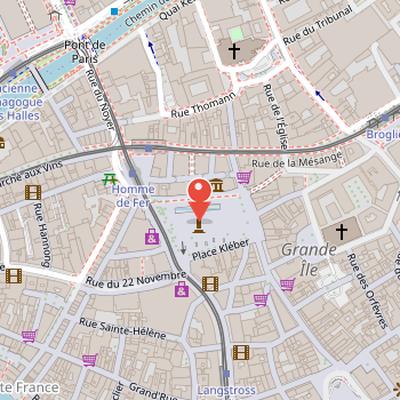
Nearby Objects
-
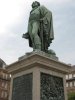 Statue of Jean-Baptiste Kléber 0 m away
 -
 Aubette 60 m away
 -
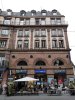 Le Cosmos 90 m away
 -
 Temple Neuf 200 m away
 -
 Saint-Pierre-le-Jeune Protestant Church 250 m away
Origin of the Name
Place Klber is named in honor of Jean-Baptiste Klber, a French general who lived from 1753 to 1800. He distinguished himself during the French Revolutionary Wars and took part in the War in the Vende and the Egyptian campaign. The name therefore reflects a historical commemoration rather than a reference to the place's physical design or construction.
Name Changes and the Kluber Mausoleum
Place Kluber has had several historical names linked to its changing uses and political contexts. It was formerly called place des va-nu-pieds in German because of the presence of a Franciscan convent, and place des Cordeliers in French for the same reason. The convent was destroyed between 1528 and 1531. The square later became the place d'Armes in German. It was renamed place Kluber on the inauguration day of the mausoleum for Jean-Baptiste Kluber. The mausoleum contains a full-length statue representing General Jean-Baptiste Kluber, and a vault beneath the statue has held his coffin since 1838. From an unspecified date until the liberation of the city, the square was renamed place Karl Roos, after Karl Roos, an Alsatian autonomist close to national-socialist ideas who was executed for espionage in February 1940.
Redesign and Public Role of Place Kleber
Place Kleber was the heart of the old tramway network from 1886 to 1960, and it also functioned for many years as a large surface parking area crossed by a road. It remained a major civic space, serving as a gathering point for both organized and spontaneous events. Among these were celebrations of the French victory in the 1998 FIFA World Cup, the 2005 Coupe de la Ligue final victory by RC Strasbourg, and spontaneous political celebrations such as the evening of the 2002 presidential election.
The square was controversially redesigned in 1994 by architect Guy Clapot, as part of the pedestrianization of the historic center. It was then entirely redesigned again in 2007 alongside the complete restructuring of Ilot de l’Aubette. This later transformation added green spaces designed according to Gilles Clement's specifications and long water basins surrounded by gneiss stone. The return of tram lines A and D also crosses the western edge of the square, continuing from rue des Francs-Bourgeois through Place Kleber.
Place Kleber also had a commercial role, hosting one of the main city markets on Wednesdays and Fridays until 2003.
The Aubette and the Memory of Kleber
Place Kleber is closely linked to the Aubette and to the memory of General Jean-Baptiste Kleber. The Aubette is a neoclassical building constructed in the 18th century under the Blondel beautification plan. It was built in 1778 as a large classical style guardhouse, and its name comes from its role in transmitting orders at dawn. In the late 19th century, it housed a music conservatory, before becoming a leisure complex decorated in 1928 by Theo van Doesburg, Hans Arp, and Sophie Taeuber-Arp. It was later rehabilitated in 2008 by Fabienne Keller, with shops and restaurants spread over nearly 2,000 square meters.
The place also preserves the memory of Jean-Baptiste Kleber, who won the victory of Heliopolis three months before his assassination, reclaiming Upper Egypt from Turks and English. He was assassinated in Cairo on June 14, 1800 by Soleyman el-Halaby, a young Syrian student. His assassination embarrassed Bonaparte, who refused national funerals or a tomb that might become a republican pilgrimage site. Kleber's body was embalmed, placed in a lead coffin inside an oak coffin, and buried in the military square of Fort Ibrahim-Bey near Cairo. After the French departure from Egypt, his remains were repatriated to Chateau d'If near Marseille and kept in quasi-clandestinity during the reign of Napoleon. In 1818, Louis XVIII ordered their transfer to Strasbourg, where they were interred in the cathedral. At Place Kleber, his body rests in a vault under his statue, created by Philippe Grass in 1840 and inaugurated discreetly in June 1840. The statue shows Kleber standing and holding Admiral Keith's letter.
Redevelopment and Seasonal Uses
At 22-24 Place Kleber, a large building known as la Maison Rouge was erected in the late 19th century. According to Batisments remarquables et lieux de memoire, the architectural complex was decided to be demolished in the late 1960s. A new commercial center was then built in 1978 by architect Francois Herrenschmidt. This replacement building, also called Maison Rouge, is described as being in a post-modern style, with large glazed spaces and an uneven surface.
Beyond its built form, Place Kleber is also used for seasonal public events. During Christkindelsmarik, a monumental Christmas tree from the Vosges is placed in the southeast corner of the square. During Advent, the Village du Partage is held there, where Soupe Etoilee is distributed. The square also hosted a tent during the 2016 Strasbourg mon amour event, and this tent became the emblem of the event. Some Saint-Valentin events are held under it.