Old Saint Peter's Church in Strasbourg is an ancient church building with a long and complex history. First publicly mentioned in 1130, it was built along the Strata Superior Roman road and contains remains from the Merovingian period. Gothic construction remains date from 1382, and the church was built between 1381 and 1428. It passed to the Reformation in 1529 and became Lutheran in the same year. From 1683, it functioned as a simultaneum dedicated jointly to Protestant and Catholic confessions. The Protestant nave has a ceiling, while part of the choir was reserved for Catholic canons and the Catholic parish, recreated in 1867. Around 1900, the choir was demolished to build the current Catholic church perpendicular to the Protestant nave. The current Catholic church has a bell tower, and the medieval bell tower was preserved. The church has been listed as a historical monument.
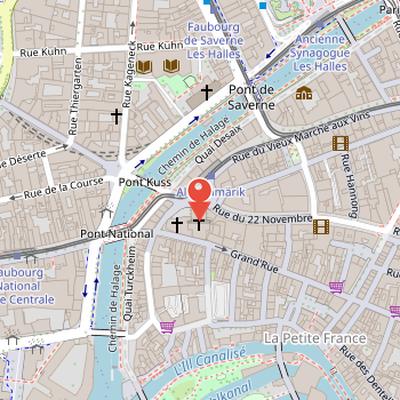
Nearby Objects
-
 Petite France 200 m away
 -
 Synagogue du Quai Kléber 300 m away
 -
 Statue of Jean-Baptiste Kléber 450 m away
 -
 Place Kléber 450 m away
 -
 Aubette 450 m away
History and Religious Use
Old Saint Peter's Church in Strasbourg is an ancient church built between 1381 and 1428. It passed to the Reformation in 1529 and became a simultaneum in 1683, dedicated jointly to Protestant and Catholic confessions. The nave is Protestant and has a ceiling, while part of the choir is reserved for Catholic canons and for the Catholic parish recreated in 1867. Around 1900, the choir was demolished to make way for the current Catholic church, which was built perpendicular to the Protestant nave and includes a bell tower. The medieval bell tower of the church was preserved. The building has been listed as a historical monument.
Historical Development of Old Saint Peter's Church
Old Saint Peter's Church in Strasbourg was publicly mentioned by name for the first time in 1130. It was built along the Strata Superior Roman road and contains remains from the Merovingian period, showing that the site has very early historical layers. Gothic construction remains date from 1382, indicating an important medieval building phase. In 1529, the church became Lutheran, marking a change in its religious use. Later, in 1683, Louis XIV ordered the choir of the church to be returned to Catholics. In the same year, he had a wall built at the jubee level to separate Protestant worship within the church. These changes reflect the church's long and complex history as a place shaped by shifting religious communities and authorities.
Protestant Reuse and Interior Changes
In 1529, the Protestant church suspended the practice of capitular offices in Strasbourg, and Saint-Pierre-le-Vieux was subjected to iconoclastic destruction. The Protestant pastor Thiiebaut Schwartz destroyed altars and hagiographic representations and covered murals with whitewash. The church was briefly returned to Catholic worship between 1550 and 1560 after the Interim imposed by Emperor Charles V, but the Honau-Rhinau canons voluntarily abandoned their liturgy in 1560. After that year, the church was assigned entirely to the Lutheran tradition in Strasbourg.
The building continued to undergo changes linked to its Protestant use. Between 1607 and 1616, a gallery was constructed in the church. The Protestant parish abandoned the choir, which was only reused in 1683 by a decree of Louis XIV. The canons then took back the apse, which had been closed by a grille, while the nave remained with the Protestant parish. In 1709, an organ was built by Andre and Gottfried Silbermann, and in 1727 the gallery was decorated with paintings of biblical scenes. During the Terror, the parish church was closed for worship and used as meat storage between 1793 and 1795.
Later Use and Interior Reorganization
Since 2012, the Protestant church at Saint-Pierre-le-Vieux has ceased holding worship services, and parishioners have attended the nearby parishes of Sainte-Aurelie or Saint-Thomas instead. In 2018, the building became the site of an experimental project called NooToos, supported by UEPAL and the presbyteral council since 2016. The interior was then reworked by moving the altar to the side and ending community worship. The nave was divided into two spaces with a glass wall, and the traditional wooden benches were replaced by deckchairs and poufs. The reconfigured church also includes a convivial space, a kitchen, meeting rooms, and coworking areas. It is presented as a free and atypical place for napping, meditation, prayer, and cultural, solidarity, or spiritual events.
Expansion and Interior Heritage
In 1867, the Catholic church was enlarged to accommodate a growing number of faithful. Architect Conrath supervised the construction, and the new building was erected perpendicularly to the first church. The sacristy contains relics that local tradition believes to be those of Sainte Brigide. The church also preserves several classified objects, including works depicting the Passion of Christ, as well as an organ, a quadriptych showing the life of St-Pierre, and a cycle of artworks dedicated to the life of St-Pierre.